Red light therapy encyclopedia
Red Light Bulb Guide: Regular Red Bulbs vs. Heat Lamps vs. Therapy Lights
Use a household red LED for ambience, a properly installed infrared heat lamp for its labeled heating purpose, and a therapy device only for its stated intended use. A red appearance alone does not provide a wavelength, irradiance, or treatment dose.
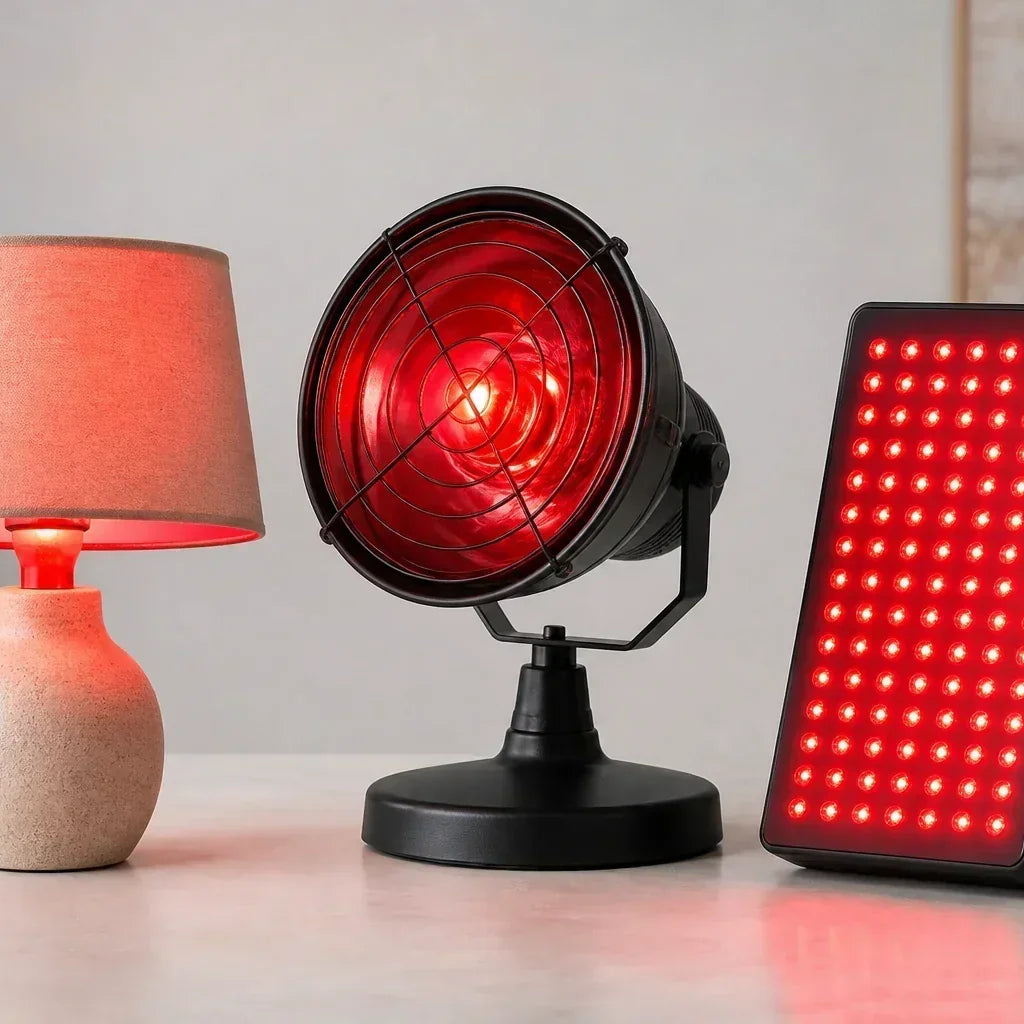
Not every bulb that looks red is a red light therapy device. A red-colored household bulb, an infrared heat lamp, and a purpose-built red or near-infrared device may look similar in an online listing, but they are designed for very different jobs.
The easiest way to choose correctly is to start with what you actually want the product to do:
- For red room lighting or ambience: choose a household red LED or a color-changing smart bulb.
- For softer evening lighting: choose a dimmable red, amber, or very warm white bulb and keep the brightness low.
- For radiant warmth: choose a properly installed infrared heat lamp made for that exact heating purpose.
- For controlled red or near-infrared exposure: choose a purpose-built device that lists wavelengths, output conditions, distance, coverage, timer settings, and instructions.
A red appearance alone cannot tell you the wavelength, optical output, heat level, coverage, or intended use of a product. That is why buying by color—or by the word “infrared”—often leads to the wrong product.
Which Red Light Product Do You Actually Need?
| Your goal | Best starting product | Most important specifications | Common mistake |
|---|---|---|---|
| Create red ambience | Household red LED or RGB smart bulb | Base type, voltage, lumens, dimming, beam spread | Assuming the red color makes it a red light therapy product |
| Use softer light before bed | Dim red, amber, or very warm white household bulb | Low brightness, dimming range, placement, glare control | Using a very bright red bulb and focusing only on color |
| Warm a particular area | Infrared heat lamp approved for that heating application | Wattage, fixture rating, installation, clearance, timer, heat warnings | Placing a high-heat bulb in an ordinary table lamp |
| Use defined red or near-infrared light | Purpose-built red/NIR device | Wavelengths, irradiance at a stated distance, coverage, modes, instructions | Buying an ordinary red bulb because it looks similar |
| Cover a large body area | Panel or other device designed for the required coverage | Illuminated area, uniformity, output at normal distance, positioning | Expecting one small bulb to provide even full-body coverage |
My practical answer: if a product page mainly discusses lumens, color modes, voice control, or room ambience, it is a lighting product. If it mainly discusses watts, high temperature, warming animals, food service, or radiant heat, it is a heat lamp. If it provides wavelengths in nanometers, optical output at a stated distance, session controls, coverage, and model-specific instructions, it is closer to a purpose-built red light device.

How to Identify a Red Bulb in 30 Seconds
You usually do not need laboratory equipment to determine the product category. Begin with the packaging or listing.
| What the listing emphasizes | What the product probably is |
|---|---|
| Lumens, E26 or E27 base, smart-home app, RGB colors, dimmable, room lighting | Household or decorative bulb |
| 2200 K, 2700 K, soft white, warm white, candlelight, CRI | White household lighting with a warm appearance |
| 150 W or 250 W, heat lamp, brooder, food warming, bathroom heat, infrared heating | High-temperature heat lamp |
| 630 nm, 660 nm, 810 nm, 830 nm, 850 nm, irradiance, treatment distance, timer | Purpose-built red or near-infrared light device |
| “Red spectrum” or “infrared technology” without any wavelength or test conditions | Insufficient information to classify confidently |
A simple decision test
-
Does the listing provide an exact wavelength in nanometers?
If not, do not assume it produces the wavelength you are looking for. -
Does it provide optical output at a specific distance?
If it only lists electrical watts or lumens, you still do not know the exposure reaching a surface. -
Is the primary selling point heat?
If so, treat it as a heating appliance rather than as an interchangeable red light device. -
Does the manual explain distance, time, modes, coverage, and eye guidance?
A controlled-use device should provide more than a colored bulb and a generic socket. -
Does the product fit into an ordinary household lamp?
That alone does not identify its purpose. Both decorative bulbs and specialized bulbs may use familiar screw bases.
If the listing cannot answer these questions, the safest assumption is that the red color is primarily a visual feature rather than proof of controlled optical performance.
What Is a Regular Red Household Bulb?
A household red bulb is designed mainly to make a room or object look red. It may use:
- red LEDs;
- an RGB LED system set to the red channel;
- colored glass or plastic;
- a red coating over another light source; or
- a smart-bulb system that mixes several LED channels.
These designs can all produce red-looking light, but they do not necessarily produce identical spectra.
What a household red bulb is good for
A normal red LED can be useful for:
- decorative room lighting;
- accent lighting;
- photography or video backgrounds;
- holiday displays;
- low-level pathway lighting;
- creating a warmer-looking evening environment; or
- adding color without producing the heat of an incandescent bulb.
For these uses, practical lighting specifications matter more than a therapy-style wavelength claim.
What to check on a household red bulb
- Bulb base: E26 is common in the United States, while E27 is common in many other markets.
- Voltage: the bulb must match the local electrical supply and fixture.
- Lumens: this indicates visible brightness for ordinary lighting.
- Dimming: confirm that both the bulb and dimmer are compatible.
- Beam angle: a spotlight and an omnidirectional bulb create very different room effects.
- Smart controls: check whether the bulb needs Wi-Fi, Bluetooth, a hub, or an app.
- Minimum dimming level: some smart bulbs remain surprisingly bright even at 1%.
- Enclosed-fixture rating: not every LED bulb is designed for a sealed fixture.
Is an RGB smart bulb the same as a dedicated red LED?
Not necessarily.
An RGB bulb creates color by controlling red, green, and blue LED channels. When set to red, it may use mainly the red channel, but its brightness and spectral output depend on the internal LED design and software.
A dedicated red bulb may produce more visible red output for the same size and price because it does not need to support a full range of colors. An RGB bulb offers flexibility but may not become as dim—or as evenly red—as expected.
For room ambience, either can work. Choose according to brightness, controls, dimming, and beam spread rather than assuming one has a special wellness effect.
Is a Warm-White Bulb the Same as a Red Bulb?
No. A warm-white bulb still produces white light. It simply has a warmer, more yellow or amber appearance than neutral or cool white light.
Common household descriptions include:
- approximately 2200 K for a candle-like warm appearance;
- approximately 2700 K for traditional warm household lighting;
- approximately 3000 K for a slightly cleaner warm white;
- approximately 4000 K for neutral white; and
- approximately 5000 K or above for cooler, bluer-looking white.
Kelvin values describe the appearance of white light. They do not identify the peak wavelength of a saturated red LED.
When warm white may be more practical than red
A warm-white bulb may be a better choice when you need to:
- read printed text;
- recognize food colors;
- move safely around a room;
- match clothing;
- see skin tones accurately; or
- perform ordinary household tasks.
A deep red bulb can strongly change color recognition. Blue and green objects may appear extremely dark, while red objects can lose contrast.
For a bedroom, many users find that a dim warm-white or amber light offers a better balance between comfort and visibility than a saturated red bulb.
Dim-to-warm bulbs
Some bulbs become warmer in appearance as they are dimmed. These can create a more candle-like environment without turning the entire room red.
This format may be useful for someone who wants one fixture to serve two jobs:
- brighter, usable white light earlier in the evening; and
- dimmer, warmer light during the final wind-down period.
What Is an Infrared Heat Lamp?
An infrared heat lamp is designed primarily to transfer warmth to a person, animal, food, or surface. Many use high electrical wattage and become much hotter than an ordinary LED bulb.
Some heat lamps use red glass, while others are clear or nearly clear. The red appearance is not what makes the lamp a heat source.
Heat lamps may be sold for:
- food warming;
- animal brooding;
- reptile enclosures;
- bathroom heating;
- industrial drying;
- workshop applications; or
- other labeled warming purposes.
These applications may require different fixtures, guards, mounting positions, and safety precautions. A bulb designed for one use should not automatically be moved into another setup.
Why a heat lamp feels different
A heat lamp commonly produces broad optical and thermal output, with a large part of its practical effect coming from radiant warmth.
A purpose-built red and near-infrared LED device is generally designed around controlled wavelengths, measured optical output, and repeatable positioning. It may become warm during operation, but high heat is not normally the primary feature used to define the device.
This does not make one category universally better. It means they solve different problems.
Why “infrared” does not identify one product
Infrared covers a broad region of the electromagnetic spectrum. The word may appear on:
- near-infrared LEDs;
- security-camera illuminators;
- remote controls;
- heat lamps;
- infrared heaters;
- sauna products; and
- temperature sensors.
These products should not be treated as interchangeable simply because they all use the word “infrared.”
Can I put a 250-watt heat lamp in a table lamp?
Do not assume that an ordinary table lamp can safely handle a high-wattage heat bulb.
The bulb must be compatible with:
- the fixture's maximum wattage;
- the socket material;
- the lamp enclosure;
- the mounting orientation;
- the required ventilation;
- the bulb shape and size; and
- the manufacturer's heat-lamp instructions.
A plastic socket, enclosed shade, lightweight clamp, or fixture rated for a low-wattage household bulb may not be appropriate for a high-temperature lamp.
Use the fixture and guard specified for the exact heating application. Do not place a heat lamp close to bedding, curtains, clothing, paper, furniture, or another combustible surface.
What Makes a Purpose-Built Red Light Device Different?
A purpose-built red or near-infrared device should provide enough information for the user to understand what light it emits and how it is intended to be positioned.
Useful specifications include:
- exact wavelengths in nanometers;
- wavelength tolerances;
- which wavelengths operate in each mode;
- irradiance measured at a stated distance;
- recommended positioning;
- illuminated coverage area;
- session timer and controls;
- heat-management features;
- eye and face-use guidance;
- electrical safety information; and
- instructions for the exact model.
Common wavelength labels
Many red and near-infrared products list wavelengths such as:
- 630 nm or 633 nm visible red;
- 660 nm visible red;
- 810 nm near-infrared;
- 830 nm near-infrared; or
- 850 nm near-infrared.
A wavelength number identifies a region of the spectrum. It does not prove that the product delivers an appropriate output, uniform coverage, or a useful routine.
Bulb format versus panel format
A purpose-built device can still use a bulb-shaped enclosure and a familiar screw base. The shape alone does not make it equivalent to an ordinary red bulb.
However, bulb-shaped devices generally illuminate a smaller area than a large panel. They may make sense for:
- a small, targeted area;
- travel;
- limited storage space;
- someone testing whether the routine is practical; or
- a lower-cost entry point.
A bulb is less convincing when the user expects broad, even coverage across the full torso or body. Moving one small spot repeatedly can make the routine longer and less consistent.
| Feature | Bulb-shaped device | Panel device |
|---|---|---|
| Coverage | Usually small and targeted | Can cover a larger area at once |
| Positioning | Requires a suitable fixture or stand | May include hanging hardware or a dedicated stand |
| Uniformity | Can create a concentrated center spot | Multiple LEDs may provide broader overlap |
| Portability | Usually compact | Depends on panel size |
| Routine time | May require repositioning for several areas | Can address a larger area in one position |
| Best fit | Small-area or occasional use | Broader and more repeatable coverage |
What Do Nanometers, Kelvin, Lumens, Watts, and Irradiance Mean?
Product listings often place several numbers together without explaining that they measure completely different things.
| Specification | What it describes | Most relevant product category | What it does not tell you |
|---|---|---|---|
| Nanometers (nm) | Wavelength or spectral position | Red and near-infrared devices | Output strength, coverage, or recommended session |
| Kelvin (K) | Color appearance of white light | Warm-white and tunable-white household bulbs | The peak wavelength of a saturated red light |
| Lumens (lm) | Visible brightness as perceived by human vision | Household and decorative lighting | Invisible near-infrared output |
| Electrical watts (W) | Power consumed by the product | All electrical products | How much optical power reaches the user |
| Irradiance (mW/cm²) | Optical power reaching a unit of surface area | Purpose-built optical devices | Meaningful information unless distance and test conditions are included |
| Radiant exposure (J/cm²) | Surface energy delivered over time | Controlled light-exposure discussions | How much energy reaches a deeper target |
| Beam angle | How widely light spreads | Bulbs, spotlights, and LED devices | Total optical output by itself |
Why watts cannot be used as an optical dose
Electrical wattage includes all of the power the product consumes. Some of that power becomes:
- visible light;
- near-infrared output;
- heat;
- fan operation;
- control electronics; or
- electrical losses.
A “100-watt” product therefore does not deliver 100 watts of useful optical power to the skin or another surface.
Two devices with the same electrical wattage can have different:
- LED efficiency;
- wavelength balance;
- beam angle;
- distance performance;
- coverage;
- cooling systems; and
- actual optical output.
Why lumens are not useful for near-infrared
Lumens are weighted around human visual sensitivity. Near-infrared output is outside normal human vision, so a lumen specification does not describe it properly.
This is why a combination red/NIR device may look less impressive than expected even when part of its output is operating normally. The eye can see the red LEDs but cannot accurately see the near-infrared channel.
Why irradiance must include a distance
Light spreads as it moves away from a source. A value such as “100 mW/cm²” is incomplete without a measurement distance.
A useful claim should specify something like:
- the distance from the front of the device;
- whether red, NIR, or both modes were active;
- whether the number is a center reading or area average;
- the instrument used;
- the size of the measured area; and
- whether output was continuous or pulsed.
Comparing one product measured at the surface with another measured several inches away does not produce a fair comparison.
Can I Use a Regular Red Bulb for Red Light Therapy?
A regular red household bulb should not be assumed to provide the same exposure as a purpose-built red light therapy device.
The problem is not simply that the bulb is inexpensive. The problem is that important information may be missing.
A household red bulb may not disclose:
- its peak wavelength;
- the width of its spectral output;
- optical power at a usable distance;
- coverage uniformity;
- recommended positioning;
- session controls;
- eye guidance; or
- an intended light-exposure use.
What if the ordinary bulb really does emit around 660 nm?
Producing light near 660 nm answers only one question: wavelength.
It does not answer:
- How much light reaches the target?
- How evenly is it distributed?
- At what distance was it measured?
- How stable is the output as the bulb warms?
- How long is the product intended to operate?
- Does the fixture position it consistently?
A matching wavelength does not make two complete devices equivalent.
What if I only want a cheap option?
A small purpose-built bulb can be a reasonable lower-cost format when it provides transparent specifications and the required coverage is limited.
The useful distinction is not “cheap bulb versus expensive panel.” It is:
documented optical device versus undocumented colored light.
A smaller device with clear wavelength, distance, output, and use instructions provides more decision value than a brighter-looking bulb supported only by color claims.
Can an Infrared Heat Lamp Replace an LED Red Light Device?
Not as a direct substitute.
A heat lamp and an LED red/NIR device may overlap in parts of their emitted spectrum, but their primary designs are different.
| Feature | Infrared heat lamp | Red/NIR LED device |
|---|---|---|
| Primary function | Produce radiant warmth | Provide controlled optical output |
| Spectrum | Often broad and heat-oriented | Usually centered around stated LED wavelengths |
| Operating temperature | Can become extremely hot | Usually designed to manage heat while emitting light |
| Main specifications | Electrical wattage, heating purpose, fixture and installation requirements | Wavelengths, irradiance, distance, coverage, timer, and modes |
| Contact risk | High-temperature bulb and fixture can cause burns | Varies by product; still requires model-specific distance and heat guidance |
| Can one replace the other? | No. Choose according to the intended function. | |
Does warmth prove that a device is working better?
No. Warmth can come from:
- inefficient electronics;
- a high-temperature filament;
- the housing;
- poor ventilation;
- close positioning; or
- absorbed optical energy.
A hotter product is not automatically a better optical device. A cooler product may simply manage heat more effectively.
Can a red light device also feel warm?
Yes. LED devices generate heat, and light absorbed at the surface may also create warmth. Larger or higher-output panels may feel noticeably warm at close distances.
The difference is that heat should not be used as the only proof of wavelength, output, or device quality.
How to Choose a Red Light Bulb for Bedroom Use
For bedroom ambience, you usually do not need a specialized red light therapy device. A household bulb designed for lighting is more practical.
The buying priority should be:
- low enough brightness;
- comfortable placement;
- good dimming performance;
- minimal direct glare;
- safe color recognition for the activity; and
- simple controls that encourage consistent use.
Brightness matters as much as color
A very bright red light can still feel alerting and visually intrusive. Changing the color without reducing the brightness may not create the calm evening environment the user expected.
For bedtime lighting:
- use the lowest comfortable brightness;
- place the lamp below eye level when practical;
- avoid staring directly at an exposed bulb;
- use a shade or diffuser suitable for the bulb;
- turn off unnecessary ceiling lights; and
- keep pathways visible enough for safe movement.
Red, amber, or warm white?
| Option | Main advantage | Main drawback |
|---|---|---|
| Deep red bulb | Strong visual shift away from ordinary white light | Heavy color distortion and reduced contrast |
| Amber or orange bulb | Warm appearance with better visibility than deep red | Still changes colors noticeably |
| 2200 K warm-white bulb | More natural color recognition and candle-like appearance | Still contains a broader visible spectrum |
| Dim-to-warm smart bulb | Can serve as normal lighting and become warmer later | Performance depends on the app, dimming range, and product design |
My practical choice for most bedrooms: a low-lumen, dimmable warm-white or amber bulb is often easier to live with than a deep red bulb. Choose saturated red when the color effect is specifically desired and the reduced visibility does not create a safety problem.
Should I use a red light therapy bulb as a night light?
Usually not.
A purpose-built optical bulb may be directional, unusually bright at close range, poorly suited to room illumination, or partly near-infrared and therefore invisible. It may also be designed for timed use rather than continuous overnight operation.
Use a household lighting product for room lighting and a purpose-built optical device for its stated routine.
Fixture, Socket, and Heat Safety
The bulb and fixture must be treated as one system. A bulb that physically screws into a socket is not automatically safe or suitable for that fixture.
Check the base type
Common screw bases include E26 and E27, but similar appearance does not guarantee complete electrical compatibility.
Confirm:
- base type;
- local voltage;
- frequency where relevant;
- fixture rating;
- bulb dimensions; and
- whether the bulb is approved for the intended orientation.
Check the fixture's maximum wattage
Never install a bulb that exceeds the fixture's rated wattage.
This is especially important with incandescent and infrared heat lamps, which can create much more heat than an LED household bulb.
Use a heat-rated fixture for heat lamps
A high-temperature lamp may require:
- a ceramic or otherwise heat-rated socket;
- a metal reflector;
- a protective guard;
- secure mounting hardware;
- adequate ventilation;
- minimum clearances; and
- a fixture approved for that bulb shape and wattage.
Follow the bulb and fixture manufacturers' instructions rather than creating a homemade close-contact setup.
Keep hot bulbs away from combustible materials
Do not place a heat lamp close to:
- curtains;
- bedding;
- clothing;
- paper;
- cardboard;
- upholstered furniture;
- plastic storage items; or
- another surface that may overheat.
Do not cover a lamp with fabric to make it dimmer. Use a compatible dimmer or select a lower-output bulb designed for the intended fixture.
Do not leave a heat lamp running while asleep or unattended
A high-temperature lamp should not be treated as an ordinary low-power night light. Follow all timer, supervision, mounting, and shutdown instructions for the exact application.
Do not touch or move a hot bulb immediately after use
Allow the product to cool according to its instructions. The bulb, reflector, guard, and socket may remain hot after the light is turned off.
What to Check Before Buying
Checklist for red room lighting
| Check | Why it matters |
|---|---|
| Correct base and voltage | The bulb must be electrically compatible with the fixture |
| Visible brightness | A bulb that is too bright may be uncomfortable for evening use |
| Dimming range | Some bulbs do not become sufficiently dim at their lowest setting |
| Beam spread | A narrow spotlight and broad room bulb create different effects |
| Color consistency | Some smart bulbs appear orange or pink rather than deep red |
| Fixture rating | Enclosed and damp locations may require specifically rated bulbs |
| Control method | App, switch, remote, and voice controls affect everyday convenience |
Checklist for an infrared heat lamp
| Check | Why it matters |
|---|---|
| Exact labeled heating use | Food warming, animal care, bathroom heating, and industrial uses may require different products |
| Electrical wattage | The fixture must be rated to handle the bulb |
| Heat-rated socket and reflector | Ordinary plastic household fixtures may not be suitable |
| Mounting and guard | The product must remain secure and protected from accidental contact |
| Clearance instructions | High temperatures can affect nearby surfaces and materials |
| Timer or shutoff plan | Reduces the risk of unintended extended operation |
| Replacement-bulb match | Shape, wattage, base, and application must remain compatible |
Checklist for a purpose-built red/NIR device
| Check | Useful product information | Weak information |
|---|---|---|
| Wavelengths | Exact nanometer values with tolerances | “Pure therapeutic red” |
| Optical output | Irradiance at a stated distance and mode | Electrical wattage presented as optical output |
| Coverage | Illuminated dimensions at the normal use distance | “Large area” without dimensions |
| Uniformity | Multiple readings or a coverage map | One maximum center reading |
| Mode controls | Clear explanation of red-only, NIR-only, and combined modes | No indication of which LEDs operate |
| Timer and distance | Model-specific operating instructions | Generic advice copied across different products |
| Thermal design | Ventilation, fans, temperature limits, and shutdown features | Heat presented as proof of optical performance |
| Eye guidance | Instructions matched to the device and treatment area | “No UV, so no precautions are required” |
| Testing | Report identifies the exact model and test conditions | Generic LED data from a component supplier |
| Return policy | Enough time to evaluate coverage, positioning, noise, and routine fit | Final sale before normal use can be assessed |
Red-Bulb Marketing Claims to Question
“Medical-grade LEDs”
The phrase does not explain the wavelength, output, manufacturing tolerance, coverage, or regulatory status of the complete product.
Ask for model-specific specifications rather than relying on an undefined grade.
“Clinical-strength red light”
Strength is not a complete optical measurement. A useful claim must identify the quantity, unit, distance, operating mode, and test conditions.
“200-watt equivalent”
For household bulbs, an equivalent-wattage statement usually compares visible brightness with an older incandescent bulb. It does not mean the LED consumes 200 watts or delivers 200 watts of optical output.
“Deep-penetrating infrared”
The word “deep” needs context. The product should still identify its wavelengths, output, geometry, distance, and intended use.
A high wavelength number or a hot surface does not automatically prove a better device.
“Red color proves 660 nm”
Several different spectra can look red to the human eye. The actual wavelength should come from a specification or spectral measurement, not from a product photo.
“Infrared bulb”
This phrase is too broad by itself. Determine whether the product is:
- a heat lamp;
- a near-infrared LED illuminator;
- a red/NIR wellness device;
- a security-camera accessory; or
- another type of infrared product.
“Full-body coverage from one bulb”
A single bulb may cast light across a large visible area, but that does not mean the output is strong or uniform across that entire area.
Check the illuminated dimensions and edge measurements at the recommended distance.
“FDA registered”
Registration or listing should not be presented as proof that every claim, wavelength, or model has been reviewed for a specific use.
When a seller makes a device-clearance claim, verify:
- the exact model;
- manufacturer;
- record number;
- intended use;
- wavelengths; and
- whether the product being sold matches the record.
“Zero EMF”
An operating electrical device should not be accepted as having literally zero electromagnetic fields without a clearly defined measurement method, frequency range, distance, and instrument.
“Low EMF” is also incomplete unless the test conditions are disclosed.
What I Would Buy for Each Use Case
For a red bedroom lamp
I would choose a low-lumen, dimmable household LED with a comfortable red or amber setting. I would prioritize low minimum brightness and glare control over an exact wavelength.
For normal evening reading
I would usually choose a dim 2200 K to 2700 K warm-white bulb rather than deep red. It preserves text contrast and color recognition while still creating a softer environment.
For radiant warmth
I would choose a heat lamp only when it is labeled for the exact heating purpose and can be installed in a compatible, heat-rated fixture with proper mounting and clearance.
For a small-area red/NIR routine
I would consider a purpose-built bulb-shaped device that clearly reports wavelengths, output at a stated distance, coverage, timer guidance, and fixture requirements.
For broad or repeatable coverage
I would choose a panel or another format designed to cover the required area without repeatedly moving one small bulb.
My Practical Take
The red-bulb market becomes much easier to understand once products are separated by their primary job.
A household bulb is judged by how well it lights a room. A heat lamp is judged by how safely and effectively it provides warmth for its labeled application. A red or near-infrared device is judged by its wavelengths, measured output, coverage, controls, and instructions.
I would not pay a premium for a household bulb simply because the listing adds the words “therapy,” “healing frequency,” or “clinical spectrum.” I would also not improvise a high-temperature heat lamp into a close-range setup because it is cheaper than an LED panel.
The most important questions are simple:
- What was this product actually designed to do?
- Which specifications support that purpose?
- Can I position and operate it safely?
- Does its coverage match the area I want to use it for?
- Are the instructions specific enough to follow consistently?
A product that answers these questions clearly is usually a better choice than one relying on dramatic claims, oversized wattage numbers, or a red product photo.
Frequently Asked Questions
Is any red light bulb suitable for red light therapy?
No. A bulb that looks red is not automatically a purpose-built red light therapy device. Look for exact wavelengths, measured output at a stated distance, coverage, timer guidance, and model-specific instructions.
Can I use a regular red LED bulb instead?
Use a regular red LED for lighting and ambience. Do not assume it provides the same controlled optical exposure as a device designed and documented for red or near-infrared use.
What wavelength should a red light bulb list?
Purpose-built products commonly list visible-red wavelengths around 630 to 660 nm and may include near-infrared wavelengths around 810 to 850 nm. The correct wavelength cannot be chosen without also considering the complete device and intended use.
Is 850 nm a red light?
850 nm is near-infrared rather than visible red. Human eyes cannot clearly see its main output, although some 850 nm LEDs may show a faint glow.
Why does my 850 nm bulb look dim?
The main output is outside normal human vision. Visible brightness should not be used to estimate near-infrared output.
Is a red heat lamp the same as a red light therapy bulb?
No. A heat lamp is primarily designed to create radiant warmth. A purpose-built red/NIR device is designed around defined optical wavelengths and controlled use conditions.
Does an infrared heat lamp contain near-infrared?
Some heat lamps may emit across a broad spectrum that includes visible and infrared wavelengths. That does not make their output equivalent to a narrow-band LED device.
Can a heat lamp be used close to the skin?
Use only the positioning and distance stated for the exact lamp and its labeled application. High-temperature bulbs can cause burns and can overheat nearby materials.
Can I put a heat lamp in a regular lamp socket?
Only when the entire fixture is rated for the bulb's wattage, heat, dimensions, orientation, and intended use. Physical fit alone does not establish compatibility.
Does a higher-watt bulb provide stronger red light?
Not necessarily. Electrical wattage measures power consumption, not the optical output reaching a surface.
Are lumens useful when comparing red light therapy devices?
Lumens describe visible brightness and are useful for household lighting. They do not properly describe invisible near-infrared output.
What does irradiance mean?
Irradiance describes optical power reaching a unit of surface area, commonly reported in mW/cm². The value should always include a measurement distance and operating mode.
Is a brighter-looking red bulb more powerful?
Not necessarily. Human visual sensitivity, spectrum, beam angle, and near-infrared content all affect appearance. Calibrated measurements are more useful than visual comparison.
Can I measure a red light bulb with my phone?
A phone camera may show visible red or some near-infrared output, but it cannot accurately confirm wavelength, irradiance, or coverage uniformity.
Can I use a lux meter?
A lux meter is designed around human-visible light and is not the correct tool for measuring near-infrared output. Suitable calibrated radiometric equipment is needed for optical power measurements.
Is a red bulb better than warm white for a bedroom?
Not universally. Deep red provides a stronger color shift but reduces color recognition. Dim warm-white or amber light is often more practical for reading and moving safely.
Does red bedroom lighting guarantee better sleep?
No. Color is only one part of the evening environment. Brightness, timing, screen habits, room lighting, and consistency also matter. Keep evening lighting as dim as is safely practical.
Can I leave a red bulb on all night?
Follow the exact product instructions. A low-power household LED night light is different from a high-output optical bulb or heat lamp. Heat lamps should not be treated as unattended bedroom lighting.
Can a red light therapy bulb illuminate a whole room?
It may make the room appear red, but room illumination does not prove even optical output across the body. Use the device according to its measured coverage and positioning instructions.
Is a single bulb enough for full-body use?
A single bulb usually provides limited, uneven coverage. A larger panel or another broad-coverage format is more practical when several body areas must be illuminated consistently.
Do more LEDs make a bulb better?
Not automatically. LED count does not reveal optical output, wavelength balance, beam angle, efficiency, uniformity, or operating distance.
Should I choose 660 nm or 850 nm?
660 nm is visible red, while 850 nm is near-infrared. Many devices combine them. Choose according to the complete device design and intended routine rather than assuming one number is universally better.
Are red bulbs UV-free?
Red and near-infrared wavelengths are different from ultraviolet. Still, confirm the product's actual spectrum and follow its eye, distance, and operating instructions.
When should I stop using a bulb or device?
Stop if you notice excessive heat, a burning smell, melting, sparking, damaged wiring, persistent discomfort, visual changes, or another unexpected reaction. Turn off and unplug unsafe electrical equipment rather than continuing to test it.
The Bottom Line
A red-looking bulb may be a decorative light, a warm household lamp, a high-temperature heat source, or a purpose-built red and near-infrared device. The color alone cannot tell you which one it is.
For room ambience, choose by visible brightness, base type, dimming, beam spread, and comfort. For radiant heat, choose a lamp and fixture made for the exact heating application. For controlled red or near-infrared use, look for wavelengths, irradiance at a stated distance, coverage, modes, timer instructions, and model-specific safety information.
Do not use electrical watts as an optical dose, lumens as a measure of near-infrared output, or visible redness as proof of a particular wavelength.
The simplest rule is also the most reliable: use a lighting bulb for lighting, a heat lamp for its labeled heating purpose, and a documented red/NIR device for controlled light exposure.
For a more detailed evaluation of purpose-built bulb specifications, read Red Light Bulb for Red Light Therapy: 7 Checks Before Buying.
To compare a compact bulb format with broader panel coverage, read LED Red Light Therapy Bulbs: Bulb vs. Panel.
You can also explore dual-wavelength red and near-infrared panels.
This article is provided for general product and lighting education. Always follow the electrical, fixture, heat, distance, and operating instructions supplied with the exact product.
Sources and Further Reading
- U.S. Department of Energy: Consumer Guide to Energy-Efficient Lighting
- U.S. Department of Energy: Purchasing Energy-Efficient Light Bulbs
- U.S. Department of Energy: Understanding LED Color-Tunable Products
- U.S. Department of Energy: LED Basics
- U.S. Consumer Product Safety Commission: Hazards Related to Electric Lighting Products
- NIST: Optical Metrology for LEDs and Solid-State Lighting
- PubMed: Overview of Red and Near-Infrared Photobiomodulation
- American Academy of Dermatology: Consumer Guidance on At-Home Red Light Devices
- FDA 510(k) Summary Example Listing Model-Specific LED Wavelengths and Operating Information
Continue reading