Red light therapy encyclopedia
Best Red Light Therapy Caps? 6 Evidence Checks Before You Buy
Compare red light therapy caps and helmets by diagnosis fit, device-specific evidence, FDA clearance, scalp coverage, routine, safety, warranty, and total ownership cost.
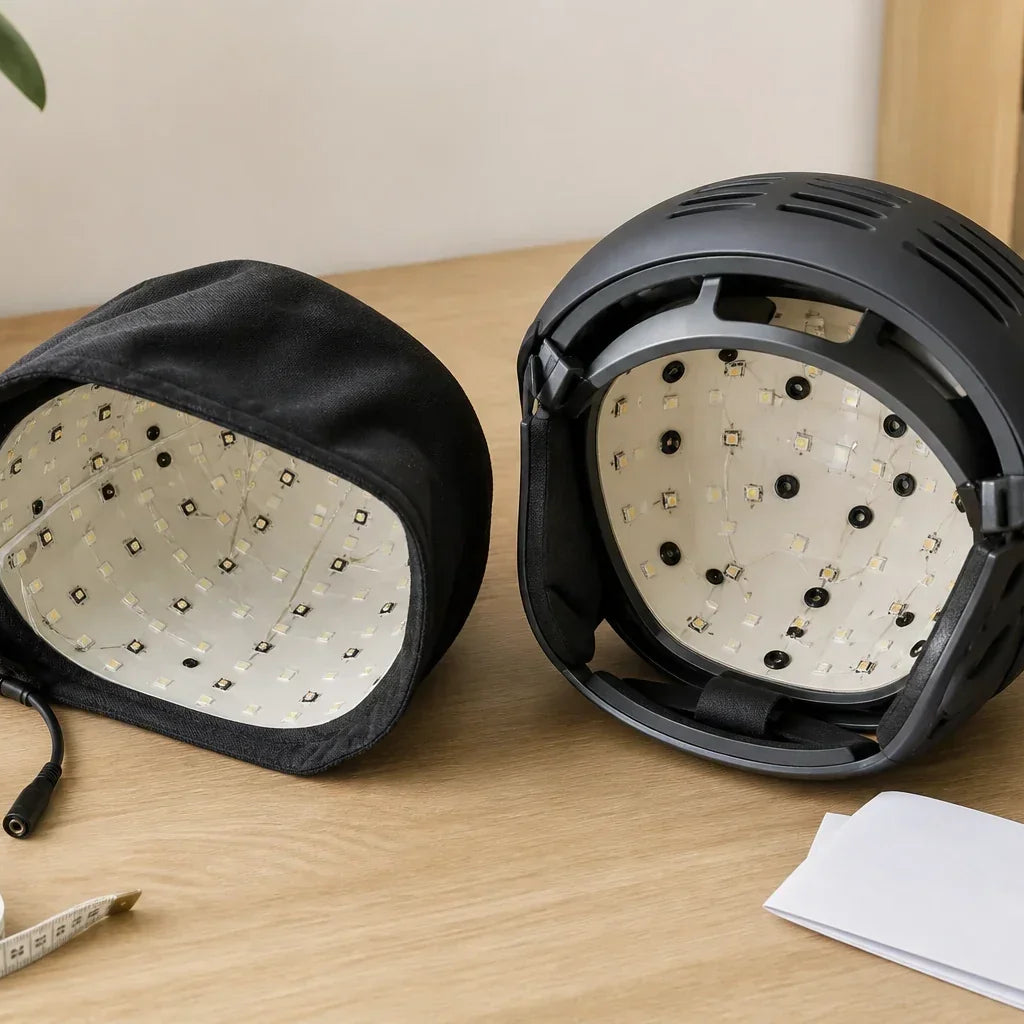
The best red light therapy caps are not simply the models with the most diodes or the highest price. For pattern hair loss, the most defensible choice is a cap or helmet with an exact model number, a traceable intended-use claim, scalp-wide coverage, a routine you can realistically follow, and instructions that fit your health context. Low-level light therapy has supportive device-specific research, but a study on one 655 nm helmet does not validate every red or near-infrared hat sold online.
Commercial disclosure: Yamuri sells red and near-infrared light devices. This guide uses model-neutral comparison criteria and does not assume a Yamuri product is suitable for every use discussed.
Quick Q&A: What Most People Want to Know First
| Question | Short answer | My practical note |
|---|---|---|
| Do light caps work for every kind of hair loss? | No. The better evidence and many device indications concern androgenetic, or pattern, hair loss. | Identify the cause of shedding before pricing a device. |
| Is a cap better than a helmet? | Neither form is universally better. | Coverage, fit, documented output, and adherence matter more than the label. |
| Are more diodes automatically better? | No. | Diode count does not establish scalp dose, uniformity, or clinical performance. |
| Does an FDA-cleared claim settle the decision? | No, but it is useful evidence when it matches the exact model and intended use. | Read the record, not just the badge. |
| Can a general red-light panel substitute for a studied helmet? | That equivalence has not been established. | Hair blocks light, geometry changes exposure, and the protocol may differ. |
| What is the biggest ownership risk? | Buying a routine you will not sustain. | Price the habit, not only the hardware. |

What the Current Search Results Get Right - and Miss
Current US results are dominated by ranked product lists, editorial testing claims, and retailer pages. They consistently discuss fit, session time, portability, wavelength, price, and FDA clearance. Those are useful categories, but many lists compare specifications copied from sellers under different test conditions. A ranking can look precise even when scalp coverage, exact indication, return costs, and protocol adherence were never normalized.
That is why this guide does not name a universal 2026 winner. A cap that is convenient for diffuse crown coverage may be a poor match for a diagnosis outside its labeled population. A structured helmet may have stable geometry yet be uncomfortable enough to create an unused-session penalty.
Caps, Helmets, Bands, and Combs Are Different Tools
| Format | Potential advantage | Verification question | Common friction |
|---|---|---|---|
| Soft cap | Portable and visually discreet | Does the emitter array keep a repeatable distance from the scalp? | Fit and hair compression can vary by user. |
| Structured helmet | More repeatable geometry | Which scalp regions receive direct coverage? | Bulk, heat, storage, and comfort. |
| Band | Smaller and often easier to store | Must it be repositioned for full coverage? | More steps can reduce adherence. |
| Comb | Can part hair and target a region | How slowly and consistently must it be moved? | Technique-dependent exposure. |
What the Evidence Actually Supports
A 2020 multicenter, randomized, double-blind, sham-controlled trial enrolled 60 adults with androgenetic alopecia and evaluated a specific helmet emitting 655 nm light over 16 weeks. The active group improved measured hair density and thickness at the photographed target site. That result supports the tested device and protocol; it does not establish that every cap, every wavelength combination, or every cause of hair loss will perform the same way.
Reviews of low-level light therapy for male and female pattern hair loss generally describe a promising evidence base, while also pointing to variation in devices, schedules, study size, and reporting. The practical conclusion is narrower than many product pages imply: home light devices can be a reasonable option for some people with pattern hair loss, but model-specific documentation and correct diagnosis remain central.
| Claim source | What it can support | What it cannot support |
|---|---|---|
| Randomized helmet trial | Outcome for that device, population, duration, and endpoint | All caps, LEDs, or causes of shedding |
| Systematic review | Direction and consistency across included studies | A guarantee for one retail model |
| FDA 510(k) summary | Substantial-equivalence decision and named indication for the exact device | FDA endorsement of a whole category or every marketing statement |
| Consumer testimonial | One person's reported experience | Causation, typical response, or diagnosis |
How to Verify an FDA-Cleared Hair Device
Search the FDA 510(k) database using the model and manufacturer. A recent 510(k) summary, K253231, describes a laser hair-growth system offered as a dome-shaped helmet or cap for women and men. The useful details are the exact device family and intended use, not the existence of the phrase "FDA cleared" in a product banner.
- Match the model number on the listing, device label, manual, and FDA record.
- Read the indications for use, including sex, pattern, skin type, or hair-loss classification where specified.
- Confirm whether the sold configuration has the same emitters and controller described in the record.
- Distinguish clearance from approval, registration, and general facility listings.
- Save the record and manual version before purchase.
Evaluation Method: Specifications That Deserve Weight
| Decision area | Strong documentation | Weak substitute |
|---|---|---|
| Intended use | Exact population and condition in model documentation | "For all hair loss" |
| Light source | Wavelength, emitter type, active area, and operating mode | A red glow or diode count alone |
| Coverage | Map of scalp regions and repeatable device geometry | One center-point output number |
| Routine | Manual-defined session length and frequency | Generic online dose advice |
| Safety | Contraindications, eye guidance, heat limits, and stop-use instructions | "Completely safe" |
| Ownership | Warranty labor, battery policy, returns, sanitation, and support | Purchase price alone |
Wavelength does not equal dose. Dose depends on output at the scalp, exposure time, geometry, and the area actually illuminated. Electrical wattage does not equal optical power, and visible brightness is not a calibrated measurement. For a cap, hair density and contact geometry add further uncertainty.
Safety and the Diagnosis Boundary
Sudden shedding, patchy loss, scalp inflammation, scarring, medication-related changes, nutritional issues, postpartum changes, and pattern hair loss do not have the same cause or management. A consumer device should not delay evaluation of new, rapid, painful, or unexplained hair loss. Follow the exact manual, especially its eye, photosensitivity, medicine, skin-condition, and age restrictions.
Do not combine a cap with minoxidil, prescription treatment, microneedling, or other scalp procedures on the assumption that more interventions must be better. Combination decisions can change irritation, adherence, and the ability to know what caused a response. That is an appropriate topic for a qualified clinician who knows the diagnosis and current medicines.
Where Buyers Often Get Misled
I would reject any shortlist that awards points for diode count without asking where the light lands. I would also reject a model whose clearance language cannot be matched to the sold configuration. Convenience is a real advantage, but it is a usability advantage - not clinical proof.
My practical priority order is: correct use case, traceable model record, scalp coverage, tolerable routine, clear safety instructions, then price. A cheaper device with honest documentation can be a better decision than a premium cap that relies on an impressive wavelength list and a nonrefundable sale.
Frequently Asked Questions
How long does a red light hair cap take to show results?
Device studies usually evaluate repeated use over months, not days. Follow the manual and use standardized photos if you and a clinician decide monitoring is appropriate. Early day-to-day impressions are unreliable.
Is 650 nm or 655 nm automatically the best wavelength?
No. Those wavelengths appear in hair-device research and regulatory records, but wavelength alone does not specify scalp dose, coverage, emitter type, or an effective protocol.
Are lasers better than LEDs for hair growth?
The evidence is device- and protocol-specific. Do not infer superiority from the source label alone. Compare the exact clinical and regulatory documentation for the model.
Can I wear the cap longer for a stronger effect?
Do not exceed the model's instructions. Longer exposure is not automatically more effective and may increase heat, irritation, or nonadherence.
Does hair have to be clean or dry?
Use the preparation instructions in the exact manual. Product materials, topical treatments, wet hair, and fit may affect safe use.
Can a cap treat alopecia areata or chemotherapy-related hair loss?
Do not generalize pattern-hair-loss evidence to those conditions. They require condition-specific medical guidance.
What if the retailer only says "FDA registered"?
Registration is not the same as clearance or approval. Ask for the exact 510(k) number and confirm that it matches the model and claim.
Should I choose the shortest session time?
Not by itself. A short routine may improve adherence, but time cannot be compared without output, coverage, and the studied protocol.
Related Yamuri guide: For wavelength context, see what wavelength of red light is used for hair growth.
Sources and Further Reading
- FDA 510(k) summary K253231 for a laser hair-growth cap and helmet system
- Randomized sham-controlled 655 nm helmet trial in androgenetic alopecia
- Review of low-level light therapy for male and female pattern hair loss
- FDA questions and safety considerations for home-use devices
Editorial Standards and General Information
This article separates general wavelength education from exact-product documentation. Regulatory records apply only to the models and intended uses named in those records. Evidence for a third-party cap or helmet is not automatically applied to Yamuri or another device. This guide supports consumer education and specification literacy, not diagnosis or personalized treatment. Follow the exact device instructions and seek qualified guidance for unexplained hair loss, photosensitivity, medicine interactions, scalp disease, or uncertainty about suitability.
Continue reading