Red light therapy encyclopedia
Red Light Therapy Gloves: Evidence, Fit and Safety Checks
Compare red light therapy gloves, wraps, and small panels by intended use, emitter coverage, fit, output documentation, heat, hygiene, evidence limits, and safety.
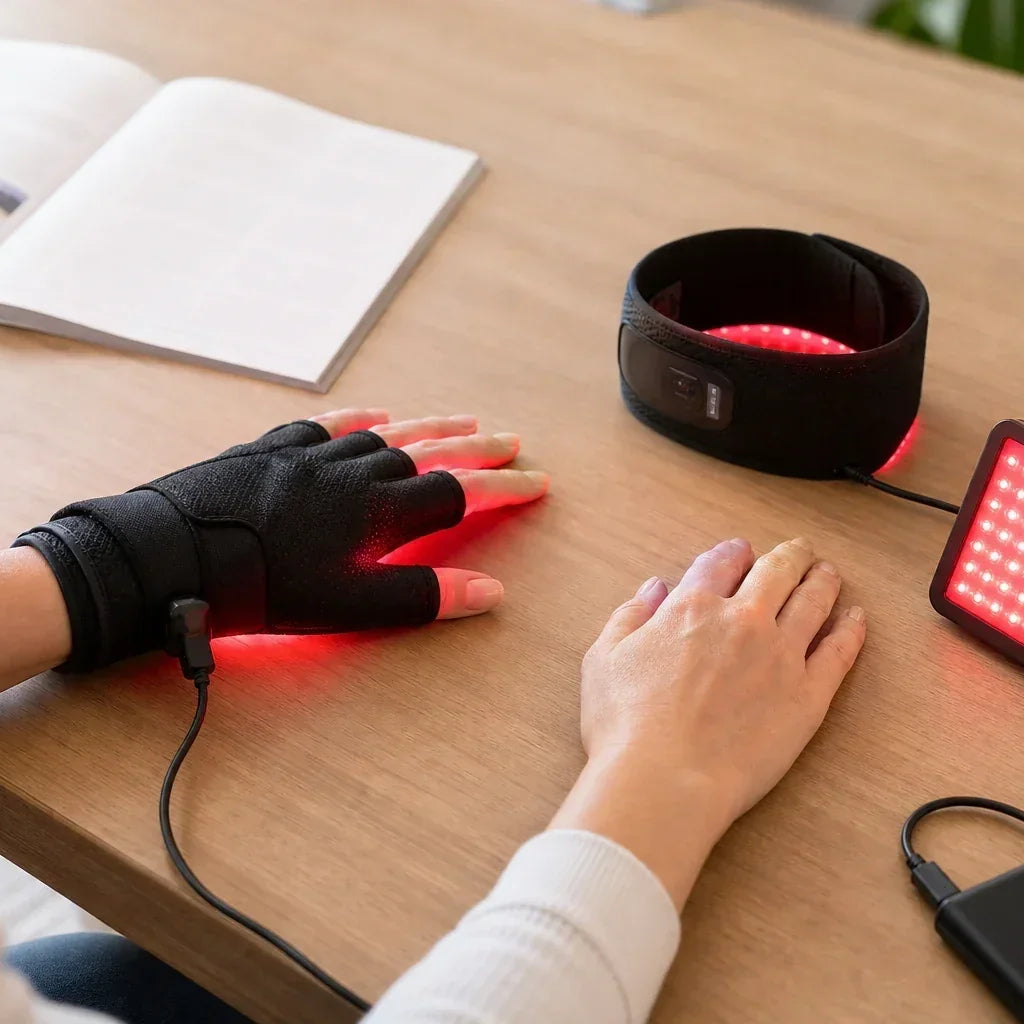
Red light therapy gloves are wearable LED devices designed to place light close to the fingers, hand, or wrist. Their main advantage is coverage and convenience, not proof that they treat arthritis, carpal tunnel syndrome, neuropathy, or every source of hand pain. Clinical low-level laser and photobiomodulation studies use specific devices and protocols, while many retail gloves provide little more than wavelength and timer claims. A defensible choice starts with the real goal, emitter coverage, fit, output documentation, heat, cleaning, and the exact intended use.
Commercial disclosure: Yamuri sells red and near-infrared light devices. This guide uses model-neutral comparison criteria and does not assume a Yamuri product is suitable for every use discussed.
Quick Q&A: What Most People Want to Know First
| Question | Short answer | My practical note |
|---|---|---|
| Do red light therapy gloves treat arthritis? | Current evidence does not justify that claim for the category. | Clinical laser research is mixed and model-specific. |
| Is a glove better than a panel? | Not always. | A glove improves close placement; a panel can be easier to clean and share. |
| Should the fingers be covered? | Coverage should match the intended area. | Open-finger designs may miss finger joints but improve dexterity. |
| Does 660/850 nm prove performance? | No. | Wavelengths do not disclose intensity, area, time, or clinical effect. |
| Can I use a glove over swollen joints? | Do not assume that is appropriate. | New, hot, red, or marked swelling deserves condition-specific guidance. |
| What is the most overlooked feature? | Fit without compression or cable strain. | A wearable device that pinches will not support consistent use. |

What People Mean by a "Red Light Glove"
Current search results include mittens, open-finger gloves, flat pads folded around a hand, wrist wraps, and cosmetic LED hand masks. Some target skin appearance; others market pain, stiffness, circulation, arthritis, or carpal tunnel relief. These are different claims, and a study relevant to one cannot silently validate the others.
Start by separating appearance goals from musculoskeletal or nerve symptoms. A glove sold for cosmetic skin use should not be assumed to treat joint disease. A clinical laser applied at selected points should not be assumed equivalent to a broad low-output LED mitten.
Glove, Wrap, or Panel?
| Format | Potential advantage | What to verify | Common friction |
|---|---|---|---|
| Full mitten | Broad dorsal and palm coverage | Emitter map, size, heat, pressure, inner cleaning | Limited dexterity and possible hot spots |
| Open-finger glove | Controls remain reachable | Whether finger joints and fingertips receive light | Incomplete coverage for some goals |
| Flexible pad or wrap | Can be repositioned between hand and wrist | Output when bent, fastening, cable strain | Gaps, folds, and uneven contact |
| Small panel | Noncontact, shareable, easy to inspect | Distance, angle, beam area, stable stand | May require turning the hand |
| Clinical probe or laser cluster | Controlled placement for a defined protocol | Diagnosis, dose, operator, and intended endpoint | Not equivalent to a retail glove |
What the Arthritis and Wrist Evidence Actually Shows
A 2024 systematic review and meta-analysis of low-level laser therapy for rheumatoid arthritis included 23 studies and reported no significant pain reduction versus placebo, while grip strength and morning stiffness improved in pooled analyses with substantial heterogeneity. A separate 2023 review of 18 randomized trials judged the evidence low or very uncertain and found that infrared laser may not be superior to sham across several outcomes.
For carpal tunnel syndrome, a 2025 systematic review of 13 randomized trials found no clear advantage for pain or grip strength but reported an improvement in function. Those findings concern defined clinical protocols, not consumer gloves as a product category. They also do not replace diagnosis: hand pain, numbness, stiffness, and weakness can arise from different conditions.
| Claim | What the research may inform | What remains unproven |
|---|---|---|
| Rheumatoid arthritis pain | Laser trials and pooled clinical outcomes | That any LED glove reduces pain or disease activity |
| Morning stiffness or grip | Signals in some pooled analyses | Durable benefit from an undocumented home mitten |
| Carpal tunnel function | Selected PBM protocols in diagnosed participants | That a glove corrects nerve compression or prevents progression |
| Skin appearance | General red/NIR skin research may be relevant | Transfer of face-device results to a particular hand glove |
| Circulation | A measurable study could test a defined endpoint | Using "improves circulation" as a universal health promise |
Evaluation Method: Specifications That Matter
| Decision area | Strong documentation | Weak substitute |
|---|---|---|
| Intended use | Specific cosmetic or wellness claim in the manual | A page that mixes arthritis, neuropathy, beauty, and recovery |
| Coverage | Emitter map for palm, dorsum, fingers, thumb, and wrist | Total LED count |
| Output | Wavelength and irradiance or energy with test conditions | Electrical watts or visible brightness |
| Fit | Hand dimensions, left/right design, strap pressure, cable exit | "Universal size" |
| Heat and controls | Independent modes, timer, temperature limit, shutoff | One preset with no detail |
| Hygiene and support | Cleanable liner, shared-use guidance, manual, warranty, returns | Influencer demonstration only |
Ask whether the published output was measured with the material flat or wrapped around a hand. Folding can change emitter direction, spacing, and heat. If a two-glove set uses one controller, confirm whether both gloves maintain the documented output when operated together.
Fit, Sensation, and Skin Checks
A glove should not require enough tension to cause numbness, color change, throbbing, or deeper pain. Inspect skin before and after use. Stop for excessive warmth, burning, persistent redness, a rash, worsening swelling, or new neurological symptoms. Impaired sensation makes home heat and contact devices harder to monitor safely.
Follow exact instructions for photosensitivity, medicines, pregnancy, implants, open skin, recent surgery, and eye exposure. Do not place a glove over wet topical products, dressings, splints, or compression garments unless the manual explicitly supports that setup.
When Shopping Should Pause
| Symptom pattern | Why a generic glove is not the first answer | Practical next step |
|---|---|---|
| New hot, red, markedly swollen joint | May represent active disease or another urgent problem | Obtain appropriate assessment. |
| Progressive numbness or weakness | Nerve compression or another neurological cause may need evaluation | Do not rely on temporary warmth or sensation change. |
| Open wound or infection | Consumer-light use may interfere with proper wound care | Protect the area and seek suitable care. |
| Recent fracture or surgery | Timing and device choice are recovery-plan specific | Ask the treating team with the exact manual. |
| Unexplained bilateral hand symptoms | Can reflect a systemic or medication-related issue | Clarify the cause before buying a treatment device. |
My Practical Take
I would choose a glove only when close, hands-free coverage solves a real usability problem. If the goal is simply to expose the back and palm of the hand, a stable small panel may be easier to clean, inspect, and use without compression.
I would not pay extra for a long list of diseases. The more conditions a glove claims to treat with the same undocumented program, the less credible the evidence translation becomes. Good documentation narrows claims.
Frequently Asked Questions
What are the best red light therapy gloves?
The best candidate is the one whose intended use, emitter coverage, output conditions, fit, controls, hygiene, and support match your goal. There is no evidence-based universal winner.
Can red light therapy gloves help arthritis?
Clinical low-level laser evidence for rheumatoid arthritis is mixed and uncertain. It does not validate every home LED glove or replace disease-modifying care.
Can a glove help carpal tunnel syndrome?
A 2025 review found a function signal for selected PBM protocols but no clear advantage for pain or grip strength. A glove should not delay evaluation of progressive numbness or weakness.
Should I buy 660 nm and 850 nm together?
A dual-wavelength label is not enough to judge performance. Ask for output, coverage, timing, safety, and evidence for the exact use.
Do I need one glove or two?
That depends on whether both hands are a legitimate target, the controller design, and the time burden. Treating one hand at a time may double the routine.
Can I wear jewelry under the glove?
Remove jewelry if the manual instructs it or if it affects fit, pressure, heat, or cleaning. Do not improvise around tight rings on swollen fingers.
Can I use hand cream during a session?
Use only products and preparation steps allowed by the manual. Creams can affect material, heat, hygiene, and skin reaction.
How often should I use a red light glove?
Use the model-specific instructions. Frequency from a clinical laser study or another product should not be copied to a glove with different output.
Related Yamuri guide: For broader setup and safety context, see how to approach red light therapy at home.
Sources and Further Reading
- 2024 systematic review and meta-analysis of low-level laser therapy for rheumatoid arthritis
- 2023 systematic review of low-level laser therapy in adults with rheumatoid arthritis
- 2025 systematic review and meta-analysis of photobiomodulation for carpal tunnel syndrome
- FDA questions and safety considerations for home-use devices
Editorial Standards and General Information
This article separates general wavelength education from condition- and device-specific evidence. Regulatory records and clinical trials apply only to the models, protocols, diagnoses, and intended uses named in those sources; they are not automatically applied to Yamuri or a retail glove. This guide supports consumer education and specification literacy, not diagnosis or personalized treatment. Follow the exact manual and seek qualified guidance for arthritis, progressive numbness or weakness, swelling, wounds, impaired sensation or circulation, recent surgery, pregnancy, photosensitivity, medicine interactions, or uncertainty about suitability.
Continue reading