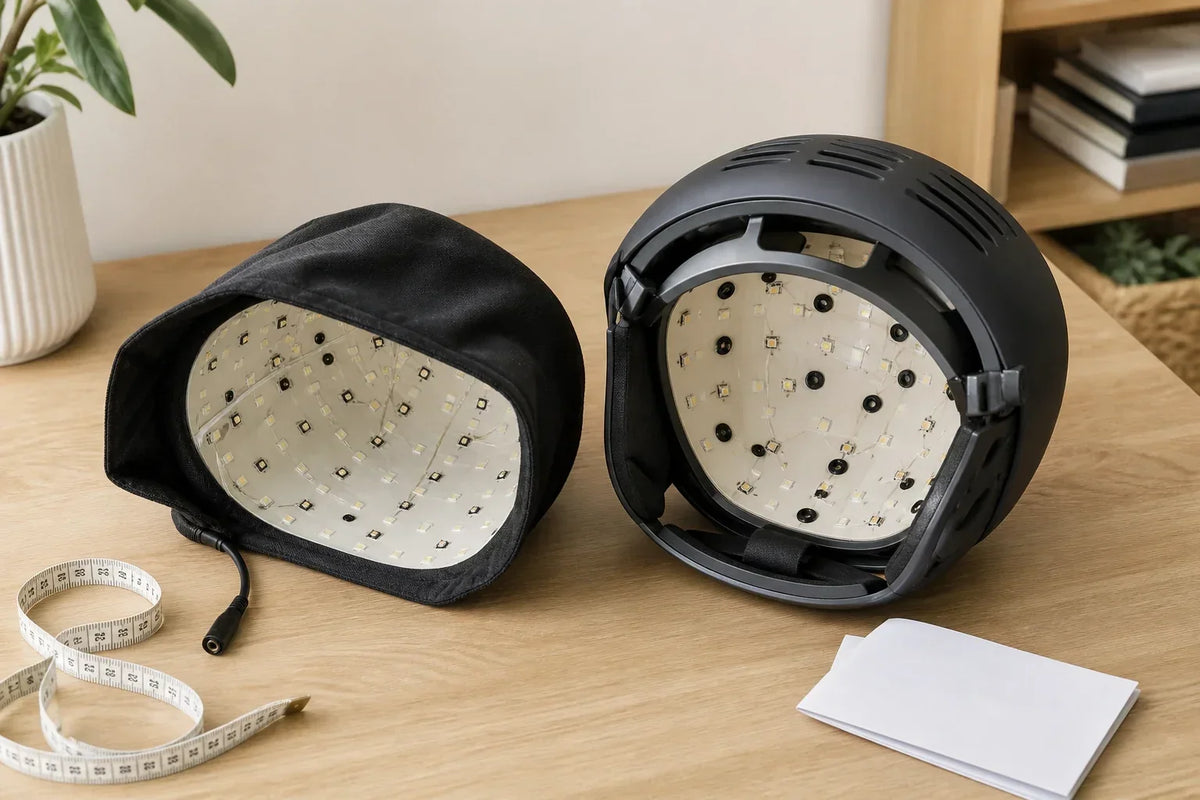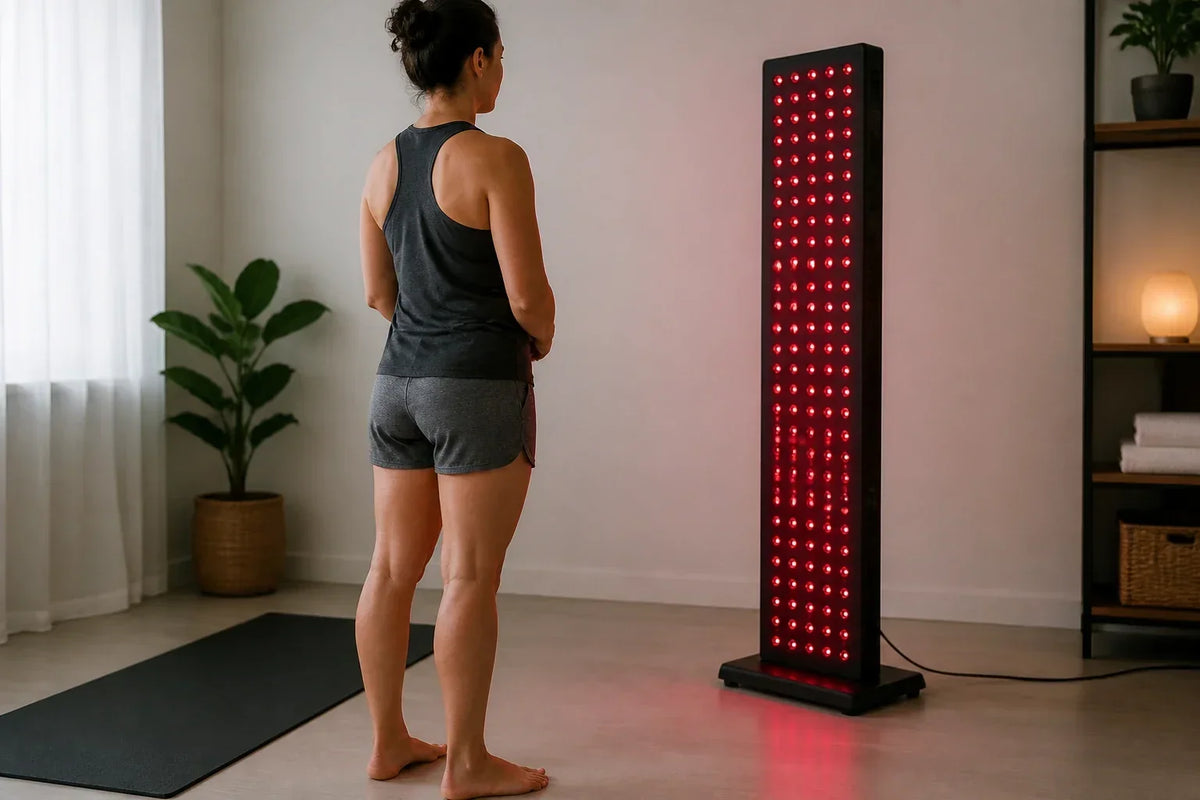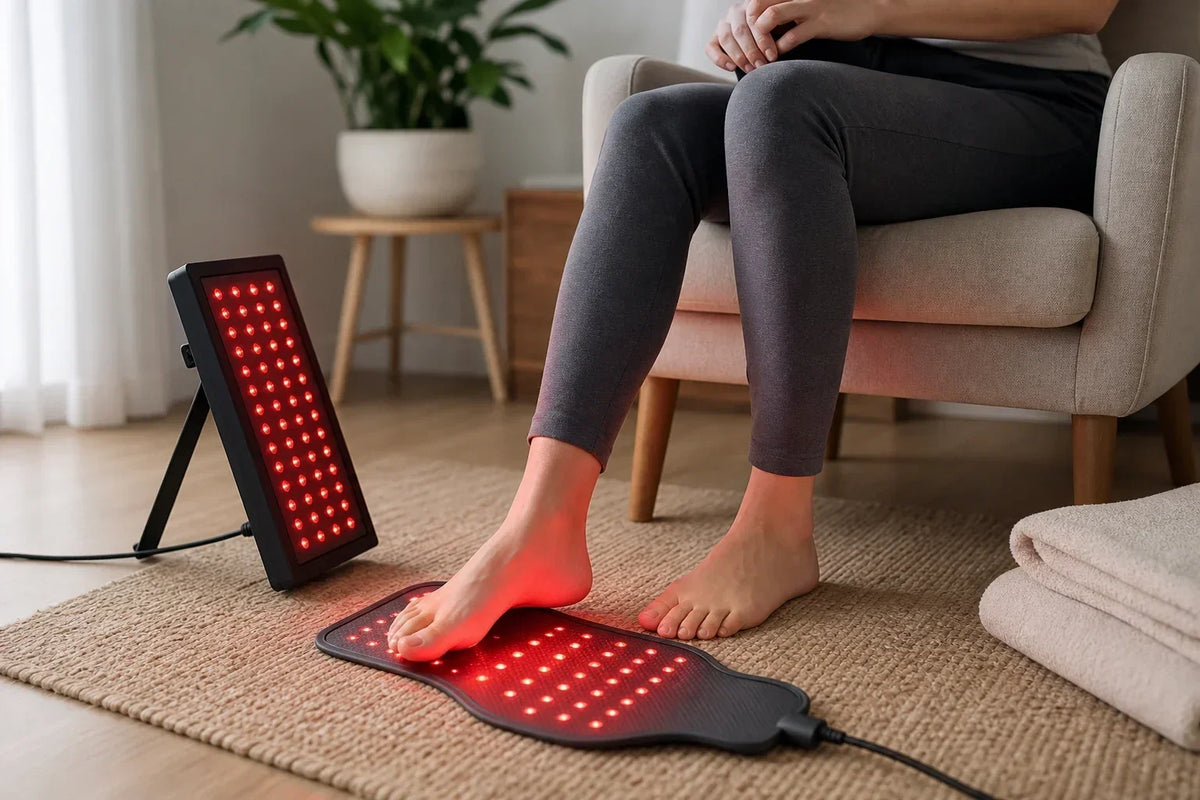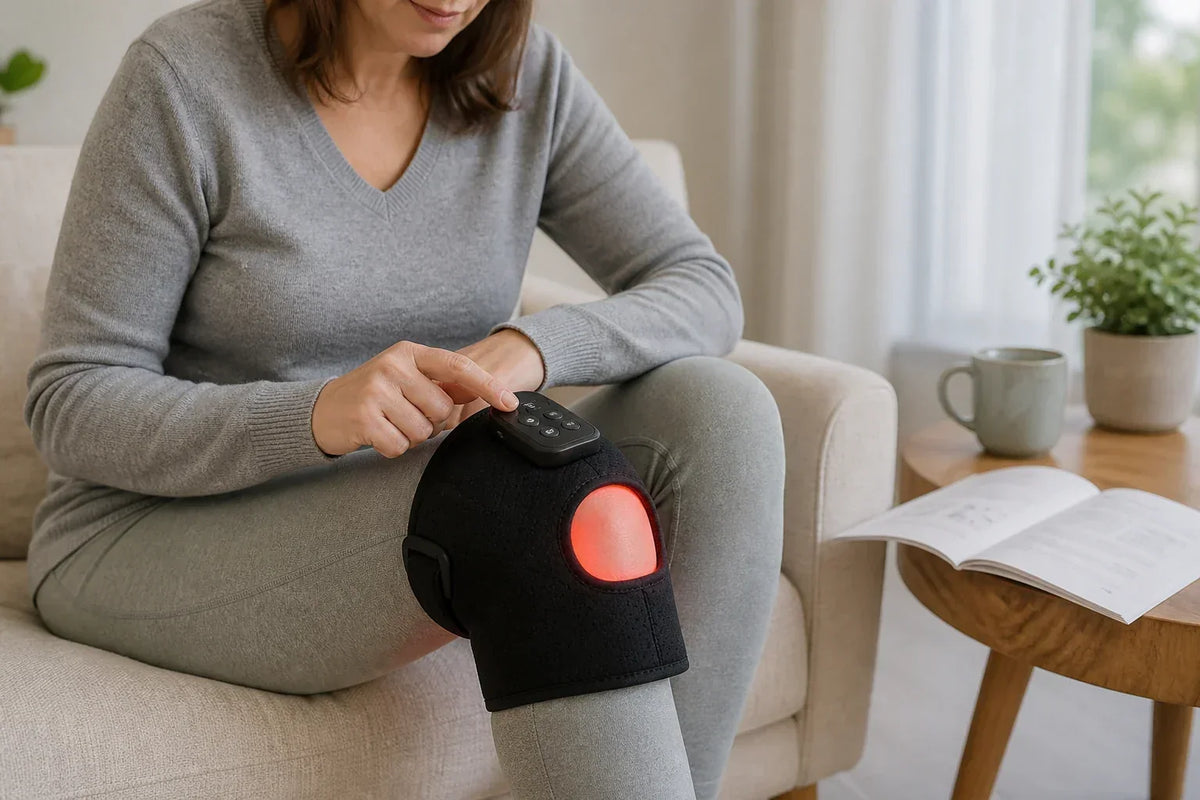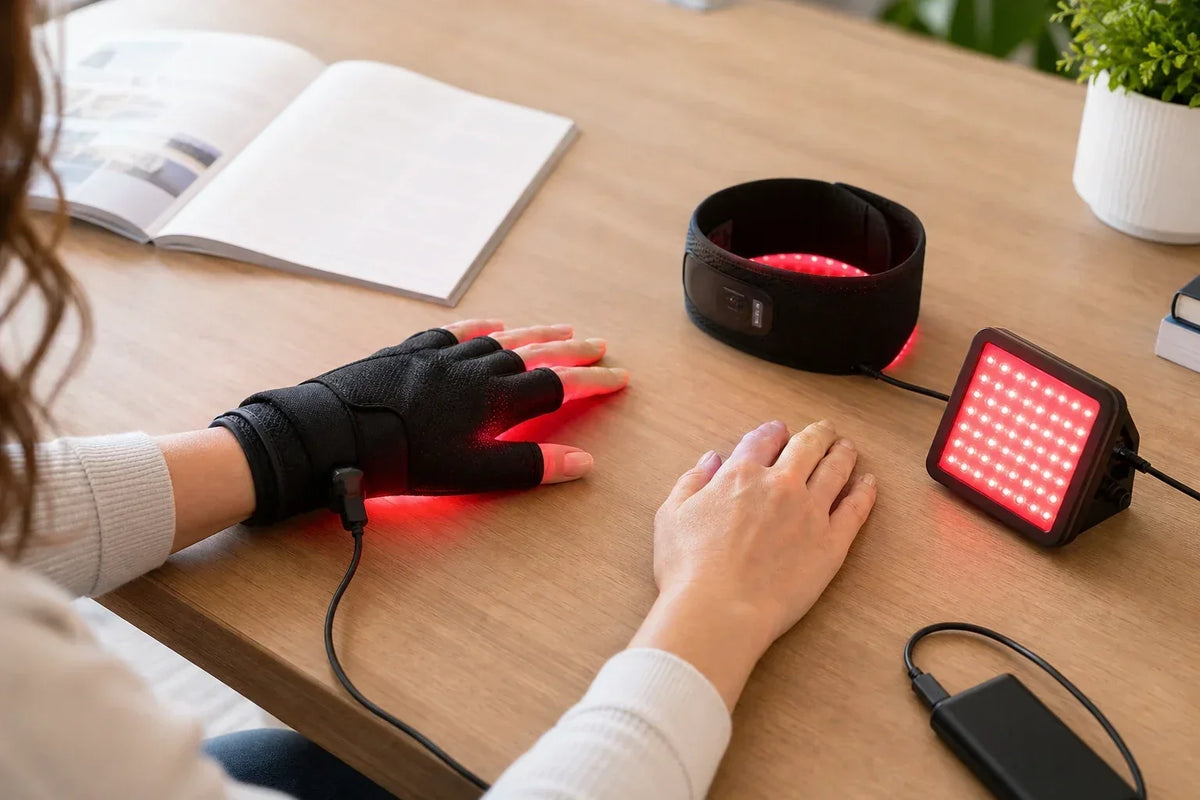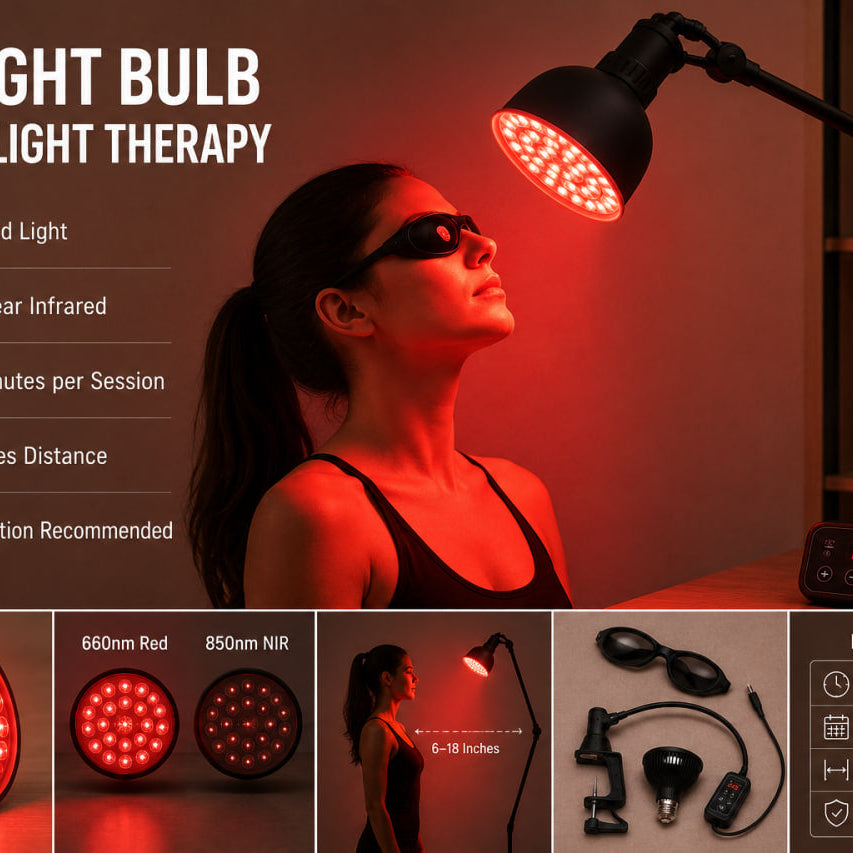
Red light bulb for red light therapy guide: compare 7 buying checks, regular vs therapy bulbs, 660nm vs 850nm, timing, distance, and safety.
Editorial Review: This article was written for consumer education about red light therapy bulbs, household red bulbs, therapy wavelengths, irradiance, beam angle, session timing, distance, eye protection, and bulb-versus-panel decisions. It references public information from Cleveland Clinic, NIH/PMC, FDA, FTC, and the American Society for Laser Medicine and Surgery. It is not medical advice.
If you are looking for a red light bulb for red light therapy, do not choose a bulb simply because it glows red. A suitable therapy-style bulb should identify its wavelengths, provide distance and session instructions, explain its beam coverage, and include appropriate electrical and eye-safety guidance.

A regular household red bulb, sleep bulb, plant grow bulb, or infrared heat lamp is not automatically interchangeable with a purpose-built red light therapy bulb. For targeted home use, many dedicated bulbs combine visible red light around 630–660nm with near-infrared light around 810–850nm.
My personal take is simple: a bulb can make sense for one small area and a limited budget. A panel usually makes more sense when you want repeatable coverage across the face, torso, back, or legs. The shape of the device affects the routine almost as much as the wavelength.
Quick Q&A: What Most People Want to Know First
| Question | Short Answer | My Practical Note |
|---|---|---|
| Can any red bulb be used for red light therapy? | No. A red color alone does not confirm wavelength, output, beam coverage, or a usable exposure routine. | I would skip any bulb that does not publish exact wavelength numbers. |
| Is 660nm or 850nm better? | They are different. 660nm is visible red light, while 850nm is near-infrared and may appear dim or invisible. | A dual-wavelength bulb can be convenient, but the other specifications still matter. |
| How long should I use a red light therapy bulb? | Many home devices use short sessions around 10–20 minutes, but the exact manual should control the routine. | Do not extend a 10-minute session simply because the bulb feels gentle. |
| How far should the bulb be from the skin? | Distance is model-specific and depends on output and beam angle. | I would not copy the distance from another brand or panel. |
| Is a bulb as good as a red light panel? | A bulb can work for small-area use, while a panel generally offers wider and more uniform coverage. | For full-face or body routines, I would usually choose a panel. |
| Do I need goggles? | Use eye protection when the bulb is close to the face, includes NIR, feels intensely bright, or the manual recommends it. | Avoid staring directly at the LEDs, even during a short session. |
| Can I put it in any lamp? | Only if the socket, voltage, wattage rating, ventilation, and fixture design are compatible. | A closed lamp shade may trap heat around a high-powered LED bulb. |
What Is a Red Light Therapy Bulb?
A red light therapy bulb is a compact LED device designed to emit selected visible red or near-infrared wavelengths. Many models screw into an E26 or E27 socket, while others come with a dedicated holder, clamp lamp, power cord, or tabletop base.
Photobiomodulation is a broader technical term for controlled exposure to non-ionizing visible or near-infrared light. The American Society for Laser Medicine and Surgery explains that PBM can use LEDs, lasers, or broadband light sources in visible and near-infrared ranges. You can review its public overview here: ASLMS photobiomodulation overview.
Cleveland Clinic describes red light therapy as low-level red light exposure and distinguishes it from ultraviolet light used by sunlight and tanning equipment. It also advises consumers to use home devices according to their directions. You can review its overview here: Cleveland Clinic red light therapy overview.
The important word is “controlled.” A purpose-built bulb should give the user enough information to control the wavelength, distance, exposure area, and session length. Without that information, the red glow does not tell you much.
Regular Red Bulb vs Therapy Bulb vs Heat Lamp
This is where many home users get confused. Several products can produce red-looking light, but they may be designed for entirely different purposes.
A sleep bulb is intended to create dim evening lighting. A grow bulb is designed around plant photosynthesis. A heat lamp is designed to generate warmth. A decorative red LED changes the color of a room. None of those purposes automatically requires the controlled output information expected from a red light therapy device.
| Bulb Type | Primary Purpose | Typical Information Provided | Suitable for a Therapy-Style Routine? |
|---|---|---|---|
| Purpose-built red light therapy bulb | Targeted red or red-plus-NIR exposure | Wavelengths, timing, distance, power, and safety guidance | Potentially, when the specifications and instructions are clear |
| Household red LED bulb | Colored room lighting | Lumens, color, electrical wattage, and socket type | Not automatically |
| Red sleep bulb | Low-blue evening illumination | Brightness, color temperature, flicker, and socket type | Usually a different product category |
| Plant grow bulb | Plant growth | Plant spectrum, PAR, coverage, and hanging height | Not designed around human use instructions |
| Infrared heat lamp | Thermal warmth | Heat output, electrical wattage, and safe clearance | Different from a non-thermal LED PBM device |
Here’s the practical way I’d look at it: if the listing focuses on room mood, sleep lighting, reptiles, plants, food warming, or intense heat, it is probably not the product you are searching for.
7 Checks Before Buying a Red Light Bulb for Red Light Therapy
A good bulb listing should answer basic technical and practical questions without forcing the shopper to guess. Electrical wattage alone is not enough because it describes power consumption, not the complete light exposure reaching the body.
A current NIH/PMC consumer product guide emphasizes evaluating wavelength, irradiance, dose, distance, coverage, product claims, and testing information together. You can review the guide here: NIH/PMC red light therapy product guide.
| Buying Check | What to Look For | Red Flag |
|---|---|---|
| 1. Exact wavelengths | Numbers such as 630nm, 660nm, 810nm, or 850nm | Only says “deep red” or “infrared technology” |
| 2. Irradiance context | Output measured at a stated distance and mode | A large mW/cm² number with no test distance |
| 3. Beam angle | A beam wide enough for the area you want to cover | No information about spread or illuminated area |
| 4. Timing guidance | A defined session range and frequency recommendation | Encourages unlimited or all-day exposure |
| 5. Distance guidance | A recommended range linked to session time | Tells users to place it “as close as possible” |
| 6. Electrical compatibility | Correct voltage, socket, fixture rating, and ventilation | No voltage or fixture warning |
| 7. Safety and claims | Eye guidance, heat warnings, contraindication language, and realistic claims | Dramatic promises with no limitations |
660nm or 850nm: Which Wavelength Should You Choose?
660nm is visible red light. 850nm is near-infrared light and may be difficult or impossible to see. A dual-chip bulb may include both wavelengths in the same LED package, but the visible red brightness does not tell you how much NIR output the bulb produces.
Research reviews commonly place photobiomodulation wavelengths within visible red and near-infrared regions, but they also emphasize that wavelength alone cannot define a complete protocol. Irradiance, exposure duration, beam area, pulse settings, and total delivered energy also matter.
You can review a detailed analysis of PBM parameters here: NIH/PMC review of PBM light parameters.
| Wavelength | Common Description | What You Can See | Practical Buyer Note |
|---|---|---|---|
| 630–660nm | Visible red light | Bright red glow | Common in targeted skin-facing and general home devices |
| 810–850nm | Near-infrared light | Little or no visible glow | Do not assume the LEDs are inactive because they look dim |
| 660nm + 850nm | Dual-wavelength configuration | Visible red with less-visible NIR | A common and straightforward combination |
| Unspecified red or infrared | Unclear marketing category | Unknown | I would not use it for a structured routine |
My practical view is that a clearly documented 660nm bulb is more useful than a vaguely described multi-wavelength bulb. A dual 660nm and 850nm device becomes attractive when the manufacturer also publishes the output, allocation, distance, and timing for both modes.
Beam Angle and Coverage: The Bulb Specification Most People Miss
A bulb can use the desired wavelengths and still be inconvenient if its beam is too narrow or too scattered. Beam angle describes how widely the light spreads after leaving the bulb.
A narrow beam concentrates light over a smaller area. A wider beam covers more skin but may reduce intensity at the same distance. This is why the best distance cannot be separated from beam angle and output.
If I were helping a friend choose a bulb, I would first ask what area they plan to illuminate. A narrow bulb may fit a hand, knee, shoulder, or small facial area. It is usually inefficient for an entire back, abdomen, or both legs.
| Coverage Goal | Bulb Suitability | Likely Setup |
|---|---|---|
| One small targeted area | Good fit | One bulb in a stable adjustable holder |
| Face | Possible, but brightness and eye protection matter | Wider beam, controlled distance, and goggles |
| Torso | Limited with one bulb | Multiple positions or a larger lamp |
| Back or both legs | Usually inefficient | A panel provides more even coverage |
| Full body | Poor fit | Use a tall panel, multi-panel system, bed, or blanket |
Red Light Therapy Bulb vs Panel
The choice between a bulb and a panel is mostly a coverage and repeatability decision. A bulb is compact, affordable, and easy to aim at one area. A panel includes many LEDs arranged over a flat surface, which generally produces wider and more uniform exposure.
A review comparing lasers and LEDs explains that LEDs can be used across larger areas and that the light source must still be understood through its parameters rather than its label alone. You can review it here: NIH/PMC photobiomodulation lasers versus LEDs.
| Feature | Therapy Bulb | Red Light Panel |
|---|---|---|
| Coverage | Small and targeted | Wider and more uniform |
| Price | Usually lower | Usually higher |
| Setup | Requires a compatible and stable fixture | Usually includes or supports a stand or mount |
| Distance consistency | Depends heavily on the lamp position | Easier to repeat with a fixed stand |
| Best use | One small area | Face, torso, back, legs, or broad body areas |
| Common mistake | Expecting full-body coverage from one bulb | Standing closer than the recommended distance |
The part I would pay attention to is how many positions the routine requires. A low-cost bulb is not truly convenient if you must move it eight times to cover the area you care about.
10 vs 20 Minutes: How Long Should You Use the Bulb?
There is no universal session time for every red light therapy bulb. Ten minutes with a concentrated bulb at close range may deliver a very different exposure from 20 minutes with a lower-output bulb farther away.
Photobiomodulation research often describes a biphasic dose response, meaning that increasing exposure does not always produce a proportionally greater response. You can review the dose-response paper here: NIH/PMC biphasic dose-response review.
In my view, the safer answer is to begin at the shorter end of the manufacturer’s range. Keep the distance fixed while you assess comfort instead of changing time, distance, and intensity at once.
| Session Length | Possible Use | Practical Note |
|---|---|---|
| 3–5 minutes | Initial brightness and comfort check | Useful when testing a new face-facing setup |
| 10 minutes | Common introductory session | A reasonable starting point when supported by the manual |
| 15 minutes | Moderate routine | Keep the recommended distance unchanged |
| 20 minutes | Some lower-output or farther-distance setups | Not automatically better than 10 minutes |
| 30+ minutes | Only when specifically directed | Often unnecessary for a small targeted bulb |
How to Set Up a Red Light Therapy Bulb at Home
- Confirm the bulb voltage and socket type before installation.
- Use a fixture rated for the bulb’s electrical wattage and physical weight.
- Avoid tightly enclosed lamp shades unless the manufacturer allows them.
- Secure the lamp so it cannot fall or rotate during the session.
- Measure the recommended distance from the bulb to the intended area.
- Expose the intended area rather than shining the light through thick clothing.
- Use goggles when the bulb faces the eyes or when the manual recommends them.
- Set a timer before switching the bulb on.
- Avoid touching the bulb or fixture until it has cooled.
- Stop if you experience excessive warmth, eye strain, irritation, or unusual discomfort.
Safety Checklist for Red Light Therapy Bulbs
A compact bulb may look less intimidating than a large panel, but the same basic safety principles apply. Bright LEDs, near-infrared output, electricity, fixture heat, and close-range positioning all require attention.
The FDA’s general wellness guidance distinguishes low-risk wellness products from disease-related medical claims. You can review it here: FDA General Wellness Policy for Low-Risk Devices.
| Safety Area | Practical Rule |
|---|---|
| Eyes | Do not stare into the bulb; use appropriate protection near the face |
| Heat | Keep ventilation open and allow the fixture to cool |
| Electrical rating | Match the bulb to the socket voltage and fixture wattage limit |
| Distance | Use the product’s stated range instead of moving as close as possible |
| Timer | Use one controlled session rather than repeated back-to-back cycles |
| Light sensitivity | Ask an appropriate professional about known photosensitivity or relevant medication |
| Claims | Be cautious with dramatic promises unsupported by clear evidence |
Common Buying and Usage Mistakes
The FTC states that health-related marketing claims should be truthful, not misleading, and supported by appropriate evidence. You can review its guidance here: FTC Health Products Compliance Guidance.
| Mistake | Why It Happens | Better Move |
|---|---|---|
| Buying a household bulb because it looks red | Color is easy to compare | Check wavelength, output, distance, and instructions |
| Comparing electrical wattage only | Higher wattage sounds stronger | Compare measured light output and coverage |
| Ignoring beam angle | Product pages emphasize wavelength | Match the illuminated area to your intended use |
| Moving too close | Users want a faster routine | Follow the recommended distance |
| Using 30–60 minute sessions | The bulb feels mild | Follow the timer supplied for the product |
| Using an enclosed fixture | The bulb fits physically | Confirm ventilation and heat compatibility |
| Expecting one bulb to cover the whole body | Marketing images make coverage look wider | Choose a panel for broad areas |
My Practical View
My personal take is simple: a purpose-built red light therapy bulb is a reasonable entry point when you want to illuminate one small area and do not need perfect full-body coverage.
If I were helping a friend buy one, I would ask seven questions before looking at reviews: What are the wavelengths? At what distance is output measured? What is the beam angle? How long is one session? What fixture is required? What eye guidance is provided? What claims does the company make?
What often gets missed is the lamp holder. A technically good bulb attached to a loose clamp, weak neck, or enclosed shade produces a poor setup. The holder needs to keep the distance and angle stable throughout the session.
I would not overthink whether 660nm or 850nm is universally “better.” The part I would pay attention to is whether the product gives you enough information to use its selected wavelengths consistently.
For a small targeted routine, a documented dual-wavelength bulb can be practical. For the face, torso, back, legs, or multiple users, a panel is usually the more efficient and repeatable format.
References
- Cleveland Clinic: Red Light Therapy Overview
- ASLMS: Photobiomodulation Overview
- NIH/PMC: What to Look for in Red Light Therapy Products
- NIH/PMC: Review of Light Parameters and PBM Efficacy
- NIH/PMC: Biphasic Dose Response in Low-Level Light Therapy
- NIH/PMC: Photobiomodulation—Lasers vs LEDs
- FDA: General Wellness Policy for Low-Risk Devices
- FTC: Health Products Compliance Guidance
FAQ
Can I use a regular red light bulb for red light therapy?
A regular red bulb is usually designed for room color or ambiance and may not provide the wavelength, measured output, beam coverage, or usage instructions needed for a controlled red light routine. Choose a purpose-built device with published specifications.
What is the best red light bulb for red light therapy?
Look for a bulb that publishes exact wavelengths, measured output at a stated distance, beam angle, session instructions, electrical requirements, eye guidance, and realistic product claims.
Is 660nm or 850nm better for a red light therapy bulb?
Neither is universally better. 660nm is visible red light, while 850nm is near-infrared. Dual-wavelength bulbs include both, but output, distance, timing, and coverage remain important.
How long should I use a red light therapy bulb?
Many purpose-built home devices use sessions around 10–20 minutes, but there is no universal time. Follow the instructions for the exact bulb and keep the recommended distance consistent.
How far should a red light therapy bulb be from the skin?
The correct distance depends on the bulb’s output and beam angle. Use the manufacturer’s specified distance rather than copying a panel routine or placing the bulb as close as possible.
Can an infrared heat lamp be used as red light therapy?
An infrared heat lamp is primarily designed to generate thermal warmth. It should not automatically be treated as equivalent to a non-thermal red or near-infrared LED therapy bulb.
Do I need goggles with a red light therapy bulb?
Use goggles when the bulb is aimed near the face, includes near-infrared light, feels intensely bright, or the instructions recommend eye protection. Avoid looking directly into the LEDs.
Should I buy a red light therapy bulb or panel?
Choose a bulb for one small, targeted area and a lower-cost setup. Choose a panel when you want wider, more uniform coverage and a routine that is easier to repeat across the face or body.