Red light therapy encyclopedia
Red Glasses for Sleep: What Lens Color Can and Cannot Do
Small trials and reviews suggest evening blue-blocking lenses may help some people, especially those with insomnia or disrupted schedules, but results are not uniform and the evidence base has limitations. Glasses work best as one part of a dim-light routine, not as a license to use bright screens all night.
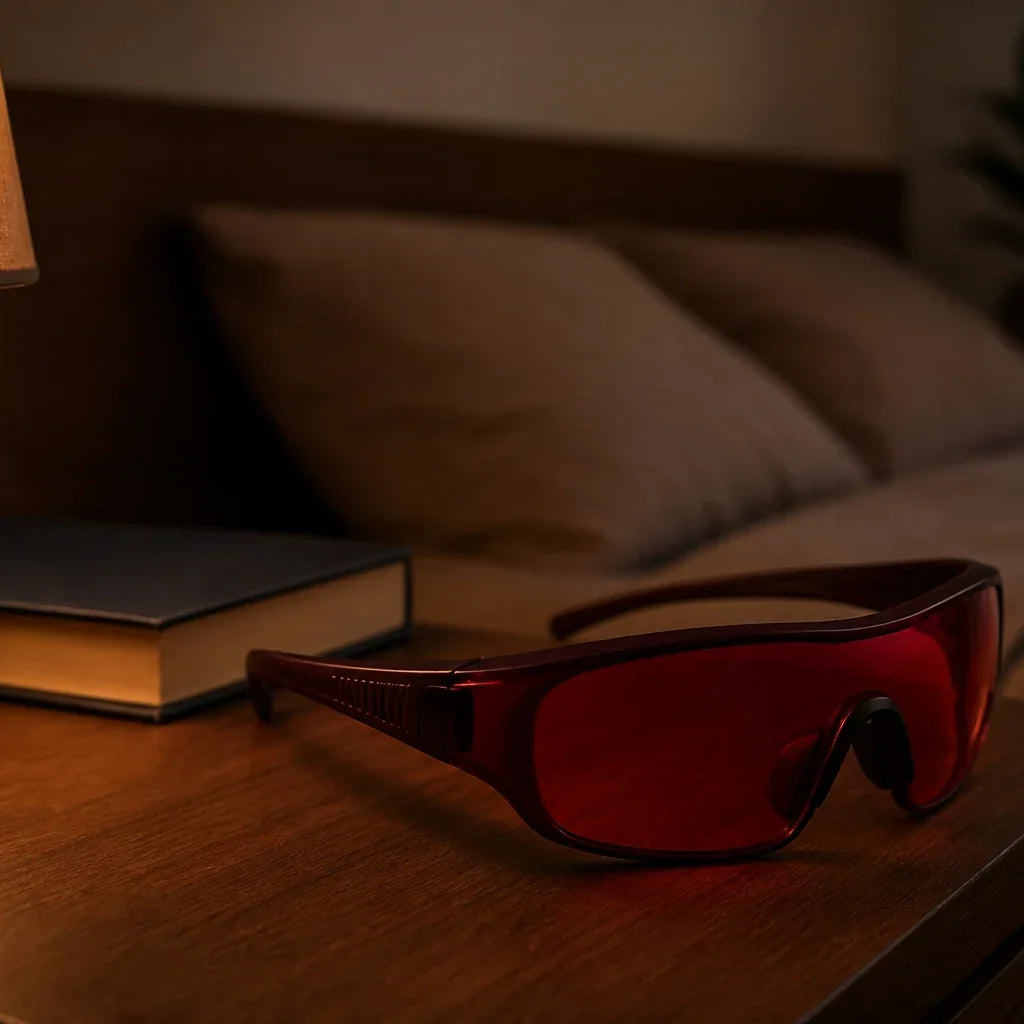
Red glasses for sleep are designed to reduce the amount of short-wavelength light reaching your eyes in the evening. They may be useful when bright screens, overhead lighting, or an irregular schedule makes it difficult to create a darker nighttime environment.
However, the red color of the lens is only a visual clue. It is not a performance specification. Two lenses can look equally red while allowing very different amounts of blue, cyan, green, and yellow light to pass through.
The most useful question is therefore not simply, “Are red glasses good for sleep?” It is:
“Do these glasses meaningfully reduce the evening light I am exposed to, while remaining comfortable and safe enough for the activities I still need to do?”
Do Red Glasses for Sleep Work?
They may help some people create a lower-stimulation evening light environment, but they are not a guaranteed solution for poor sleep.
Small studies have tested amber or blue-blocking glasses for a fixed period before bedtime and reported improvements in some self-reported or activity-based sleep measures. At the same time, broader reviews have found that the results are inconsistent and that the overall evidence remains limited.
This mixed result makes sense because “blue-blocking glasses” is not one standardized product. Studies may use different:
- lens colors;
- spectral cutoffs;
- wearing times;
- room-light conditions;
- screen habits;
- participant groups; and
- ways of measuring sleep.
A nearly clear office lens that reduces a small portion of blue light is not equivalent to a deep red lens that blocks most blue and green light. Placing both products in the same category can make research conclusions sound more contradictory than they really are.
| Question | Practical answer |
|---|---|
| What do red glasses do? | They reduce selected shorter wavelengths reaching the eyes, depending on the lens. |
| Are red lenses always stronger than amber lenses? | Often, but not always. The measured transmission curve matters more than the visible color. |
| When should they be worn? | During a consistent evening window before the intended bedtime, based on the product information and personal routine. |
| Do they replace dim lighting? | No. They work best as part of a lower-light evening environment. |
| Can they be worn while driving? | Dark, strongly color-distorting lenses should not be used for driving or other safety-critical tasks. |
| Does a darker lens always work better? | No. A darker lens may block more light but may also be uncomfortable, impractical, or unsafe for some activities. |
| What is the best proof of performance? | A model-specific spectral transmission chart from an identifiable test method. |

What Red Sleep Glasses Actually Do
Light entering the eyes helps the body distinguish daytime from nighttime. The effect depends on more than whether the light looks blue or white. Timing, brightness, duration, distance, spectrum, and previous light exposure all matter.
Red sleep glasses attempt to change one part of that equation: the spectrum of the light reaching the eyes.
Depending on the lens, the glasses may reduce:
- violet light;
- blue light;
- blue-green or cyan light;
- some green light; and
- the total amount of visible light entering the eyes.
A deep red lens usually allows longer red wavelengths to pass while reducing much of the shorter visible spectrum. An amber lens normally allows more green and yellow light through, making the surroundings easier to see but providing less aggressive filtering.
They do not add red light
Red glasses are sometimes confused with red-light devices. They do not shine red light into the eyes and should not be described as a form of red light therapy.
The lens works mainly by filtering incoming environmental light. The world appears red because shorter wavelengths have been reduced, leaving a greater proportion of longer-wavelength light to reach the eyes.
They do not make bright light irrelevant
A red lens may reduce selected wavelengths, but a very bright environment can still deliver substantial light through the lens.
For example, wearing sleep glasses under bright ceiling fixtures is not necessarily equivalent to sitting in a dim room with a small warm lamp. Total brightness still matters.
My practical view: glasses should support a dim-light routine, not become an excuse to keep every screen and ceiling light at full brightness.
Why Lens Color Is Not a Reliable Specification
A lens can look red because it transmits mostly red light, but visual appearance alone cannot show exactly where the filtering begins or how complete it is.
Two red-looking lenses may differ in several ways:
- one may block nearly all blue and green light;
- one may block blue but allow substantial green light;
- one may reduce the full visible spectrum without a sharp cutoff;
- one may be dark mainly because of a neutral tint; or
- one may have uneven performance across different parts of the lens.
The same problem applies to amber and orange lenses. A darker orange lens may block more short-wavelength light than a pale yellow lens, but the color name does not tell you the exact percentage.
Why “blocks 99% of blue light” may still be incomplete
A percentage claim needs a wavelength range.
“Blocks 99% of blue light” could mean:
- 99% at one selected wavelength;
- 99% between 400 and 450 nm;
- 99% between 400 and 500 nm;
- an average across a test range; or
- a marketing estimate without a published measurement.
Those are not the same claim.
A useful product page should state:
- the tested wavelength range;
- the percentage transmitted or blocked at each wavelength;
- the model or lens tested;
- the test equipment or laboratory;
- the date or report identifier; and
- whether the chart shows transmission or blocking.
Red vs. Amber Glasses for Sleep
Red and amber lenses are often marketed for the same evening purpose, but they create different tradeoffs between stronger filtering and normal visibility.
| Feature | Deep red lenses | Amber or orange lenses |
|---|---|---|
| Typical filtering | Often blocks most blue and a larger portion of green light | Usually reduces blue light while allowing more green and yellow light through |
| Color distortion | Strong | Moderate |
| Screen appearance | Colors may become difficult to distinguish | Usually easier to read and navigate |
| Room visibility | May be noticeably darker | Generally more practical for routine household tasks |
| Best practical use | A later, lower-activity part of the evening | An earlier evening period when normal visibility is still needed |
| Main drawback | Reduced color recognition and safety | May allow more short-wavelength light through |
When red lenses may make more sense
A deep red lens may be suitable when:
- you are already finished driving and working;
- the room can be kept relatively dim;
- you mainly read, listen to audio, or perform simple low-risk tasks;
- you want stronger filtering than a lightly tinted lens provides; and
- the lens remains comfortable enough to wear consistently.
When amber lenses may be more practical
Amber lenses may be more useful when:
- you still need to move around the house;
- you need to read or use a keyboard;
- deep red lenses feel too dark;
- you are beginning the wind-down period earlier in the evening; or
- strong color distortion makes red lenses difficult to tolerate.
The more practical lens can be the better lens. A product that theoretically blocks more light is not useful when it is so dark or uncomfortable that it stays in a drawer.
Could someone use amber first and red later?
Some people prefer a two-stage routine:
- use amber glasses while finishing ordinary evening activities; and
- switch to deep red glasses during the final lower-light period before bed.
This is a practical strategy rather than a universal requirement. One properly documented and comfortable lens may be enough.
How to Read a Spectral Transmission Chart
A transmission chart is one of the most useful pieces of information a seller can provide. It normally places wavelength in nanometers on the horizontal axis and the percentage of light passing through the lens on the vertical axis.
Transmission and blocking are opposites
If a chart shows transmission:
- 0% means almost none of that wavelength passes through;
- 20% means approximately one-fifth passes through; and
- 100% means nearly all of that wavelength passes through.
If a seller reports blocking, the direction is reversed:
- 100% blocked means approximately 0% transmitted; and
- 80% blocked means approximately 20% transmitted.
This sounds simple, but product pages sometimes switch between blocking and transmission without making the distinction clear.
Look beyond the blue region
A deep red lens may also reduce cyan and green wavelengths. This can be important because a lens that blocks violet and blue but allows most blue-green light through may perform differently from a lens that blocks a broader portion of the visible spectrum.
When reviewing a chart, look across at least the visible range rather than checking only one point such as 450 nm.
Look for the cutoff shape
Some lenses have a sharp cutoff: very little light passes below a certain wavelength, followed by a rapid increase in transmission.
Other lenses have a gradual slope: transmission slowly increases across the blue, green, yellow, and red regions.
Neither shape is automatically better. The key is understanding what the lens actually allows through and whether that balance suits the intended evening activities.
Watch for charts that are too perfect
A credible chart should identify the lens and measurement conditions. Be cautious when:
- the chart has no product or model name;
- the image appears identical across several unrelated brands;
- the axes have no units;
- only a narrow wavelength range is shown;
- the laboratory or instrument is not identified;
- the line looks computer-generated rather than measured; or
- the chart contradicts the visible appearance of the lens without explanation.
When Should You Wear Red Glasses Before Bed?
There is no single wearing time proven to be ideal for every person. Studies and products have used different schedules, often beginning one to three hours before the intended bedtime.
The most sensible starting point is a consistent window that fits the user's evening routine.
For example:
- choose a regular target bedtime;
- begin dimming the room during the final one or two hours;
- put on the glasses at the same time each evening;
- reduce screen and overhead-light brightness; and
- remove the glasses only when entering a dark bedroom or when the product instructions advise.
The exact window matters less than using a schedule consistently enough to evaluate it.
Do they need to be worn all evening?
Not necessarily. Someone who goes to bed at 11 p.m. may not need to wear deep red lenses from sunset onward.
Starting too early can make ordinary evening activities frustrating. It may also reduce adherence because the glasses interfere with work, meals, family time, or color-dependent tasks.
A shorter, repeatable period is often more practical than an ambitious routine that is followed only twice.
Should the timing change on weekends?
Keeping the evening routine and wake time reasonably consistent makes the results easier to interpret. Large changes between weekdays and weekends can introduce another variable.
This does not require a perfectly rigid schedule. It means that glasses are easier to evaluate when bedtime, wake time, and wearing time are not changing dramatically every night.
Are Red Glasses Mainly for Phone and Computer Screens?
No. Screens are only one source of evening light.
In many homes, ceiling fixtures can produce more total light at the eyes than a phone held at low brightness. Bright bathroom mirrors, kitchen lights, televisions, gaming monitors, and decorative lighting can all contribute to the evening environment.
This is why a screen-only strategy may be incomplete.
| Source | Practical adjustment |
|---|---|
| Ceiling lights | Turn off unnecessary fixtures and use lower-positioned lamps |
| Phone | Lower brightness and use the warmer evening display setting |
| Computer monitor | Reduce brightness, use warm display settings, and increase text size if needed |
| Television | Reduce room contrast by using a dim warm lamp rather than a bright ceiling light |
| Bathroom lighting | Avoid very bright mirror lighting immediately before bed when a dimmer option is available |
| Bedroom | Keep it quiet, cool, and dark enough for sleep |
Do phone night modes replace the glasses?
Warm screen settings can reduce some shorter-wavelength output, but they do not control the rest of the room. They also do not necessarily reduce overall brightness enough on their own.
Glasses have the advantage of filtering multiple light sources at the same time. Screen settings have the advantage of preserving normal color vision outside the device.
They can be used together, but neither should distract from the simpler step of lowering unnecessary brightness.
Can I keep using my phone for hours while wearing them?
The glasses may change the light reaching your eyes, but they do not remove every other reason late-night phone use can keep someone awake.
Content can still be:
- emotionally stimulating;
- work-related;
- socially engaging;
- stressful;
- designed for continuous scrolling; or
- a reason to delay bedtime.
Light filtering cannot turn an alerting activity into a relaxing one.
My practical rule: use the glasses to support the decision to wind down, not to extend screen time indefinitely.
Who May Find Red Sleep Glasses Most Useful?
The glasses may be most practical for people who cannot easily control all of their evening lighting.
Examples include people who:
- share a brightly lit home with other family members;
- need to use a computer during part of the evening;
- work late but want a clear transition into a wind-down routine;
- travel frequently between unfamiliar lighting environments;
- finish a late shift and need to reduce light exposure afterward;
- live in a small space where screens and lights are difficult to avoid; or
- find it easier to follow a routine when putting on the glasses acts as a clear evening cue.
The last point is often overlooked. The glasses may be useful partly because they create a behavioral boundary: once they go on, bright work, overhead lighting, and stimulating activities begin to wind down.
Who may notice little difference?
The glasses may add little value when someone already:
- uses very dim evening lighting;
- stops screen use well before bed;
- maintains a consistent schedule;
- sleeps well without them; or
- cannot tolerate the color distortion.
A product does not need to be useful for everyone to be useful for someone. It simply should not be marketed as a universal answer.
When Should Red Sleep Glasses Not Be Worn?
Deep red lenses can substantially change brightness, contrast, and color recognition. They should not be used when accurate vision is important for safety.
Avoid wearing strongly tinted sleep glasses while:
- driving;
- cycling on public roads;
- operating tools or machinery;
- walking in poorly lit or unfamiliar areas;
- using stairs when visibility is reduced;
- cooking with open flames or sharp tools;
- reading warning lights or color-coded displays;
- performing color-sensitive work; or
- supervising an activity where rapid visual recognition is required.
Why color recognition matters
Deep red lenses can make blue and green objects appear extremely dark. This may affect the ability to distinguish:
- traffic signals;
- indicator lights;
- warning labels;
- food appearance;
- skin color changes;
- electrical wiring colors; and
- information displayed on a screen.
A product sold for bedtime use should not be assumed to be suitable for driving simply because it resembles ordinary eyewear.
What if the glasses cause discomfort?
Stop using the glasses if they consistently cause:
- headaches;
- eye discomfort;
- dizziness;
- nausea;
- difficulty moving safely; or
- unusual visual effects that continue after removal.
A darker lens is not automatically better when it makes the routine unpleasant or unsafe.
How to Run a Simple Personal Test
Because individual results vary, a structured personal comparison is more useful than judging the glasses after one night.
Step 1: Keep the schedule stable
Choose a period when bedtime, wake time, caffeine intake, and work demands are reasonably consistent.
Step 2: Record a baseline
For approximately one week before using the glasses, record:
- when you went to bed;
- approximately how long it took to settle;
- how often you remember waking;
- when you got out of bed;
- how rested you felt in the morning;
- late caffeine or alcohol use; and
- unusual stress, travel, or illness.
Step 3: Use one consistent wearing window
Wear the glasses at the same approximate time for another one or two weeks. Keep room lighting and screen habits as consistent as reasonably possible.
Step 4: Do not change everything at once
If you simultaneously begin exercising, stop caffeine, buy blackout curtains, change bedtime, and wear the glasses, you will not know which change mattered.
It is fine to build a complete evening routine, but evaluate the overall routine rather than claiming that the glasses alone produced the difference.
Step 5: Judge practical value, not perfection
At the end of the test, ask:
- Was the routine easy to maintain?
- Did I feel more ready to wind down?
- Did my bedtime become more consistent?
- Did I notice fewer evenings of staying alert under bright light?
- Were the glasses comfortable?
- Did color distortion interfere with normal activities?
- Would I continue using them without forcing myself?
A modest improvement from an easy routine may be more valuable than a larger theoretical effect from glasses that are never worn.
How to Choose Red Glasses for Sleep
| Check | What useful information looks like | Warning sign |
|---|---|---|
| Spectral data | A wavelength-by-wavelength transmission chart | Only “blocks blue light” with no test range |
| Lens identity | The report names the exact model or lens | One generic chart reused for every product |
| Visible light transmission | The seller explains how dark the lens is overall | No indication of how much visibility is reduced |
| Lens color | Red or amber selected for a clear evening use case | Color alone is presented as proof of performance |
| Frame coverage | A frame that reduces direct and side light without causing discomfort | Large gaps around the sides when coverage is a key selling point |
| Fit | Measurements for lens width, bridge, temple length, and frame width | One-size claims with no dimensions |
| Prescription-glasses compatibility | Clear over-glasses dimensions or a clip-on design | Product photos show layering but no actual measurements |
| Safety guidance | Warnings against driving and low-visibility activities | The glasses are presented as suitable for every evening task |
| Return policy | Enough time to assess fit, tint, and routine compatibility | No return once the package is opened |
Do wraparound frames work better?
A wraparound frame can reduce light entering from the sides, especially in a bright room. This may be useful when ceiling fixtures or surrounding screens remain visible outside a small lens.
However, wraparound coverage can also create:
- pressure near the temples;
- fogging;
- heat around the eyes;
- difficulty fitting over prescription glasses; or
- a more enclosed feeling.
Coverage matters only when the frame remains wearable.
Can red sleep glasses fit over prescription glasses?
Some products use an over-glasses frame, while others offer clip-on lenses or prescription options.
Check the internal frame width and height rather than relying on a product photo. A pair that touches the prescription lenses, presses on the temples, or slides down the nose is unlikely to become part of a nightly routine.
Are expensive glasses necessarily better?
No. Price does not guarantee better spectral performance.
A more expensive product may offer:
- better optical clarity;
- lighter frames;
- more durable coatings;
- verified test reports;
- prescription options;
- replaceable components; or
- a better return policy.
Those features may justify the cost, but a high price and premium-looking case do not replace model-specific transmission data.
Common Marketing Claims to Treat Carefully
“Blocks 100% of blue light”
Ask which wavelengths were tested. A complete percentage without a defined range is incomplete.
“Scientifically proven sleep glasses”
Check whether the research tested the exact lens or merely a similar amber or red product. Findings from one lens should not automatically be transferred to every product with the same color.
“Increases melatonin”
Light exposure can influence evening biological signaling, but a product should not promise a specific hormonal change without model-specific evidence and clearly defined conditions.
“Works from the first night”
Some users may notice an immediate change in how calm or dark the evening feels. That is not the same as proving a reliable change in sleep after one night.
“Use your phone as much as you want”
Filtering light does not remove the mental stimulation, delayed bedtime, notifications, or emotional content associated with late-night screen use.
“Red lenses are always better than amber”
Red lenses may filter a broader range, but amber lenses may be easier to wear consistently. The best option depends on the transmission curve and intended activity.
My Practical Take
I would consider red or amber sleep glasses when evening light is difficult to control and the glasses make it easier to create a clear wind-down period.
I would not buy them based only on the lens color, a vague blocking percentage, or dramatic claims about hormones and instant sleep.
The best product is usually the one that provides:
- a credible transmission chart;
- a lens strength suited to the user's evening activities;
- comfortable coverage;
- clear warnings about driving and visibility;
- a practical return policy; and
- a routine simple enough to repeat.
I would also spend money on the lighting environment before buying several pairs of glasses. A dimmable bedside lamp, lower screen brightness, a regular bedtime, and a dark bedroom may have more practical value than using strong red lenses under bright ceiling lights.
Red glasses can be a useful tool. They should not become the entire strategy.
Frequently Asked Questions
Are red glasses good for sleep?
They may help some people reduce evening short-wavelength light exposure and create a clearer wind-down routine. Results vary, and the glasses work best alongside lower room brightness and consistent sleep habits.
Are red glasses better than blue-light glasses?
“Blue-light glasses” describes a broad category. Some are nearly clear and filter very little visible light, while deep red lenses may block most blue and part of the green region. Compare the actual transmission charts rather than the product names.
Are red or amber glasses better before bed?
Red lenses often provide stronger filtering but greater color distortion. Amber lenses usually preserve more visibility and may be easier to wear earlier in the evening. Neither is universally better.
How long before bed should I wear red glasses?
Many routines begin approximately one to three hours before the intended bedtime, but there is no universal schedule. Choose a consistent window that matches the product information and your evening routine.
Can I wear them only while using my phone?
You can, but room lighting may also be an important source of evening exposure. The glasses are more useful when the entire environment is considered.
Do red glasses block all blue light?
That depends on the lens. A red appearance does not prove complete blocking. Review a wavelength-specific transmission report.
Do they also block green light?
Some deep red lenses block much of the green region, while amber lenses normally allow more green light through. The exact result should be visible on the transmission chart.
Can I wear red sleep glasses while watching television?
They can be worn while watching television when visibility remains adequate and the activity is not safety-critical. Lowering screen and room brightness is still sensible.
Can I drive while wearing red sleep glasses?
Strongly tinted red or amber sleep glasses should not be worn while driving. They can reduce overall visibility and make important signal colors difficult to distinguish.
Why do red glasses make blue objects look black?
The lenses reduce much of the blue light reflected from those objects. With little blue light reaching the eyes, the objects may appear very dark.
Do red glasses need to be very dark?
No universal darkness level is required. A darker lens may block more total light but may also reduce comfort and safety. Spectral performance is more informative than darkness alone.
Do clear blue-light glasses help with sleep?
Some clear lenses reduce a small portion of shorter-wavelength light, but they generally do not create the same filtering as deep amber or red lenses. Evidence for broad sleep benefits from lightly filtering lenses remains uncertain.
Can I use a phone camera to test the lens?
A phone camera is not a calibrated spectrometer. It may show a visible color change but cannot accurately confirm the wavelengths or percentages being blocked.
Can I test the glasses with a blue flashlight?
A colored flashlight may provide a basic visual demonstration, but it cannot replace a full transmission chart. The flashlight itself may emit a broad range of wavelengths.
Should children wear red sleep glasses?
Do not automatically apply an adult routine to a child. Fit, visibility, bedtime habits, screen use, and ongoing sleep concerns should be considered with an appropriate professional.
Can shift workers use red glasses?
Light-blocking glasses may be useful in some shift-work routines, particularly when reducing bright light after work or during travel home. Timing is important because shift workers may need bright light at other points to remain alert.
What if I still cannot sleep?
Glasses cannot address every reason for ongoing sleep difficulty. Seek qualified guidance when problems continue despite allowing enough time for sleep, or when there is loud snoring, breathing pauses, severe daytime sleepiness, or another persistent concern.
The Bottom Line
Red glasses for sleep are light-filtering tools, not automatic sleep switches. They may help reduce evening exposure to selected shorter wavelengths, especially when bright screens or room lighting cannot be fully avoided.
The lens color alone does not show how well the glasses perform. Look for a model-specific spectral transmission chart, clear information about total visibility, comfortable frame coverage, and appropriate safety warnings.
Deep red lenses generally provide stronger filtering but greater color distortion. Amber lenses may be easier to use during ordinary evening activities. The best choice is the lens that provides meaningful filtering without making the routine uncomfortable or unsafe.
Most importantly, use the glasses as one part of a broader evening routine: dim unnecessary lights, lower screen brightness, keep bedtime reasonably consistent, and maintain a dark, quiet sleeping environment.
This article is provided for general educational purposes. It does not promise a particular sleep outcome or replace individualized professional guidance.
Sources and Further Reading
- Randomized crossover study of amber lenses used before bedtime
- Systematic review of evening blue-blocking glasses and sleep-related outcomes
- Cochrane review of blue-light filtering spectacle lenses
- Randomized crossover study in healthy adults
- National Institute of General Medical Sciences: Circadian Rhythms
- National Heart, Lung, and Blood Institute: Healthy Sleep Habits
- National Heart, Lung, and Blood Institute: Managing Light Exposure and Sleep-Wake Schedules
Continue reading