Red light therapy encyclopedia
Knee Massager With Red Light Therapy: Heat, Vibration or PBM?
Learn how to compare knee massagers that combine red light, heat, vibration, or compression without treating unlike features and clinical PBM evidence as interchangeable.
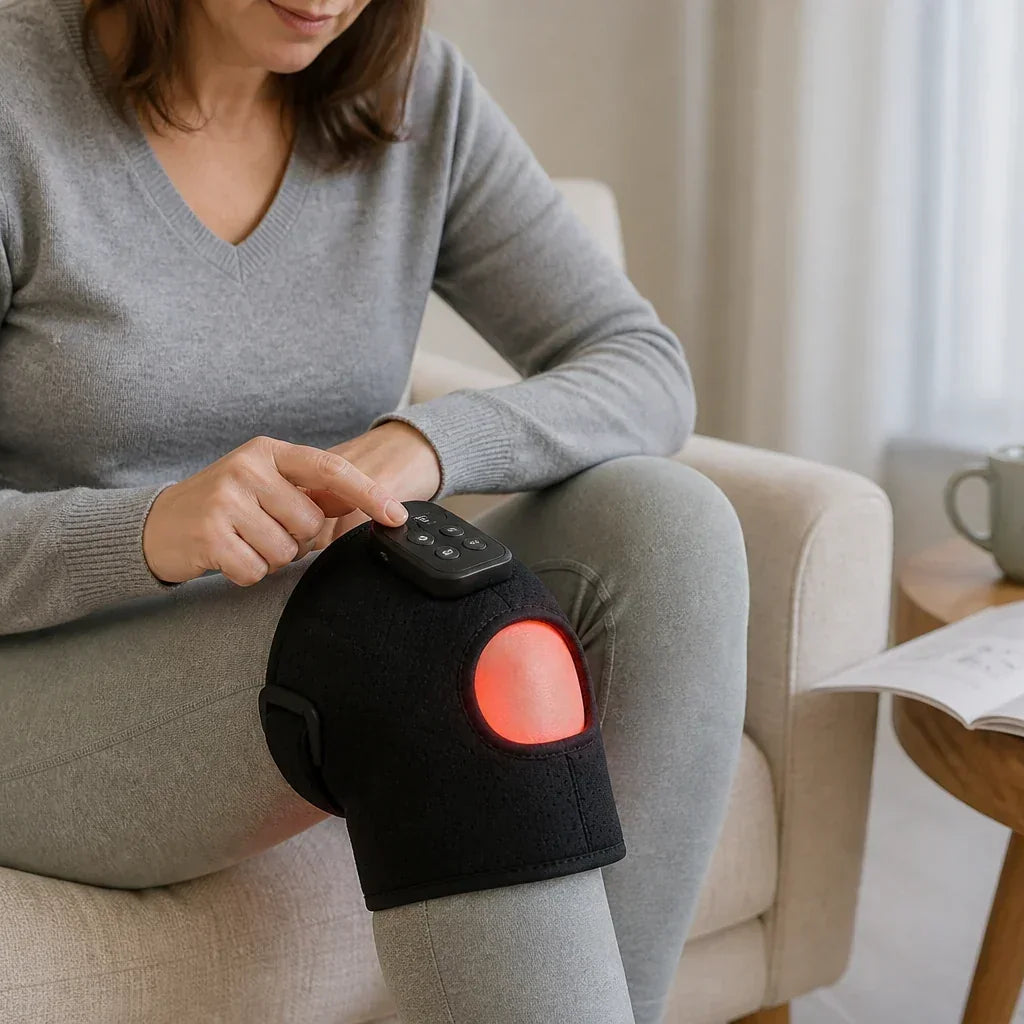
A knee massager with red light therapy can be convenient, but the label often bundles three separate features: photobiomodulation, heat, and vibration or compression. The best choice is not the wrap with the longest benefit list. It is the one that identifies each mode, fits without excessive pressure, provides a usable manual, and makes claims that match the exact device. Clinical photobiomodulation research for knee osteoarthritis cannot automatically validate a retail massager with unknown wavelength, output, or placement.
Commercial disclosure: Yamuri sells red and near-infrared light devices. This guide uses model-neutral comparison criteria and does not assume a Yamuri product is suitable for every use discussed.
Quick Q&A: What Most People Want to Know First
| Question | Short answer | My practical note |
|---|---|---|
| Is the red glow the same as therapeutic heat? | No. Light and heat are separate inputs even when a device combines them. | Look for independent controls and specifications. |
| Does vibration prove deeper treatment? | No. | Vibration may change comfort, but it does not establish a light dose. |
| Does PBM research prove a massager works? | No. Trials use specific devices and protocols. | Match the retail model to the evidence before extrapolating. |
| Is hotter better? | No. | Heat should remain within the manual's safe range and feel tolerable. |
| Should a brace be tight? | Secure is not the same as restrictive. | Numbness, color change, or worsening pain is a stop signal. |
| Can it replace a knee evaluation? | No. | New injury, locking, instability, marked swelling, or severe pain needs appropriate assessment. |

What Current Listings Actually Sell
Current US search results are dominated by retailer and marketplace pages for rechargeable wraps that combine red light with heat, vibration, or air compression. Product pages emphasize convenience and relief, but many omit the wavelength, optical output, measurement distance, or regulatory basis for the claimed use. They may also call ordinary resistance heating "infrared" or use the red color of an indicator as proof of photobiomodulation.
That makes the first task classification, not ranking. Determine which function you are paying for and whether it can be evaluated independently.
Separate the Three Main Functions
| Feature | What to verify | What it does not prove |
|---|---|---|
| Red or near-infrared light | Wavelength, emitter type, output conditions, active area, timer | Pain relief or tissue repair for this model |
| Heat | Temperature range, sensor, automatic shutoff, skin-contact limits | Photobiomodulation or safe use with impaired sensation |
| Vibration | Intensity levels, location, noise, independent control | Compression, circulation treatment, or joint stabilization |
| Air compression | Pressure levels, release behavior, fit range | Suitability for vascular conditions or acute swelling |
| Brace structure | Strap placement, range of motion, slipping, cleaning | Medical support equivalent to a prescribed brace |
What Knee Photobiomodulation Research Can Tell Us
A 2024 systematic review and meta-analysis included 10 placebo-controlled studies with 542 participants with knee osteoarthritis. It reported a reduction in pain at rest, but rated the certainty very low and found no significant improvement in the Timed Up and Go test. An earlier 2019 meta-analysis of 22 trials reported pain and disability improvements when certain laser doses were used, while other reviews have reached less favorable conclusions.
The disagreement is useful. It shows why a retail listing cannot borrow the word "clinically proven" from the category. Wavelength, energy per treatment spot, number of sessions, participant diagnosis, co-treatment, and device geometry vary. A wrap with undocumented LEDs, heat, and vibration may feel soothing, but that experience is not the same as reproducing a clinical laser protocol.
| Evidence layer | Reasonable conclusion | Unsafe leap |
|---|---|---|
| PBM meta-analysis | Selected protocols may affect selected knee outcomes | Every glowing knee massager treats osteoarthritis |
| One randomized trial | The tested device and schedule deserve study-specific consideration | Matching wavelength alone creates an equivalent device |
| Heat comfort | Warmth may feel soothing for some users | More heat repairs cartilage or is safe for everyone |
| Vibration preference | A user may prefer the sensation | Vibration establishes clinical efficacy |
| Marketplace reviews | Can reveal fit, noise, battery, and durability problems | Can diagnose or prove a treatment effect |
Evaluation Method: A Defensible Buying Checklist
| Decision area | Strong evidence | Weak substitute |
|---|---|---|
| Fit | Thigh and calf circumference range, strap map, seated-use photos | "One size fits all" |
| Light | Exact wavelengths, active area, timer, measurement conditions | Red color or LED count |
| Heat | Actual temperature settings, sensors, shutoff, warnings | Low/medium/high without temperatures |
| Controls | Each mode can be selected independently | One combined program with no disclosure |
| Safety | Contraindications, stop-use guidance, cleaning, battery care | "Safe for all ages" |
| Ownership | Manual, warranty labor, return window, replacement charger | Discount countdown |
Test the workflow before the feature list. Can you place it without twisting the knee? Are controls readable? Does the device stay positioned without overtightening? Can the liner be cleaned? Is the battery replaceable or supported? These details often determine whether the product is used after the first week.
Safety Boundaries and Stop Signals
Do not use a home massager to self-manage a new traumatic injury, suspected clot, infection, unexplained warmth and swelling, a locked or unstable knee, severe pain, or symptoms that are worsening. Heat and compression deserve extra caution when sensation, circulation, skin integrity, or swelling is impaired. Follow the exact manual and seek qualified guidance when a health condition, implant, medicine, recent surgery, or pregnancy changes the risk discussion.
FDA home-device guidance recommends reviewing instructions before choosing a device and considering the user's capabilities, power requirements, cleaning, support, and reliable source. A clear manual is therefore part of the product, not optional paperwork.
What I Would Actually Prioritize
I would buy for fit and controllability before intensity. Independent mode controls let a user discover whether heat, vibration, or the physical wrap is creating comfort without attributing everything to light. I would also choose a seller that provides the manual before purchase.
I would not pay a premium for a wavelength number unless the company discloses the rest of the exposure conditions and makes a model-specific claim. The biggest number is not automatically the most useful one.
Frequently Asked Questions
Is a knee massager with heat and red light better than red light alone?
It may be more comfortable or convenient, but combining modes makes it harder to know which feature contributes. Better depends on fit, controls, intended use, and evidence for the exact model.
What wavelength should a knee device use?
Knee PBM studies use varied red and near-infrared laser parameters. Wavelength alone cannot define an effective consumer protocol. Request complete model documentation.
How tight should the straps be?
Follow the fit instructions. Stop if you notice numbness, tingling, color change, increased swelling, or worsening pain.
Can I use the device after knee replacement?
Do not assume routine consumer use is appropriate after surgery or with an implant. Ask the treating team and provide the exact manual and model details.
Can I use red light and heat at the same time?
Only if the exact device is designed and instructed for combined use. Do not improvise by stacking separate devices or trapping heat.
Does vibration improve circulation?
A seller should not convert a general sensation claim into treatment for a vascular problem. Vascular symptoms require appropriate evaluation.
How long should one session last?
Use the manual-defined time. Copying a laser-trial schedule to a retail wrap with different output is not evidence-based.
What should I do if the massager makes pain worse?
Stop using it and follow the manual's adverse-reaction guidance. Seek qualified assessment when pain is significant, persistent, or accompanied by swelling, instability, redness, or systemic symptoms.
Related Yamuri guide: For broader setup and safety context, see how to approach red light therapy at home.
Sources and Further Reading
- 2024 systematic review and meta-analysis of photobiomodulation for knee osteoarthritis
- Systematic review of dose and low-level laser therapy in knee osteoarthritis
- 2025 randomized controlled trial of photobiomodulation for symptomatic knee osteoarthritis
- FDA questions and safety considerations for home-use devices
Editorial Standards and General Information
This article separates general PBM research from exact-product documentation. Regulatory records and clinical trials apply only to the devices, diagnoses, and intended uses named in those sources; they are not automatically applied to Yamuri or a retail knee massager. The content supports consumer education and specification literacy, not diagnosis or personalized treatment. Follow the exact manual and seek qualified guidance for injury, persistent pain, swelling, impaired sensation or circulation, recent surgery, implants, or other individual risks.
Continue reading