Red light therapy encyclopedia
650 nm Red Light Therapy: Uses, Evidence, and Device Basics
650 nm sits within the red-light range commonly used for photobiomodulation. Some human studies have evaluated red or mixed red and near-infrared light for skin appearance and other outcomes, but evidence for one exact wavelength cannot automatically be transferred to every product or health claim.
650 nm is a visible deep-red wavelength used in some red light therapy devices. It sits within the red portion of the visible spectrum, close to other commonly listed wavelengths such as 630 nm and 660 nm.
However, a “650 nm” label tells you only where the light sits on the spectrum. It does not tell you how much light reaches the user, how evenly the device covers an area, how long it should be used, or whether it was designed for your particular goal.
For most shoppers, the practical answer is simple:
- 650 nm is visible red light, not near-infrared.
- 650 nm and 660 nm are close neighboring wavelengths.
- The 10 nm difference usually matters less than the complete device design.
- A brighter-looking device is not automatically stronger or better.
- Wavelength, output, distance, coverage, and session time must be considered together.
650 nm Red Light Therapy: Quick Answers
| Question | Practical answer |
|---|---|
| Is 650 nm visible? | Yes. It appears as deep red light to the human eye. |
| Is 650 nm near-infrared? | No. Near-infrared begins beyond the visible red region. |
| Is 650 nm the same as 660 nm? | No, but they are close neighboring wavelengths and may overlap within the output range of real LEDs. |
| Is 650 nm better than 660 nm? | Not automatically. Output, coverage, device format, and intended use usually matter more than the 10 nm difference. |
| Does 650 nm penetrate deeply? | It interacts with tissue differently from shorter visible wavelengths, but there is no universal penetration depth. |
| Does brightness show device output? | No. Visible brightness is influenced by the spectrum, optics, beam angle, and human vision. |
| Is electrical wattage the same as optical output? | No. Electrical wattage includes energy used by LEDs, electronics, fans, and heat losses. |
| What is the most useful device specification? | No single number is enough. Check wavelength, irradiance at a stated distance, coverage, mode, session time, and instructions together. |

What Does 650 nm Actually Mean?
The abbreviation nm means nanometer. One nanometer is one billionth of a meter. In a light-device specification, the number identifies the wavelength of the emitted light.
Shorter visible wavelengths include violet, blue, and green. As the wavelength increases, visible light moves through yellow, orange, and red. At 650 nm, the light appears deep red.
Common wavelength labels found on consumer devices include:
- approximately 630 nm for visible red light;
- approximately 650 nm for visible deep-red light;
- approximately 660 nm for visible deep-red light;
- approximately 810 or 830 nm for near-infrared light; and
- approximately 850 nm for near-infrared light.
The boundaries between color categories are not perfectly fixed across every scientific field. That does not create meaningful uncertainty about 650 nm: it sits clearly within the visible red region.
Does a 650 nm LED emit only one exact wavelength?
No. Real LEDs normally emit light across a small band of neighboring wavelengths.
The listed wavelength usually refers to the approximate point where the spectral output reaches its peak. A specification may therefore appear as:
- 650 nm;
- 650 nm ±5 nm;
- 650 nm ±10 nm; or
- peak wavelength: approximately 650 nm.
A tolerance of 650 nm ±10 nm means the peak of individual units may fall somewhere around 640 to 660 nm, depending on the stated specification and manufacturing controls.
The LED's full emission band may extend beyond that peak range. This is one reason two devices labeled 650 nm and 660 nm may be more similar than their product titles suggest.
Why does the light look red?
Unlike 850 nm near-infrared LEDs, 650 nm output is visible to the human eye. A 650 nm device should therefore produce a noticeable deep-red appearance when operating.
Still, visible appearance cannot be used as an accurate output measurement. A device may look brighter because it has:
- a wider beam angle;
- more visible-red LEDs;
- a different lens design;
- greater output concentrated toward the center;
- a broader spectral band; or
- a housing that reflects more light toward the viewer.
Brightness can help confirm that visible LEDs are operating. It cannot tell you the irradiance reaching the skin or compare two products accurately.
650 nm vs. 660 nm: Is There a Meaningful Difference?
650 nm and 660 nm are both visible deep-red wavelengths. They are separated by only 10 nanometers.
They are technically different, but product comparisons often exaggerate the importance of that difference. In a complete consumer device, several other factors can create a much larger practical difference than moving from 650 to 660 nm.
| Property | 650 nm | 660 nm |
|---|---|---|
| Spectrum | Visible deep red | Visible deep red |
| Can humans see it? | Yes | Yes |
| Difference between them | 10 nanometers | |
| Common device formats | Scalp devices, handheld products, bulbs, and some combination systems | Panels, masks, bulbs, handheld products, and combination systems |
| Can the emission ranges overlap? | Yes. LED peak tolerances and spectral width can create overlap. | |
| Which is automatically better? | Neither. The complete device and operating conditions matter more. | |
Why 660 nm appears more often on large panels
Many large red and near-infrared panels are marketed with a 660 nm and 850 nm combination. This pairing has become familiar to shoppers and is widely available from LED suppliers.
Its popularity does not prove that 660 nm is universally superior to 650 nm. It often reflects a combination of:
- component availability;
- existing product designs;
- consumer familiarity;
- supplier manufacturing systems; and
- the popularity of dual-wavelength 660/850 nm panels.
Why 650 nm appears frequently in scalp devices
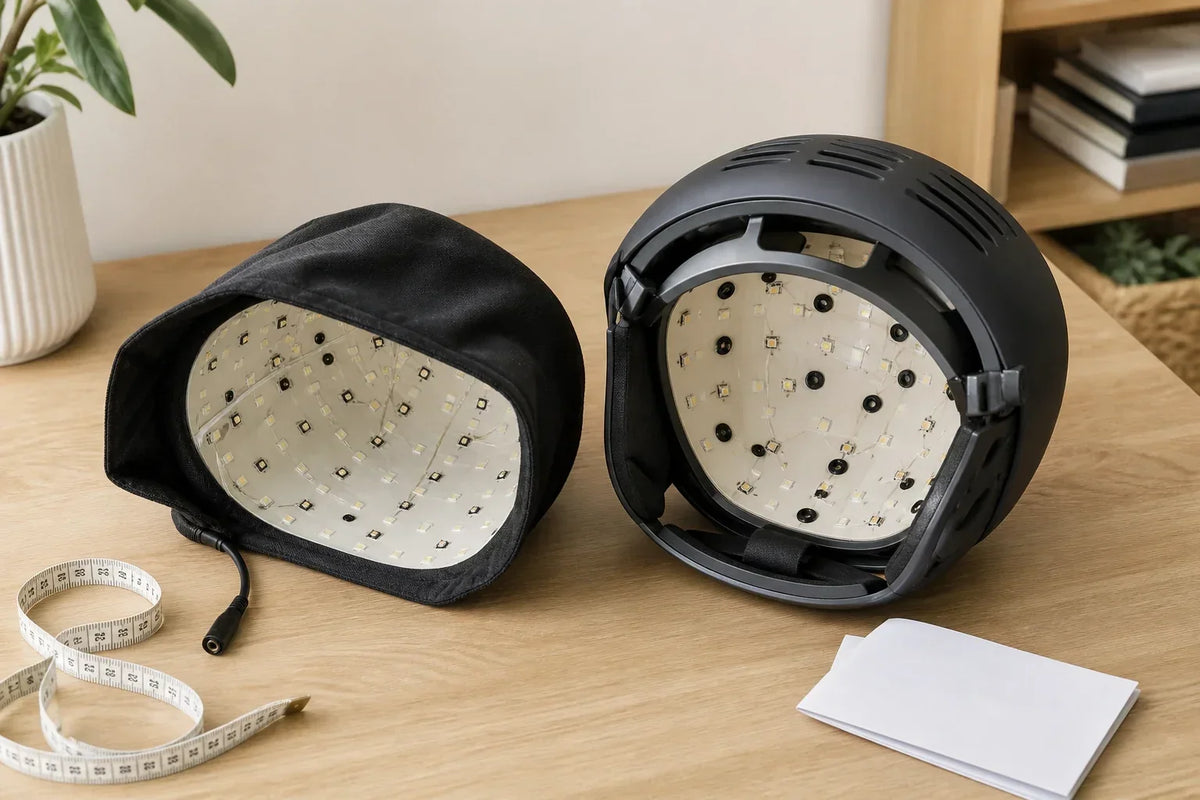
650 nm is commonly listed on certain laser caps, helmets, and comb-shaped devices. In these products, the wavelength is only one part of the design.
The complete device may also specify:
- laser or LED emitter type;
- power per emitter;
- number and spacing of emitters;
- distance from the scalp;
- automatic session time;
- weekly schedule;
- eye precautions; and
- a narrowly defined intended use.
This does not mean that every 650 nm panel, bulb, or handheld light should be treated like a scalp-specific device.
An exact wavelength appearing in one regulated device record does not make the wavelength itself cleared, proven, or suitable for every purpose. The record belongs to the complete model and its defined operating conditions.
Should you choose 650 nm or 660 nm?
For a general red light panel, I would not make the decision based on the 10 nm difference alone.
I would compare the following first:
- measured output at the intended distance;
- coverage across the area you want to illuminate;
- uniformity from the center to the edges;
- red and near-infrared mode controls;
- recommended session time;
- heat and fan noise;
- device positioning; and
- clarity of the instructions.
A well-documented 650 nm device is more useful than a poorly documented 660 nm device, and the reverse is equally true.
650 nm vs. 630 nm and 850 nm
Understanding neighboring wavelengths can make the 650 nm specification easier to interpret.
| Wavelength | Light category | Visible to the eye? | Practical distinction |
|---|---|---|---|
| 630 nm | Visible red | Yes | A somewhat shorter red wavelength frequently found in facial LED products |
| 650 nm | Visible deep red | Yes | A middle point between commonly listed 630 and 660 nm red wavelengths |
| 660 nm | Visible deep red | Yes | Frequently paired with 850 nm in larger consumer panels |
| 830 nm | Near-infrared | No | Invisible output used in some combination light devices |
| 850 nm | Near-infrared | No | Commonly paired with visible red in panels and wearable devices |
650 nm vs. 630 nm
Both are visible red wavelengths. The 20 nm difference may slightly change optical absorption and scattering, but it does not provide enough information to select a device by itself.
A 630 nm facial mask and a 650 nm handheld product may differ more because of their:
- shape;
- distance from the skin;
- beam pattern;
- irradiance;
- coverage;
- session schedule; and
- intended use.
The format and operating conditions often matter more to the user than the wavelength difference.
650 nm vs. 850 nm
The difference between 650 nm and 850 nm is more substantial.
- 650 nm is visible red light.
- 850 nm is invisible near-infrared light.
They also interact differently with skin and tissue because absorption and scattering change across the spectrum.
This is why many devices combine a visible red channel with a near-infrared channel. The combination covers two distinct wavelength regions instead of relying on a single red wavelength.
However, the presence of both wavelengths does not automatically make a device better. The manufacturer should disclose how much output comes from each channel and whether the channels can be controlled separately.
Does a higher wavelength always reach deeper?
No. Wavelength behavior is not a simple ladder where every larger number automatically travels farther and produces a better result.
Optical distribution depends on:
- wavelength;
- skin and tissue composition;
- surface reflection;
- scattering;
- blood and water absorption;
- beam geometry;
- distance;
- coverage area; and
- starting output.
“Deeper” should be treated as a general optical tendency under defined conditions, not as a universal promise.
What Does the Evidence for 650 nm Actually Mean?
Studies of red light do not normally test a wavelength in isolation. They test a complete protocol.
A protocol can include:
- a specific LED or laser device;
- one or more wavelengths;
- measured power or irradiance;
- a fixed distance or contact method;
- a defined session length;
- a weekly schedule;
- a particular body area;
- a selected participant group; and
- a defined method for judging change.
When a study reports a change, the result belongs to that full setup. It should not be shortened into a claim that “650 nm does this” under every condition.
Why nearby-wavelength research still needs context
Controlled studies have examined red and mixed red/near-infrared devices for aspects of skin appearance. FDA records also include exact models using red wavelengths around 630, 640, 650, or 660 nm for narrowly defined purposes.
These records show that several neighboring red wavelengths can be incorporated into legitimate device designs.
They do not establish that:
- every red LED is equivalent;
- every 650 nm device produces the same output;
- results from a mask apply to a panel;
- results from a laser cap apply to a household bulb;
- a higher-powered product is automatically more useful; or
- one study schedule should be copied to an unrelated device.
Why the original cellulite study should not lead the article
A small study involving 650 nm and a narrowly defined measurement does not answer the main consumer question behind this article.
Most users searching for “650 nm red light therapy” want to know:
- whether 650 nm is red or infrared;
- whether it is different from 660 nm;
- what type of device uses it;
- which specifications matter; and
- whether a 650 nm label is enough to trust a product.
A niche outcome from a small study may be scientifically interesting, but presenting it prominently can imply a broad product claim that the research does not support.
For that reason, the more useful article focuses on how to interpret the wavelength and evaluate the device.
650 nm LED vs. 650 nm Laser Devices
650 nm can be produced by both LEDs and low-level laser diodes. Matching wavelengths do not make these products identical.
| Feature | 650 nm LED | 650 nm laser diode |
|---|---|---|
| Light source | Light-emitting diode | Laser diode |
| Beam pattern | Usually spreads across a wider angle | Usually more directional |
| Common format | Panels, masks, bulbs, wraps, and some caps | Combs, caps, helmets, and targeted handheld products |
| Coverage | Can cover a broad area through overlapping LEDs | Depends on diode number, spacing, and beam layout |
| Eye guidance | Still requires model-specific instructions | Laser classification and direct viewing precautions are especially important |
| Are they interchangeable? | No. The same wavelength can be delivered with different power, geometry, coverage, and safety requirements. | |
Does a laser always reach deeper than an LED?
That statement is too broad for a consumer buying guide.
The delivered light depends on the complete optical system, including:
- power per emitter;
- beam divergence;
- distance;
- spot size;
- number of emitters;
- spacing;
- contact with the target area; and
- session time.
A highly directional source and a broad LED array create different exposure patterns. Neither should be judged only by the word “laser” or “LED.”
Why direct eye exposure matters
A visible red laser may not feel painful when viewed briefly, but that does not make direct viewing appropriate.
Follow the exact device's:
- laser classification;
- eye-protection requirements;
- positioning instructions;
- automatic shutoff controls; and
- intended treatment area.
Do not point an unverified 650 nm laser product toward the eyes, and do not assume that a product is suitable for eye-related use merely because some specialized 650 nm devices exist.
How to Compare 650 nm Devices
A useful product page should answer more than “What wavelength does it use?”
| Specification | What it tells you | What to watch for |
|---|---|---|
| Peak wavelength | Where the device's red output is centered | “Red spectrum” with no nanometer value |
| Wavelength tolerance | How much the peak may vary between emitters or production units | An exact-looking number with no tolerance or spectral report |
| Irradiance | Optical power reaching a unit of area | A large number without a measurement distance |
| Operating distance | Where the user is expected to position the device | Measurements taken at the LEDs rather than normal use distance |
| Coverage area | How much area can be illuminated at once | “Full body” without dimensions |
| Uniformity | Whether output is reasonably distributed from center to edge | One maximum center reading |
| Mode information | Whether 650 nm operates alone or with other wavelengths | One combined output number used for every mode |
| Session instructions | Recommended time, frequency, distance, and positioning | “Use as much as desired” |
| Thermal design | How the device manages heat during operation | Warmth presented as proof of better optical output |
| Eye guidance | How to reduce unnecessary direct exposure | No guidance because the light is described as non-UV |
| Model-specific testing | Whether the report belongs to the product being sold | A generic LED supplier report reused across several devices |
What does irradiance mean?
Irradiance describes the amount of optical power reaching a unit of surface area. It is commonly reported in milliwatts per square centimeter, or mW/cm².
An irradiance number is useful only when the test conditions are provided.
Look for:
- measurement distance;
- operating mode;
- instrument type;
- measurement position;
- whether the reading is a maximum or average;
- the size of the measured area; and
- whether the output is continuous or pulsed.
“120 mW/cm²” without this information is not a complete comparison.
Why coverage uniformity matters
A device may produce a high reading directly in front of one LED while delivering much less light between emitters or near the outer edges.
This is especially relevant for small bulbs and handheld products, which may create a concentrated central spot.
A broader panel may improve coverage by allowing neighboring LED beams to overlap, but panel size alone does not guarantee uniformity.
Useful evidence may include:
- measurements at several positions;
- a grid of center and edge readings;
- a coverage map;
- measurements at normal operating distance; or
- an area-average value rather than one peak measurement.
Why wavelength ratio matters in combination devices
A product may advertise 650 nm and 850 nm while using very different numbers or output levels for each wavelength.
For example, a panel could contain:
- equal numbers of red and near-infrared LEDs;
- more red LEDs than NIR LEDs;
- more NIR LEDs than red LEDs;
- multi-chip LEDs containing both wavelengths; or
- different optical power per wavelength channel.
LED count alone does not reveal the optical balance. Ask whether the manufacturer reports separate red-only, NIR-only, and combined-mode measurements.
How Output, Distance, and Time Work Together
A wavelength does not create a complete light-exposure routine. Output, distance, and session time also matter.
Distance changes the exposure
As light travels away from a device, it spreads across a wider area. Irradiance generally decreases, although the exact pattern depends on the size and optical design of the source.
Standing closer may provide:
- higher center irradiance;
- a smaller illuminated area;
- greater differences between bright and dim spots; and
- more noticeable warmth.
Standing farther away may provide:
- lower irradiance;
- broader coverage;
- greater overlap between neighboring LEDs; and
- more even illumination.
Closer is therefore not automatically better. The recommended distance should balance output, coverage, uniformity, and comfort.
How surface exposure is estimated
A simplified surface radiant-exposure calculation is:
Radiant exposure (J/cm²) = irradiance (W/cm²) × time in seconds
For example, if a device provides a measured irradiance of 30 mW/cm²:
30 mW/cm² = 0.030 W/cm²
Used for 600 seconds:
0.030 W/cm² × 600 seconds = 18 J/cm²
This is a calculated surface value. It does not tell you how much light reaches a particular depth or establish a recommended amount for every use.
The calculation is also only as reliable as the original irradiance measurement. A marketing number measured under unclear conditions cannot produce a trustworthy exposure estimate.
Does more time produce a better result?
Not automatically.
Longer use increases calculated surface exposure when irradiance remains stable, but that does not prove that extending every session will improve the user experience or cosmetic outcome.
It may instead increase:
- warmth;
- skin discomfort;
- eye exposure;
- time burden; and
- the chance that the routine will be abandoned.
Follow the instructions for the exact model rather than building a schedule from the wavelength alone.
650 nm Bulbs, Handheld Devices, Caps, and Panels
The same wavelength can appear in several device formats. Format affects coverage and routine more directly than many shoppers expect.
| Format | Main advantage | Main limitation |
|---|---|---|
| Bulb-shaped device | Compact and relatively simple | Small or uneven coverage and requires a suitable fixture |
| Handheld wand | Easy to position over a small area | Requires manual movement and longer routines for larger areas |
| Scalp cap or helmet | Fixed placement over the intended area | Designed around a narrow, model-specific purpose |
| Comb-style laser device | Can separate hair while positioning emitters near the scalp | Requires careful movement and exact instructions |
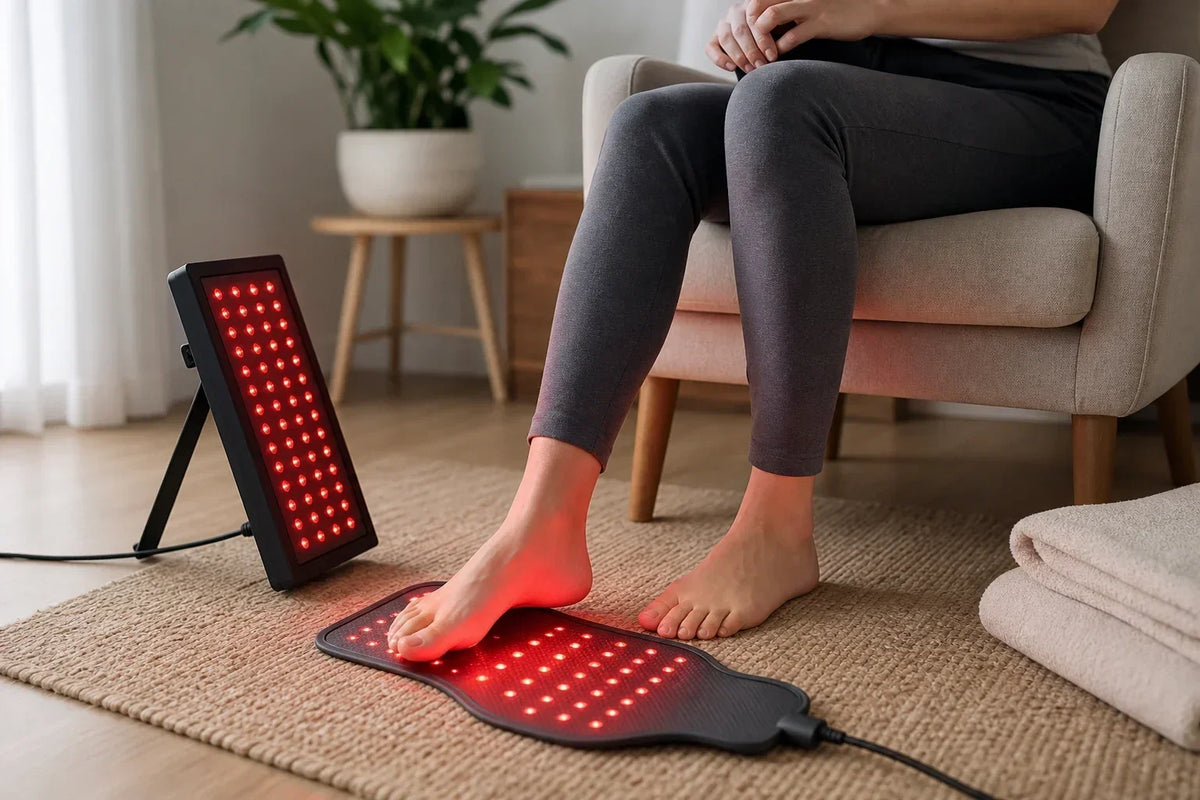
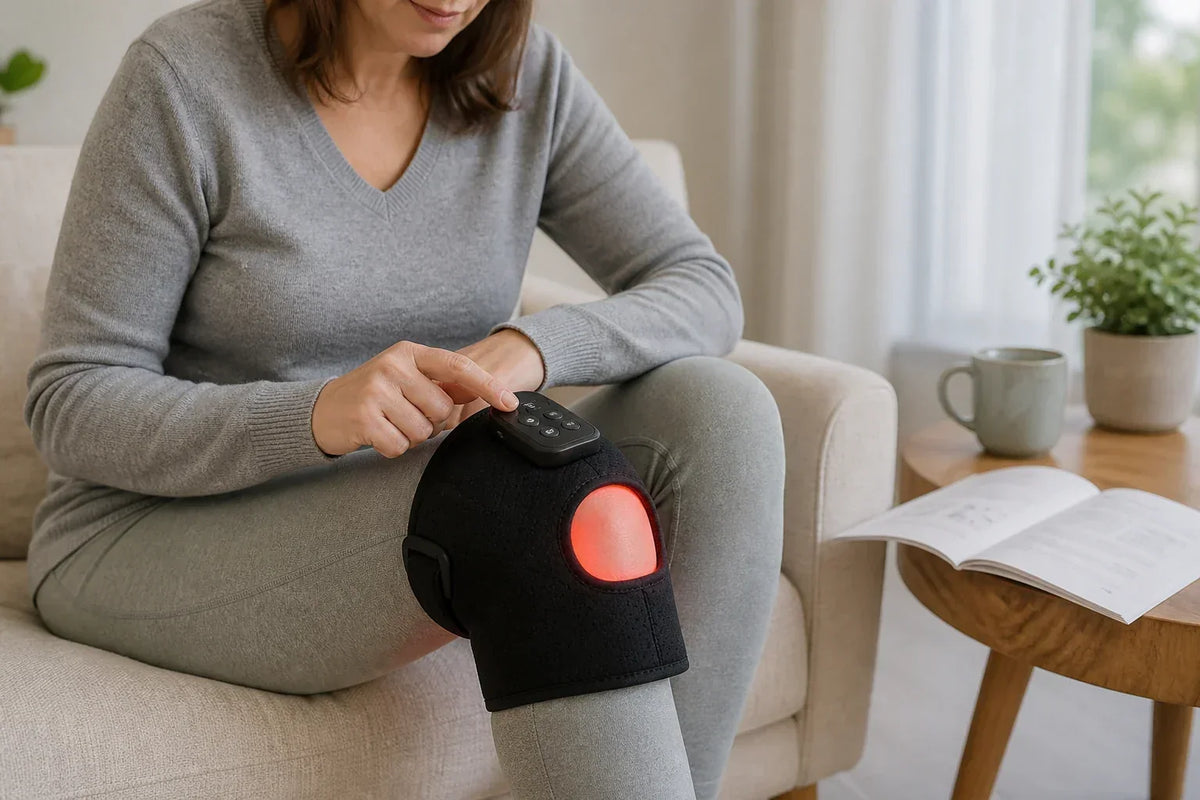
| Wearable wrap | Maintains a relatively fixed distance around a body area | Fit, heat, and emitter spacing can vary |
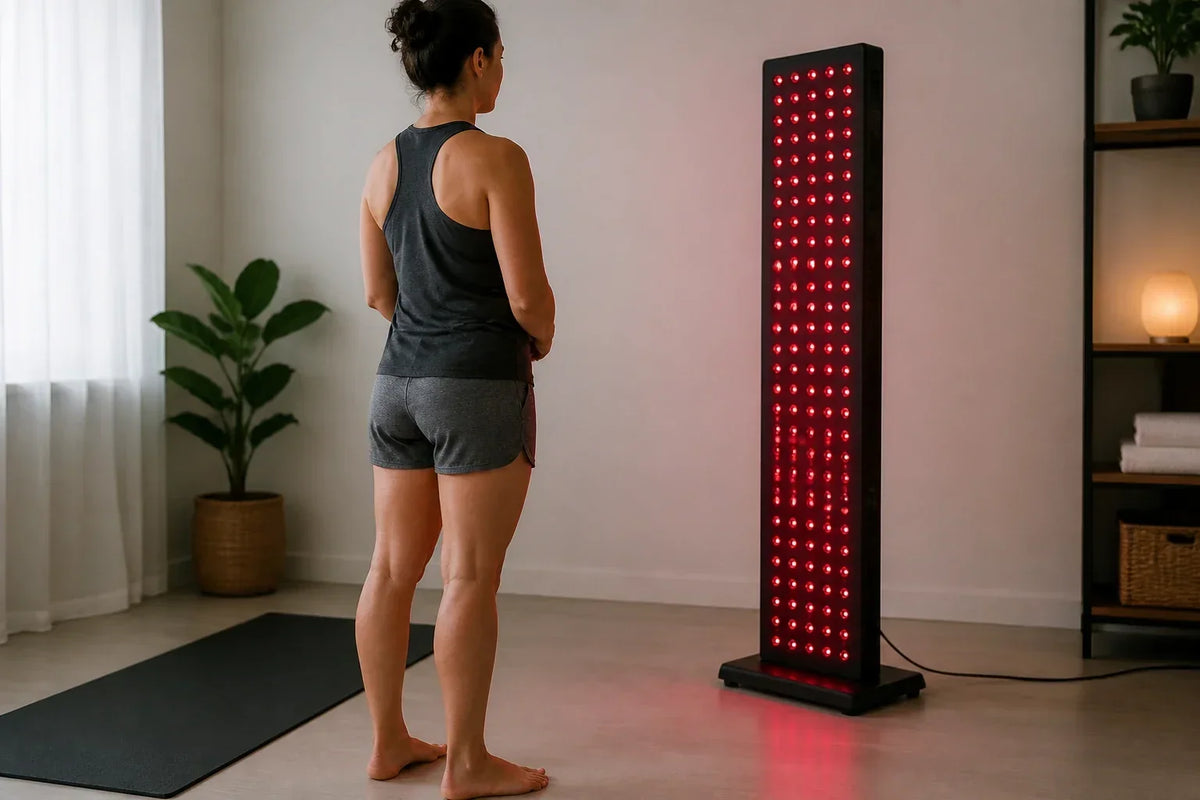
| Large panel | Broader coverage and hands-free use | Requires space, positioning, and a suitable distance |
Is a 650 nm bulb enough for a large area?
A bulb may make a large part of a room look red, but visible room illumination does not prove that the optical output is strong or uniform across the full area.
A single bulb is usually more appropriate for:
- a small targeted area;
- travel;
- limited storage space;
- a simple entry-level routine; or
- someone who does not need broad coverage.
For several body areas, repeatedly repositioning a bulb can make the routine longer and less consistent than using a larger panel.
Is a cap better than a panel for the scalp?
A cap provides fixed positioning and places emitters around the scalp. A panel is more flexible but may be partially blocked by hair and requires the user to maintain a consistent angle and distance.
This does not mean every cap is better. Compare:
- emitter type;
- wavelength tolerance;
- coverage pattern;
- fit;
- session time;
- eye guidance;
- heat and comfort; and
- model-specific intended use.
650 nm Red Light Device Buying Checklist
Before purchasing, try to answer each of the following questions.
-
Is the wavelength actually documented?
Look for 650 nm with a tolerance or model-specific spectral report. -
Is it an LED or laser device?
The source type affects beam behavior, design, positioning, and safety instructions. -
What is the output at normal use distance?
Do not compare values measured at different distances. -
Which mode was measured?
Confirm whether the output number refers to red only, NIR only, or all wavelengths combined. -
How large is the illuminated area?
Visible red glow across a room is not the same as measured optical coverage. -
Is the output uniform?
A maximum center reading may not represent the full area. -
What session does the manufacturer recommend?
Look for a clear time, frequency, distance, and positioning method. -
Is the intended use narrow and understandable?
Avoid products claiming one small device addresses every skin, hair, recovery, and wellness concern. -
Are eye instructions included?
Visible red light is not UV, but that does not make direct viewing appropriate. -
Can the device be returned?
Coverage, comfort, heat, noise, fit, and routine compatibility can be difficult to judge from a product page.
Common Mistakes When Choosing 650 nm
Mistake 1: Treating 650 nm as a complete product description
Wavelength identifies color. It does not describe output, coverage, build quality, timer accuracy, heat management, or instructions.
Mistake 2: Assuming 660 nm must be better
The 10 nm difference is less important than how the complete device delivers the light. Real LED tolerances may also overlap.
Mistake 3: Copying the routine from a scalp device
A 650 nm laser comb, cap, panel, and bulb may all use different output levels and schedules. The shared wavelength does not make their instructions interchangeable.
Mistake 4: Judging output by visible brightness
Human vision is not a calibrated optical meter. Lens design, beam angle, LED count, and spectrum all affect appearance.
Mistake 5: Comparing electrical wattage
Electrical wattage measures energy consumption. It does not directly state how much 650 nm optical power reaches the user.
Mistake 6: Believing more LEDs automatically means more output
Emitter count does not reveal power per emitter, efficiency, operating current, beam angle, or coverage uniformity.
Mistake 7: Applying one FDA record to another product
A regulatory record applies to the exact device, model, intended use, optical design, and instructions described in the submission.
A different product using the same 650 nm label does not automatically share that status.
Mistake 8: Choosing the highest irradiance number
A larger value is not automatically more useful, especially when the measurement conditions are missing or the coverage is highly concentrated.
Mistake 9: Expecting one wavelength to address every goal
Different products may combine red and near-infrared wavelengths because no single number describes every device design or consumer routine.
Marketing Claims to Treat Carefully
“650 nm is the scientifically proven sweet spot”
This is too absolute. Specific 650 nm devices and protocols have been studied, but that does not establish one universally ideal wavelength for every target, format, and user.
“Medical-grade 650 nm LEDs”
The phrase does not define output, tolerance, testing, coverage, or regulatory status. Ask for measurable specifications.
“Deep-penetrating 650 nm light”
Depth cannot be reduced to a product slogan. It depends on the light source, output, beam, target, geometry, and optical properties of the illuminated area.
“FDA-approved wavelength”
FDA status belongs to a specific device and intended use, not to a wavelength in isolation. A wavelength itself is not FDA-approved.
“Brighter than competing devices”
Visible brightness does not provide a calibrated comparison of irradiance or coverage.
“Use for any body area”
The product should clearly identify its intended placement, operating distance, eye guidance, and any areas excluded by its instructions.
Practical Use and Safety Guidance
Use the instructions supplied with the exact device. Do not create a schedule only from an online dose calculator or another product's routine.
Before the first use
- Read the complete manual.
- Confirm the intended distance.
- Check which wavelengths operate in each mode.
- Review the eye guidance.
- Inspect the cable, housing, LEDs, and controller.
- Make sure ventilation openings are not blocked.
- Confirm that the product is suitable for the intended environment.
During use
- Keep the recommended distance.
- Use the built-in timer when available.
- Do not stare directly into the emitters.
- Do not cover the device or cooling vents.
- Do not use damaged electrical equipment.
- Do not extend the session simply because the light feels comfortable.
Stop using the device when
Stop and review the instructions if you notice:
- persistent discomfort;
- excessive heat;
- lasting redness or irritation;
- headache or visual symptoms;
- a burning smell;
- flickering or unexpected shutdowns;
- damaged wiring; or
- another unexpected reaction.
Seek qualified guidance before use when you have a known light sensitivity, an eye-related concern, or use a product or prescription that may increase sensitivity to light.
Being visible red rather than ultraviolet does not mean the operating instructions can be ignored.
My Practical Take on 650 nm
650 nm is a legitimate and widely used visible red wavelength. It appears in specific consumer devices, particularly some targeted and scalp-oriented products.
But the number has become more powerful as a marketing label than it is as a buying decision.
I would not choose between 650 and 660 nm until I had compared:
- output at a realistic distance;
- coverage and uniformity;
- device format;
- red-to-NIR balance;
- session instructions;
- eye guidance;
- model-specific testing;
- return policy; and
- whether the routine fits normal life.
For a general panel, the difference between a well-designed 650 nm system and a well-designed 660 nm system is unlikely to be explained by the wavelength label alone.
For a specialized cap, comb, or handheld product, the correct decision depends on the exact model and its complete design—not on taking a study involving one 650 nm device and applying it to another.
The most trustworthy product page does not claim that 650 nm is a magic wavelength. It explains what the product emits, how that output was measured, how the device should be positioned, and what the user can realistically expect from the routine.
Frequently Asked Questions About 650 nm
Is 650 nm red light or near-infrared?
650 nm is visible red light. Near-infrared wavelengths such as 830 or 850 nm sit beyond normal human vision.
Can humans see 650 nm?
Yes. It appears as deep red light.
Is 650 nm the same as 660 nm?
No. They are separated by 10 nanometers, but both belong to the visible deep-red region. Their real emission bands may overlap depending on LED tolerance and spectral width.
Is 650 nm better than 660 nm?
Neither is universally better. The complete device, output, distance, coverage, session schedule, and intended use usually matter more than the 10 nm difference.
Is 650 nm better than 630 nm?
Not automatically. Both are visible red wavelengths. A device using either wavelength can differ greatly in format, output, coverage, and instructions.
Is 650 nm better than 850 nm?
They belong to different spectral regions. 650 nm is visible red, while 850 nm is near-infrared. Many products combine red and NIR rather than presenting them as direct substitutes.
Does 650 nm reach deeper than 630 nm?
Optical absorption and scattering change with wavelength, but no universal penetration depth applies to every device, person, or body area. The 20 nm difference should not be interpreted without considering output and geometry.
Why is 650 nm used in hair devices?
Some scalp-specific caps, helmets, and comb devices use 650 nm laser or LED emitters as part of a complete model-specific system. Their evidence and regulatory status cannot be transferred to unrelated 650 nm products.
Can I use a 650 nm panel instead of a laser cap?
Do not assume they are interchangeable. A panel and cap may differ in source type, distance, coverage, emitter spacing, power, instructions, and intended use.
Is a 650 nm LED the same as a 650 nm laser?
No. They may share a peak wavelength but differ in beam behavior, emitter power, coverage, optical design, and safety classification.
Does a brighter 650 nm light work better?
No. Visible brightness is not a calibrated measurement of optical exposure.
How can I measure a 650 nm device?
Peak wavelength requires appropriate spectral measurement. Irradiance requires calibrated radiometric equipment suitable for the relevant wavelength and test conditions.
Can I use a lux meter?
A lux meter measures visible brightness weighted around human visual sensitivity. It is not a complete tool for comparing optical exposure from red and near-infrared devices.
Does higher electrical wattage mean stronger 650 nm output?
No. Electrical wattage includes power used by the full system and does not directly state the optical power reaching the user.
What does 650 nm ±10 nm mean?
It means the peak wavelength is expected to fall within a stated tolerance around 650 nm. It does not mean the device emits only wavelengths between 640 and 660 nm.
Should a 650 nm device include 850 nm too?
That depends on the product design and intended routine. A dual-wavelength device provides both visible red and near-infrared output, but more wavelengths do not automatically make a product better.
How long should I use a 650 nm device?
Use the model-specific schedule. Wavelength alone is not enough to determine session length because devices differ in output, distance, coverage, and source type.
Can I use a 650 nm device every day?
Only when the instructions for the exact model support that schedule. Do not assume that a routine from another 650 nm device applies to yours.
Is 650 nm ultraviolet?
No. 650 nm is visible red light and is located far from the ultraviolet region of the spectrum.
Does non-UV mean no eye precautions are needed?
No. Avoid staring directly into bright LEDs or lasers and follow the eye guidance provided for the exact device.
Is FDA registration the same as FDA clearance?
No. Registration or listing is not the same as clearance for a defined intended use. Verify the exact product name, manufacturer, model, and record when a seller makes a clearance claim.
The Bottom Line
650 nm is a visible deep-red wavelength used in some red light therapy devices. It sits close to 630 and 660 nm and is clearly different from invisible near-infrared wavelengths such as 830 and 850 nm.
The most important thing to understand is that 650 nm describes the light's spectral position—not the quality, strength, coverage, or likely usefulness of the complete product.
Do not choose a device based only on whether it says 650 or 660 nm. Compare:
- wavelength tolerance;
- LED or laser source type;
- irradiance at a stated distance;
- coverage and uniformity;
- operating modes;
- session time;
- device format;
- eye guidance; and
- model-specific documentation.
A clear, repeatable routine from a well-documented device is more valuable than a precise-looking wavelength attached to vague or exaggerated claims.
For more explanations of red and near-infrared wavelengths, visit the Red Light Therapy Encyclopedia.
To compare products combining visible red and near-infrared output, explore dual-wavelength red light therapy panels.
This article is provided for general product and light-spectrum education. Always follow the operating, distance, session, and eye-safety instructions supplied with the exact device.
Sources and Further Reading
- PubMed: Overview of red and near-infrared photobiomodulation
- Controlled study using defined red and near-infrared devices and schedules
- FDA 510(k) summary for model-specific 650 nm ±10 nm laser devices
- FDA 510(k) summary listing 640 nm red and 880 nm near-infrared output
- FDA 510(k) summary listing 630, 660, 830, and 850 nm wavelengths
- FDA: Draft guidance for photobiomodulation device submissions
- FDA: Home-use device information
- American Academy of Dermatology: At-home red light device guidance
Continue reading