Red light therapy encyclopedia
LED Light Colors for Skin: What Each Color Can—and Cannot—Do
Red and blue are the best-established LED colors for consumer skin devices, while evidence for many rainbow-color claims is much thinner. Wavelength, dose, intended use, and device quality matter more than the color shown in an app.
Short answer: red light is commonly used in cleared devices for the temporary reduction of visible wrinkles, blue light for mild-to-moderate inflammatory acne, and near-infrared is often paired with red light for wrinkle treatment. Green, yellow, cyan, purple, and white modes may be combinations or marketing labels; their benefits cannot be inferred from color alone.
Quick Q&A: What Most People Want to Know First
| Question or category | Practical answer | What to verify |
|---|---|---|
| Red | Often wrinkle-focused | Look for the specified wavelength and cleared intended use. |
| Blue | Often acne-focused | Blue light is not a universal treatment for every acne type. |
| Near-infrared | Invisible; often paired with red | NIR is not UV and is not visible to the eye. |
| Other colors | Evidence varies | Do not assume a seven-color mask has seven proven benefits. |

Color is shorthand; wavelength is the useful number
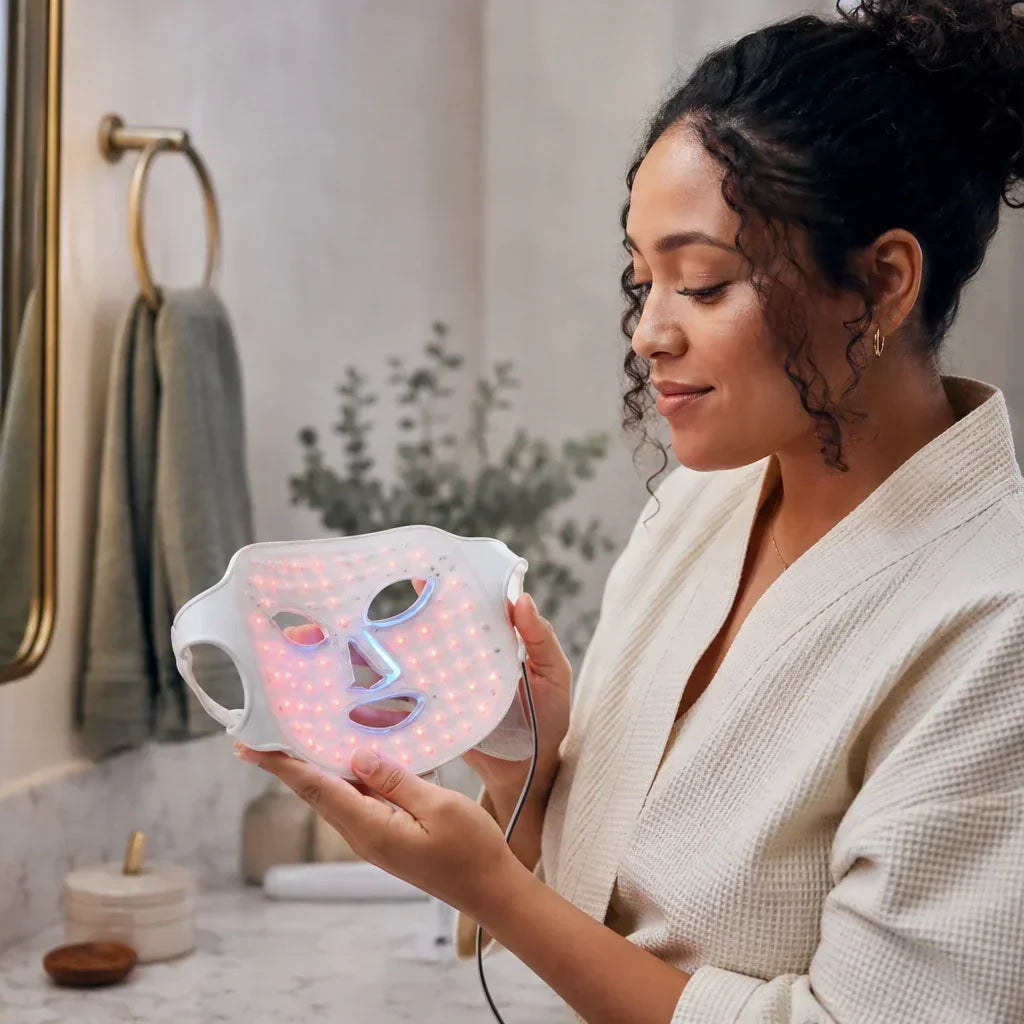
Visible color describes a band, not a precise biological dose. Two masks that look equally red can emit different peak wavelengths, bandwidths, irradiance, and total energy. The FDA’s clearance record for one over-the-counter LED mask specifies red plus infrared for full-face wrinkles and red plus blue for mild-to-moderate inflammatory acne. That is a product-specific intended use—not proof that every similarly colored lamp works the same way.
Red and near-infrared
Photobiomodulation literature commonly describes red light around 620–700 nm and near-infrared around 700–1,440 nm, although individual devices use narrower peaks. A 2024 clinical overview indexed by PubMed explains these ranges and also notes that parameters and evidence differ across uses. For cosmetic decisions, prioritize a device’s stated wavelength, treatment protocol, and clearance over a generic claim that red “boosts collagen.”

Blue light
Blue light is used in some cleared home devices for inflammatory acne. It is not a stand-alone answer for severe, cystic, scarring, or diagnostically uncertain acne. Excessively intense or poorly specified light is not better; follow the product protocol and seek dermatology care when acne is painful, scarring, or not improving.
What about green, yellow, purple, cyan, and white?
Some modes combine red, green, and blue LEDs, so the displayed name may describe a mixture rather than a distinct wavelength. Evidence and regulatory indications are far less consistent than social-media charts suggest. Treat a benefit chart as a manufacturer claim unless it is tied to the exact model, wavelength, protocol, and credible clinical evidence.
Safety comes before a device schedule
Read the exact device instructions rather than copying another product's time or distance. Output, wavelength, treatment area, heat management, and eye-safety directions vary. Stop if a device causes persistent pain, blistering, marked redness, visual symptoms, or worsening of a skin condition. Ask a qualified clinician before use if you have a photosensitive condition, take a photosensitizing medicine, have active skin disease, are pregnant, or are treating an area with a known or suspected lesion.
“Non-UV” does not mean “risk-free,” and a consumer wellness device is not a substitute for diagnosis or medical treatment. Check the label for the intended use, contraindications, warranty, and U.S. regulatory status. The FDA explains its role in regulating home-use medical devices and provides searchable device databases.
A practical buying checklist
| Check | Why it matters |
|---|---|
| Exact intended use | A device proven or cleared for one concern cannot be assumed to treat another. |
| Model-specific specifications | Wavelength, output, distance, and session time determine exposure. |
| Contraindications and eye guidance | These define who should not use it and how to reduce avoidable risk. |
| Evidence quality | Prefer the exact device or a closely matched protocol over generic marketing. |
| Warranty and return window | Cosmetic results vary and long-term adherence is uncertain. |
Frequently asked questions
Is near-infrared the same as red light?
No. Red is visible; near-infrared sits just beyond visible red and cannot be judged by brightness.
Does more colors mean a better mask?
Not necessarily. Useful specifications and evidence for the intended concern are more important than the number of modes.
Can I use red and blue on the same day?
Only if the exact device instructions allow that program. Do not improvise combined exposure.
Are LED masks UV-free?
Many are marketed and designed without UV, but verify the model’s specifications rather than assuming every light product is UV-free.
The bottom line
Choose the narrowest tool that matches the actual goal, verify the exact product rather than its marketing category, and keep expectations proportional to the evidence. From an editorial standpoint, clear specifications and a sustainable protocol are more persuasive than extra modes or dramatic promises.
Sources: FDA 510(k) summary for an OTC LED therapy mask. Supporting regulatory and safety context is available from the linked FDA and NIH resources throughout this article.
Continue reading