Red light therapy encyclopedia
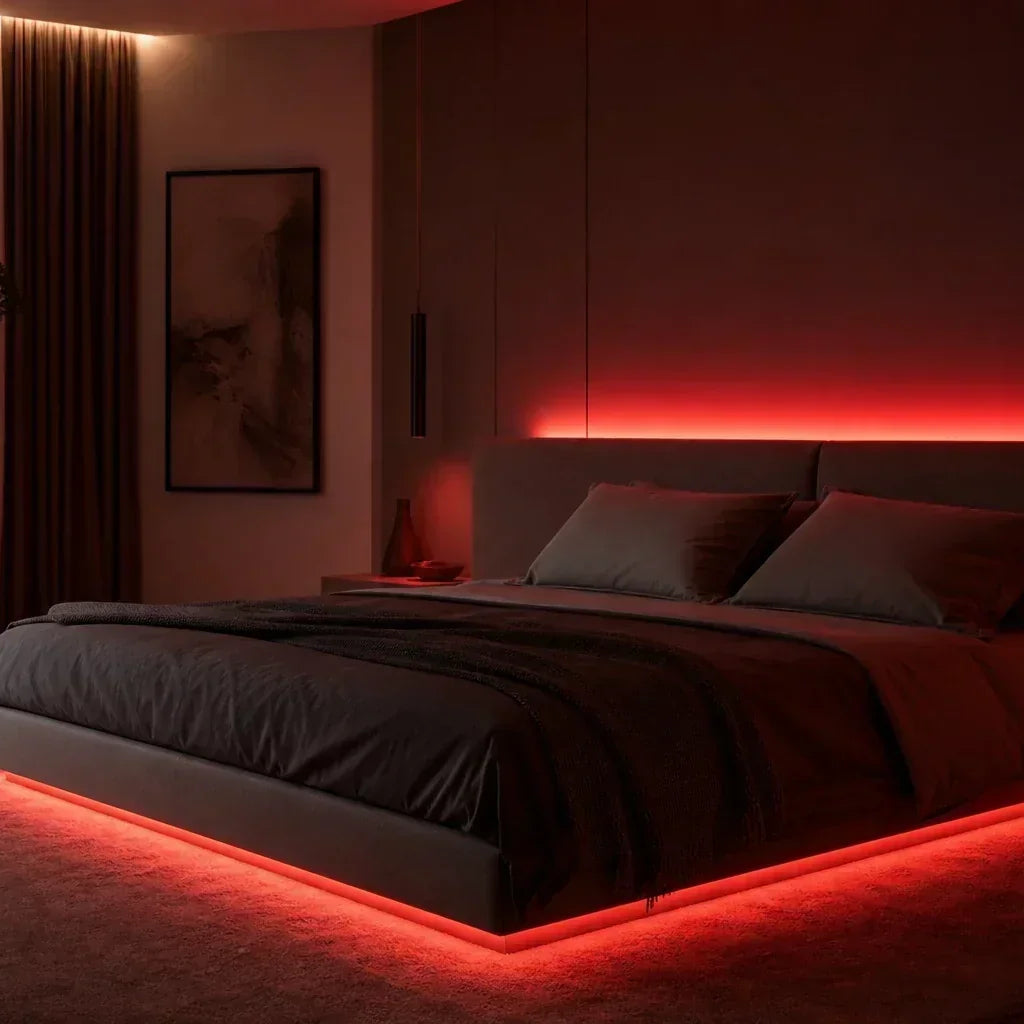
Red LED Lights for the Bedroom丨Good for Sleep, Safe All Night?
For evening use, dim red or warm light is generally a more sleep-friendly choice than bright blue-rich light. Keep it low in brightness, out of direct eye view, and use it for navigation or ambience—not as proof of a sleep treatment. Darkness remains the clearest default for sleep.
Quick answer: Red LED lights can make a bedroom feel dimmer and warmer than bright cool-white lighting, but the color red does not make an excessively bright room harmless. For sleep-friendly lighting, reduce total brightness first, use low-positioned warm or red light in the evening, and keep the room dark during sleep when practical.
Can red LED bedroom lights improve sleep?
Light timing and brightness influence the circadian system. Short-wavelength blue-enriched light is especially effective at signaling daytime, but any sufficiently bright light can affect alertness and sleep timing. A dim red light generally creates less circadian stimulation than a bright cool-white lamp, yet product brightness, distance, exposure time, and individual sensitivity still matter.
Red bedroom lighting should be treated as an evening environment choice, not as red light therapy. Decorative bulbs and strips are not medical or photobiomodulation devices, even when both products appear red.
Red light vs. warm-white light
| Lighting option | Best use | What to watch |
|---|---|---|
| Dim red LED | Late-evening navigation or low-stimulation accent lighting | Some products remain too bright or flicker at low dimmer settings |
| Warm-white lamp | Reading and normal evening tasks | Choose low brightness and a warm color temperature |
| Cool-white ceiling light | Daytime cleaning or work | Often too bright and stimulating close to bedtime |
| RGB strip | Decorative accent lighting | Color accuracy, flicker, exposed LEDs, and app settings vary widely |
A practical three-stage evening routine
Two to three hours before bed
Dim overhead lighting and switch to warm, shaded lamps. Keep enough light for safe movement and normal tasks.
During the final hour
Use the lowest comfortable brightness. A dim red or amber lamp placed below eye level can work well for navigation. Reduce screen brightness and avoid holding a bright display close to your eyes.
During sleep
A dark bedroom is usually the simplest choice. If you need a night light for safety, use a very dim, shielded light near the floor and keep it out of the direct line of sight.
Where should a red bedroom light go?
- Near floor level for nighttime navigation
- Behind furniture or a diffuser to prevent glare
- Away from the pillow and direct line of sight
- Where cables do not create a trip hazard
- On a timer if you do not need it throughout the night
Avoid exposed LED strips facing the bed. The individual points of light can be visually intense even when the room appears dark overall.
Can you leave red LED lights on all night?
Red light is not automatically “invisible” to the body. If an all-night light is unnecessary, turn it off. When a light is needed for a child, older adult, hallway, or bathroom, prioritize the lowest safe brightness, shielding, and placement below eye level. Sleep disruption, headaches, glare, or eye discomfort are signs to change the setup.
Buying checklist
- Reliable dimming without visible flicker
- Low minimum brightness
- A diffuser or shaded design
- Timer or scheduling control
- Recognized electrical safety certification for your market
- Clear return policy
- No exaggerated therapy or sleep-cure claims
Red bedroom light vs. red light therapy
A household red bulb is designed for illumination. A red light therapy device is designed to deliver specified wavelengths and a defined light dose at a stated distance. Do not use a decorative lamp as a treatment device, and do not use a high-output therapy panel as an all-night bedroom lamp.
Learn more in our red bulb comparison guide and guide to red and amber sleep glasses.
Sources and further reading
Continue reading