Red light therapy encyclopedia
What Does NIR Stand For? Near-Infrared Light Explained
In light science and skin-device discussions, NIR stands for near-infrared. It is invisible, non-ionizing electromagnetic radiation just beyond visible red—not UV and not automatically therapeutic.
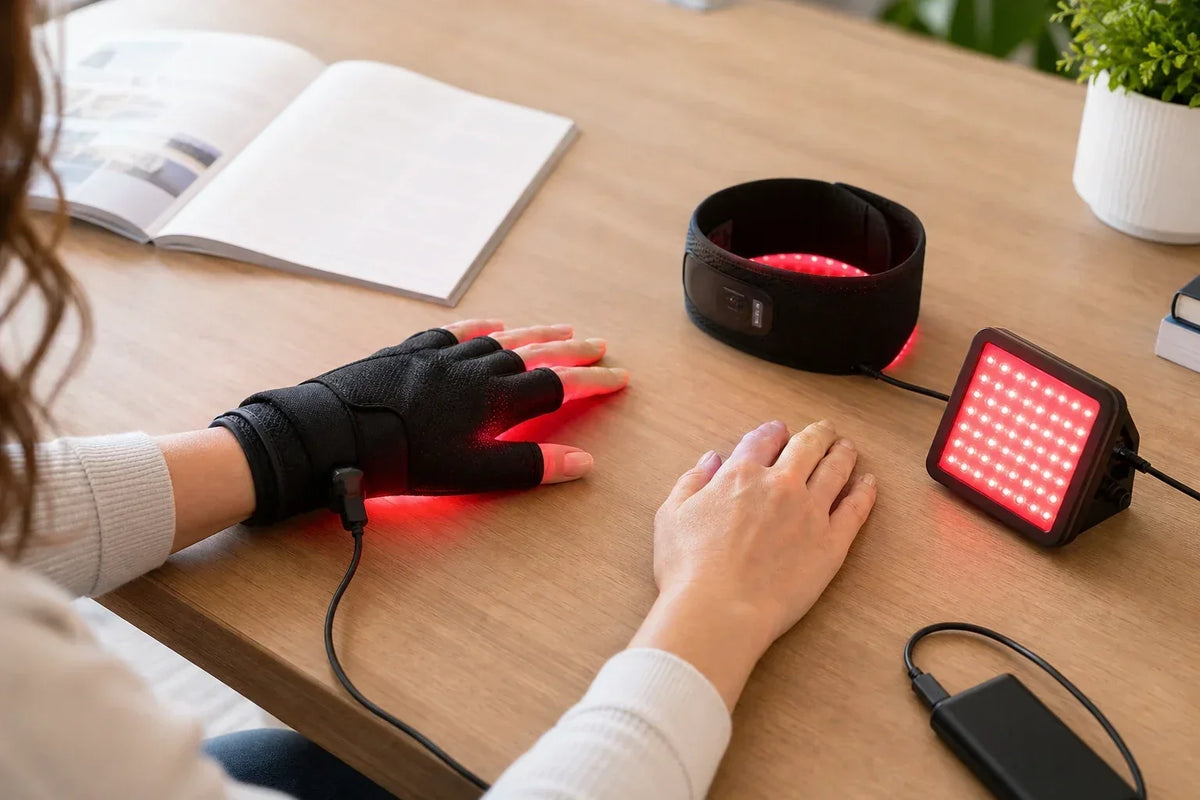
NIR stands for near-infrared. In red light therapy and photobiomodulation, the term describes invisible wavelengths located just beyond the red edge of the visible spectrum. Consumer devices commonly list wavelengths such as 810 nm, 830 nm, or 850 nm as NIR.
That definition is simple, but it leaves out the part that matters when comparing devices: NIR is a wavelength category, not a guarantee of a particular result. The actual exposure depends on the wavelength, output at your use distance, session time, coverage, optical design, and instructions for the individual device.
What Does NIR Stand For? Quick Answers
| Question | Practical answer |
|---|---|
| What does NIR stand for? | Near-infrared. |
| Can the human eye see NIR? | No. Its primary output is outside the visible range. |
| Is 850 nm near-infrared? | Yes. It is one of the most frequently listed NIR wavelengths on consumer light devices. |
| Is NIR the same as red light? | No. Red light is visible; NIR begins beyond the visible red region. |
| Is NIR the same as infrared heat? | Not exactly. Near-infrared is one part of the much broader infrared spectrum. Whether a source feels warm depends on its wavelength, power, design, and exposure conditions. |
| Is NIR ultraviolet light? | No. NIR and UV are located on opposite sides of the visible spectrum. |
| Does every NIR device work the same way? | No. Devices with the same stated wavelength can deliver very different output, coverage, and exposure. |
| Can NIR mean something else? | Yes. In some radiation-safety documents, NIR can mean non-ionizing radiation. In spectroscopy and light-device discussions, it usually means near-infrared. |

Where Does Near-Infrared Sit on the Light Spectrum?
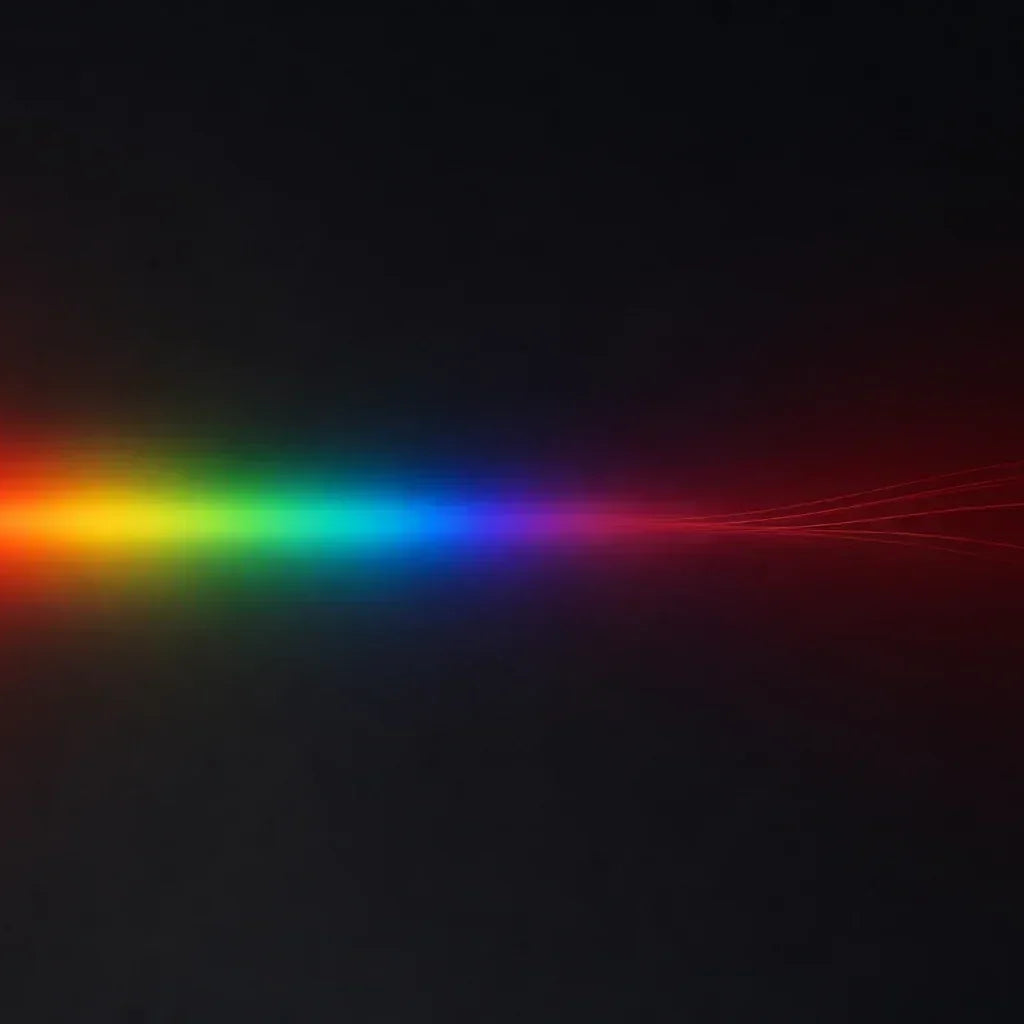
Visible light is commonly described as spanning approximately 400 to 700 nanometers. Near-infrared begins near the long-wavelength edge of visible red and continues into the wider infrared region.
You may see different upper and lower boundaries in different sources. For example, one scientific field may describe NIR as approximately 700–1,400 nm, while another may extend it to 2,000 nm or beyond. This is not necessarily a contradiction. Spectral categories are often defined according to the equipment, application, or scientific standard being used.
For someone comparing a red light therapy device, the practical lesson is straightforward: do not rely on the word “NIR” alone. Look for the actual wavelength in nanometers.
| Light category | Visibility | Typical position | What consumers should understand |
|---|---|---|---|
| Visible red light | Visible | At the long-wavelength end of visible light | Often listed around 620–700 nm, depending on the source and application. |
| Near-infrared | Invisible | Immediately beyond visible red | Common device wavelengths include 810, 830, and 850 nm. |
| Longer-wavelength infrared | Invisible | Farther into the infrared spectrum | Thermal effects may become a more prominent part of the user experience. |
| Ultraviolet | Mostly invisible | Beyond the violet side of visible light | UV is a separate, shorter-wavelength category and should not be confused with NIR. |
NIR vs. Red Light: What Is the Real Difference?
The most obvious difference is visibility. Red light can be seen. Near-infrared cannot.
The second difference involves how light is absorbed and scattered as it moves through tissue. Red and NIR wavelengths do not behave identically, and some NIR wavelengths may experience less attenuation than visible red under certain conditions. However, penetration is not a fixed number that applies to every person, body area, device, or wavelength.
The internet often reduces the distinction to “red light is for the skin, while NIR is for deeper tissue.” That is a useful starting point, but it is too tidy to be treated as a scientific rule. Skin, blood, water, fat, connective tissue, distance, beam geometry, and output all affect how much light reaches a particular depth.
Our editorial view: wavelength should help explain a device, not replace the rest of its specifications. A clearly reported 850 nm device with measured output is more informative than a product that simply advertises “deep infrared technology.”
Is NIR the same as infrared heat?
NIR is part of the infrared spectrum, but the term does not automatically mean “heat therapy.” A sufficiently powerful NIR source can produce warmth, yet photobiomodulation is generally discussed in relation to controlled optical exposure rather than heat alone.
This is why a near-infrared LED panel, an infrared sauna, and an infrared heating lamp should not be treated as interchangeable products. They may all use infrared wavelengths, but they can differ substantially in wavelength range, power, distance, temperature, intended use, and exposure pattern.
Is NIR non-ionizing?
Near-infrared light is non-ionizing radiation, meaning its photons do not carry enough energy to ionize atoms in the way X-rays can. However, “non-ionizing” does not mean that unlimited exposure is automatically harmless. Output, duration, heat, eye exposure, and device design still matter.
What Do 810 nm, 830 nm, and 850 nm Mean?
The abbreviation “nm” means nanometer, a unit used to describe wavelength. One nanometer is one billionth of a meter.
When a product lists 850 nm, it is identifying the approximate peak wavelength of its near-infrared output. It does not mean that every photon is emitted at exactly 850 nm. LEDs usually produce a band of wavelengths centered around a stated peak, which is why technical documents may show a tolerance such as 850 nm ± 10 nm.
Is 850 nm the best NIR wavelength?
There is no universally best near-infrared wavelength for every purpose. Researchers and device manufacturers use several NIR wavelengths, including approximately 810, 830, 850, 940, and 1,064 nm. These wavelengths are not automatically interchangeable because absorption, output, optical components, and study protocols can differ.
For a shopper, “best wavelength” is usually the wrong first question. A better sequence is:
- What is the device intended to be used for?
- What exact wavelength or wavelength combination does it emit?
- What output reaches the user at the stated distance?
- How long is each session according to the manufacturer?
- Are the safety instructions and contraindications clearly disclosed?
- Is the evidence relevant to this model or only to the general wavelength?
Why do many devices combine 660 nm and 850 nm?
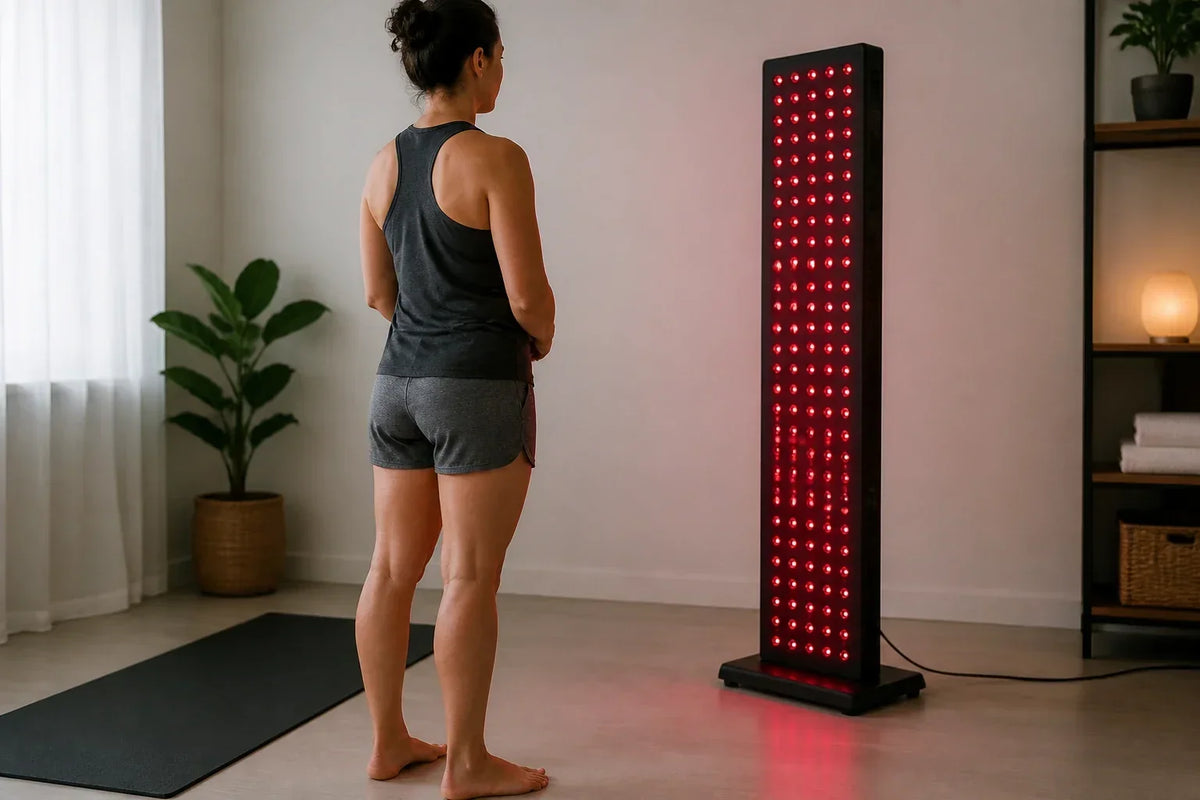
Visible red around 660 nm and NIR around 850 nm are a common pairing in consumer panels. Combining them allows one device to produce both visible-red and near-infrared output rather than limiting the device to a single wavelength region.
That does not prove that every 660/850 nm product delivers the same exposure. Two devices can list the same wavelengths while differing in LED quality, beam angle, irradiance, coverage uniformity, distance, session time, and heat management.
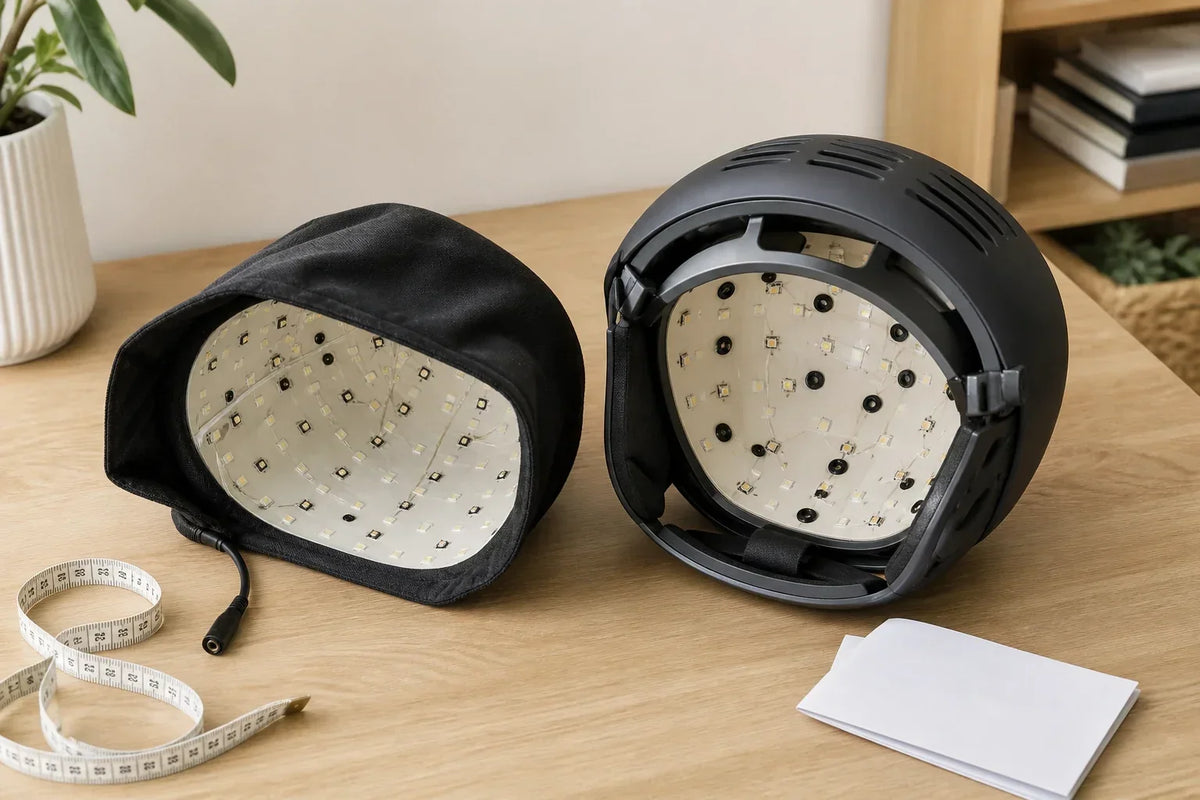
Some FDA-cleared home-use LED masks also combine visible red and NIR for a specific wrinkle-related indication. The important detail is that FDA clearance applies to the reviewed device, its specifications, labeling, and intended use. It is not blanket evidence for every light that emits the same wavelength.

Why Do NIR LEDs Look Like They Are Turned Off?
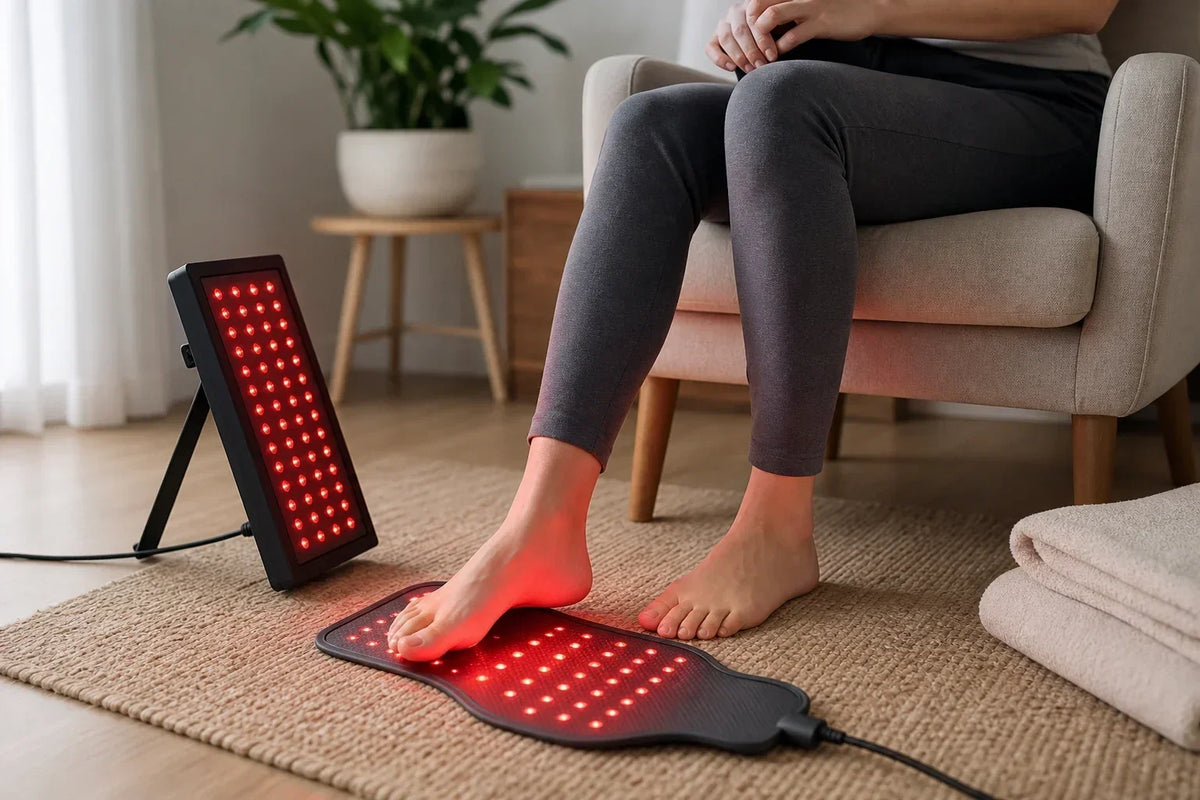
A near-infrared LED may appear dark because the human eye cannot see its main wavelength. That does not necessarily mean the LED is defective.
Some NIR LEDs produce a faint red glow. This can come from a small visible portion of the LED's emission band, nearby visible-red LEDs, or an indicator light. The glow is not a reliable measurement of NIR power.
The reverse is also true: a panel that looks extremely bright may be producing strong visible red output without delivering equally strong NIR output.
Can a phone camera detect NIR?
Some phone cameras can display certain infrared sources as a pale white, pink, or purple spot. However, camera sensors and infrared-blocking filters vary by phone model, lens, and camera mode.
A phone-camera check may help reveal that an emitter is active, but it cannot confirm the wavelength, irradiance, coverage uniformity, or calibrated performance of the device. It should not replace manufacturer test data or proper measurement equipment.
A useful rule: use your eyes to check the display and controls, not to estimate invisible optical output.
How to Read Near-Infrared Device Specifications
The word “NIR” is only the beginning of a useful specification. A well-documented device should provide enough information to understand what reaches the user and under what conditions.
| Specification | What it tells you | What may be missing |
|---|---|---|
| Peak wavelength | The central wavelength, such as 850 nm | The tolerance or full emission range |
| Irradiance | Optical power reaching each unit of area, often reported in mW/cm² | The measurement distance and test method |
| Use distance | How far the device should be from the body | Whether output was actually measured at that distance |
| Session duration | How long the manufacturer intends each use to last | Whether the schedule applies to every mode and body area |
| Coverage area | How much area is illuminated at once | Whether output is uniform across the center and edges |
| Radiant exposure | The surface energy delivered over a session, usually expressed in J/cm² | Whether it was calculated from measured or advertised irradiance |
| Pulse settings | Whether output is continuous or delivered in pulses | Duty cycle, pulse frequency, and supporting rationale |
| Intended use | What the manufacturer says the device is designed to support | Whether marketing claims extend beyond the label or evidence |
| Eye guidance | Whether eye protection, closed eyes, or positioning precautions are required | Device-specific optical safety testing |
Why irradiance must include a distance
Irradiance usually decreases as you move farther from a panel, although the exact change depends on LED spacing, beam angle, lenses, panel size, and measurement geometry. A statement such as “100 mW/cm²” is incomplete when it does not say where and how the value was measured.
The specification we trust least is a large output number without a distance, measurement area, instrument, or test condition. It may look impressive while telling the reader very little about normal use.
How surface dose is estimated
A simplified calculation for radiant exposure is:
Radiant exposure (J/cm²) = irradiance (W/cm²) × time in seconds
For example, an irradiance of 40 mW/cm² equals 0.040 W/cm². If that measured output remains constant for 600 seconds, the calculated surface exposure is:
0.040 W/cm² × 600 seconds = 24 J/cm²
This calculation does not tell you how much energy reaches a deeper biological target. It is a surface estimate based on the stated measurement conditions. Tissue absorption, reflection, scattering, body area, and distance still affect actual exposure.
Does More NIR Always Mean Better Performance?
No. More wavelengths, more LEDs, higher electrical wattage, and longer sessions do not automatically mean a better device or a better outcome.
Photobiomodulation is often discussed as having a dose-dependent response. Too little exposure may be insufficient for the intended protocol, while increasing exposure indefinitely does not guarantee a larger benefit and may increase heat or irritation.
This is one reason it is risky to copy a session schedule from an unrelated panel, mask, laser, or heating lamp. Even when two products use 850 nm, their output and recommended distance may be completely different.
Our practical preference is clarity over feature count. One or two well-documented wavelengths with repeatable controls can be more useful than seven modes supported only by vague claims.
A Practical NIR Buying Checklist
| Check | Why it matters |
|---|---|
| Exact wavelength | “Infrared” alone covers too broad a region to describe the product accurately. |
| Measured irradiance and distance | Output without a measurement distance is difficult to compare. |
| Recommended session time | A usable protocol should match the actual device rather than a generic online schedule. |
| Coverage uniformity | A strong center reading does not prove that the edges receive similar output. |
| Mode controls | Confirm whether red and NIR can be selected separately or only used together. |
| Eye-safety instructions | NIR is invisible, so brightness cannot be used to judge eye exposure. |
| Intended use and evidence | Evidence for one device or purpose should not automatically be applied to another. |
| Contraindications | Clear labeling helps users recognize when professional advice may be appropriate. |
| Warranty and return policy | Comfort, heat, controls, coverage, and routine compatibility cannot be judged from wavelength alone. |
Near-Infrared Light Safety
Use the instructions supplied with the exact product. Do not assume that the distance, session duration, or eye guidance from another device also applies to yours.
Because NIR is invisible, the eye cannot judge its intensity from brightness. Do not stare directly into emitters. Follow the manufacturer's instructions regarding goggles, integrated eye shields, closed eyes, positioning, and minimum distance.
Ask a qualified healthcare professional for guidance before using a light device when you:
- have a diagnosed photosensitivity disorder;
- take medication or use a topical product that may increase light sensitivity;
- have an active or unexplained skin condition in the intended use area;
- are considering use over a known or suspected lesion;
- have an eye condition or have recently undergone an eye procedure; or
- have been advised to avoid light-based devices.
Stop using the device and seek appropriate advice if you experience persistent pain, blistering, marked or lasting redness, visual symptoms, unexpected swelling, or worsening of an existing condition.
“No UV” and “non-ionizing” are useful descriptions, but neither phrase proves that a product is suitable for unlimited exposure. Safety still depends on the device, output, duration, distance, heat management, user, and area of use.
Frequently Asked Questions About NIR
Does NIR stand for near-infrared or non-ionizing radiation?
It can mean either, depending on context. In red light therapy, spectroscopy, cameras, sensors, and LED specifications, NIR usually means near-infrared. In some radiation-protection documents, NIR is used as an abbreviation for non-ionizing radiation.
Is 850 nm red light or near-infrared?
850 nm is near-infrared. It lies beyond the wavelengths normally visible to the human eye.
Should an 850 nm LED look completely dark?
It may look dark or show only a faint red glow. Appearance alone cannot confirm whether the LED is producing the correct wavelength or output.
Why can I see some red dots when NIR is supposed to be invisible?
You may be seeing visible-red LEDs, indicator lights, or the weak visible edge of an NIR LED's emission spectrum. The main 850 nm output remains invisible.
Is NIR stronger than red light?
Not necessarily. “Red” and “NIR” describe wavelength regions, not output strength. Either wavelength can be delivered at low or high irradiance depending on the device.
Does NIR always penetrate deeper than red light?
NIR often experiences different absorption and scattering than visible red and may reach deeper under some conditions. However, penetration depends on the exact wavelength, tissue, body area, output, distance, beam design, and exposure time. A fixed penetration depth should not be assumed for every product.
Can red and NIR be used at the same time?
Many devices are designed to emit both simultaneously. Use the available modes according to the device instructions rather than combining settings based on a schedule written for another model.
Is a higher number of wavelengths better?
No. Additional wavelengths are useful only when they are delivered at appropriate, documented settings for a clear purpose. A long wavelength list does not replace reliable output data, safety guidance, or an understandable protocol.
Does FDA clearance apply to every device using the same wavelength?
No. FDA clearance is tied to a specific device, intended use, technological characteristics, labeling, and supporting submission. A cleared 830 nm mask does not make every 830 nm lamp or panel equivalent.
How can I tell whether an NIR specification is credible?
Look for a complete specification rather than a single marketing number. At minimum, the manufacturer should identify the wavelength, measurement distance, irradiance, recommended use time, operating modes, safety instructions, and intended use. Independent or model-specific testing provides more value than a generic statement about NIR.
The Bottom Line
NIR most commonly stands for near-infrared. In light-device discussions, it refers to invisible wavelengths immediately beyond visible red, including commonly used outputs such as 810, 830, and 850 nm.
The abbreviation tells you where the light sits on the spectrum. It does not tell you how powerful the device is, how evenly it delivers light, how long it should be used, or whether it is appropriate for a particular goal.
The best way to compare NIR devices is to move past the acronym and inspect the complete system: exact wavelengths, irradiance at a stated distance, session duration, coverage, controls, intended use, eye guidance, contraindications, and evidence relevant to the individual model.
To continue learning, visit the Red Light Therapy Encyclopedia. Readers currently comparing red and NIR options can also review the specifications of dual-wavelength red light therapy panels.
This article is for general educational purposes and is not medical advice. A consumer wellness device is not a substitute for professional diagnosis or medical care.
Sources and Further Reading
- National Institute of Standards and Technology: Spectral wavelength ranges
- PubMed: Photobiomodulation overview and wavelength discussion
- PubMed: Review of visible and near-infrared light penetration
- Review of photobiomodulation wavelength, irradiance, fluence, and exposure parameters
- U.S. Food and Drug Administration: Home-use devices
- FDA 510(k) summary example for a red and near-infrared LED face mask
- National Cancer Institute: Definition of non-ionizing radiation
```
Continue reading