Red light therapy encyclopedia
Red Light Therapy Stand-Up Bed: Booth Buying Guide
A red light therapy stand-up bed is a vertical booth whose value depends on three-dimensional coverage, repeatable positioning, safe access, and service support. Compare booths with panels and lie-down systems before paying for the enclosure.
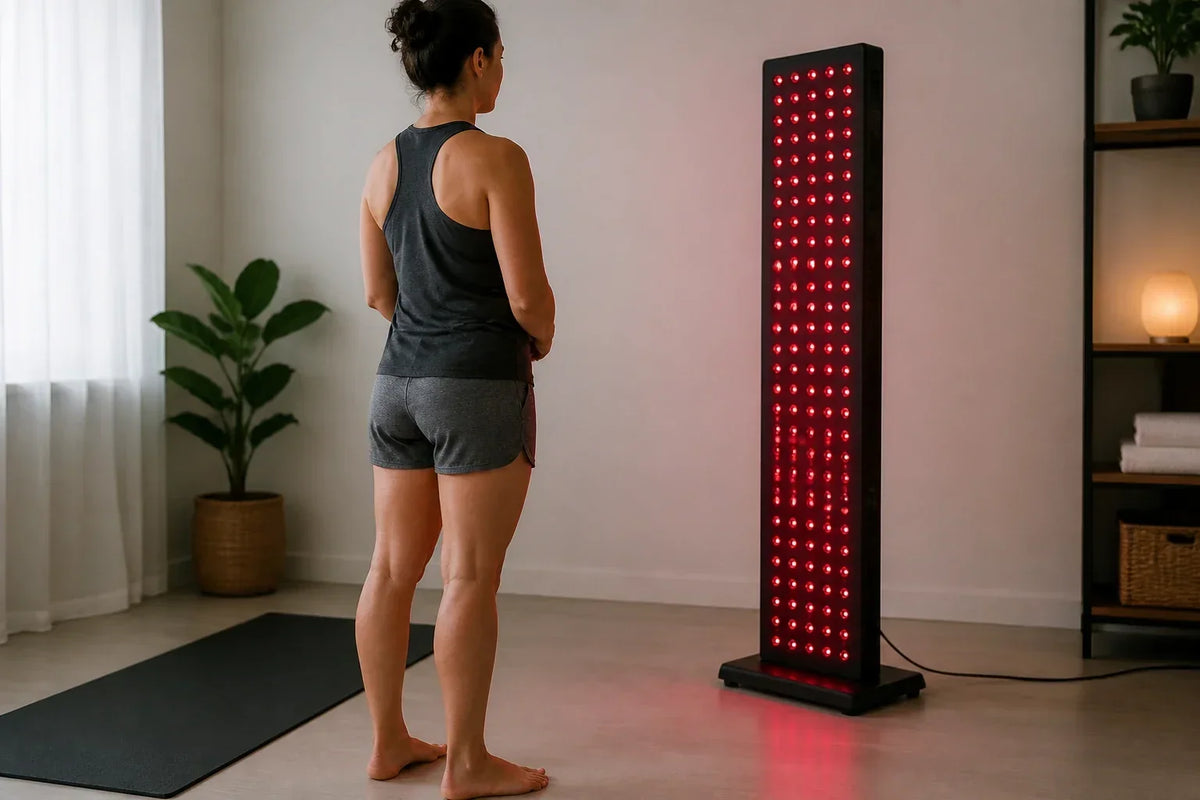
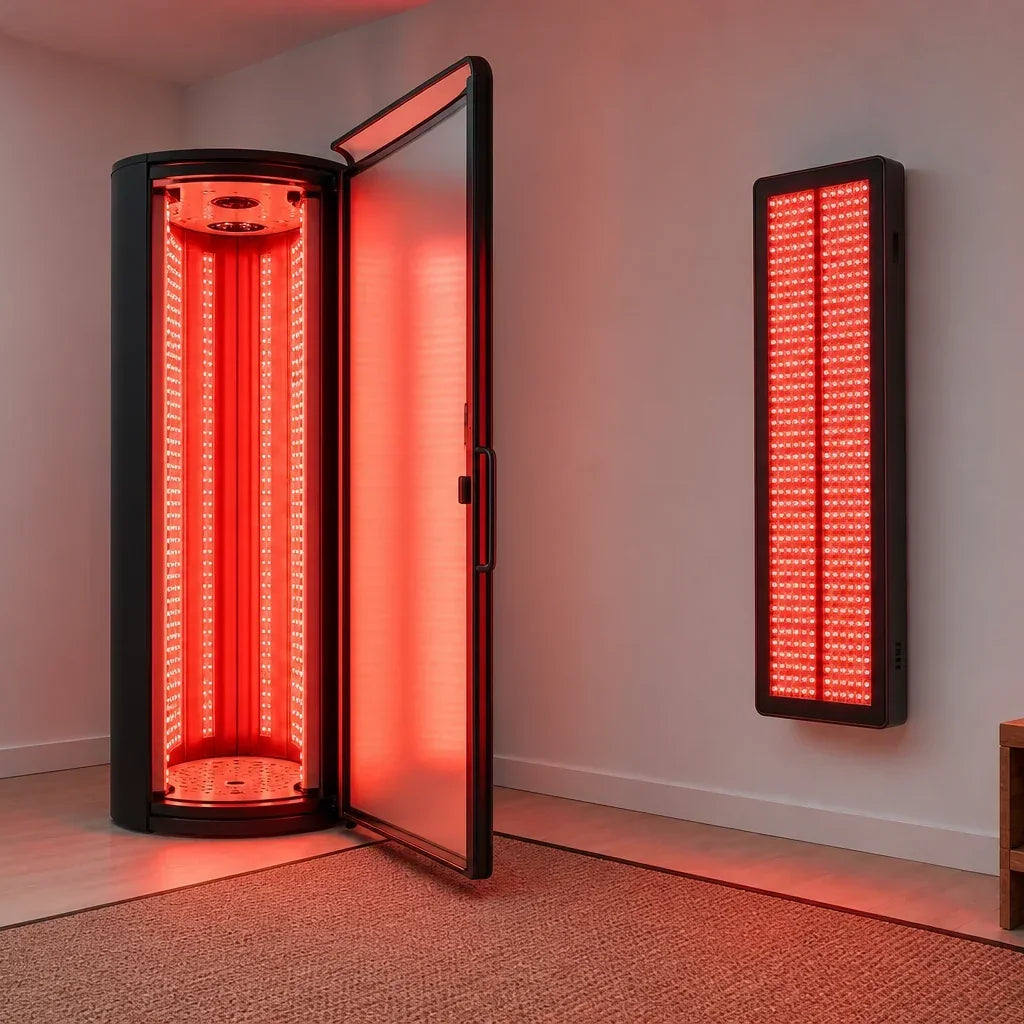
A stand-up red light bed is better described as a booth: vertical LED arrays surround or face a standing user. It can provide broad coverage without contact surfaces, but it requires stable footing, accessible controls, ventilation, space, and documented uniformity from head to lower legs.
Commercial disclosure: Yamuri sells red and near-infrared light devices. This guide uses model-neutral comparison criteria and does not assume a Yamuri product is suitable for every use discussed.
Quick Q&A: What Most People Want to Know First
| Option or question | Practical answer |
|---|---|
| Stand-up booth | Fast entry and broad vertical coverage; balance and accessibility matter. |
| Lie-down bed | Stable position and repeatable geometry; contact cleaning and access matter. |
| Large panel | Smaller footprint and easier service; requires turning or multiple panels. |
| Canopy | Allows reclining with an open design; coverage depends on height and angle. |

What a stand-up system changes
Standing removes the bed surface and may simplify cleaning, but user distance can vary with posture. A narrow booth can create hot spots near the LEDs and weak areas at the centerline or lower legs unless the array is designed and measured for uniform coverage.
How we compare formats
Useful criteria include wavelength, irradiance and distance, coverage map, timer, door and emergency exit, handholds, non-slip floor, accessibility, ventilation, electrical requirements, cleaning, warranty, and service. A booth should also accommodate the intended user without forcing contact with emitters.
Output and coverage
The maximum irradiance at one point is not a full-body performance measure. Ask for uniformity data at the actual standing position. If the product combines red and near-infrared channels, ask whether output is reported together or separately.
Installation and operational safety
Commercial booths may require freight, assembly, dedicated electrical service, floor space, and local code review. Controls should be reachable, exits obvious, and the structure stable. People who cannot stand comfortably need a different format.
Claims and regulatory language
Verify the exact model when a seller mentions FDA clearance. Establishment registration, product listing, and 510(k) clearance are different concepts. A clearance for one model and indication should not be generalized to a different booth.
My practical take
A stand-up booth earns its footprint only when its coverage documentation and user access are better than a simpler panel setup. Convenience claims are credible when the controls, distance, entry, and service plan are equally clear.
A Deeper Decision Framework
A stand-up bed is better understood as a light booth. It may reduce surface contact and speed entry, but standing changes distance, posture, balance, and uniformity. Its value depends on measured coverage at the real user position and a design that permits safe entry and immediate exit.
A reliable comparison separates four layers: what the device is, what it measurably delivers, what evidence supports the intended use, and what ownership requires. Mixing those layers lets a true specification imply an unproven outcome. For example, a wavelength can be measured accurately while the promised benefit remains unsupported for that model, dose, or population.
Translate the sales page into verifiable questions
| Decision area | Evidence worth requesting | Weak substitute |
|---|---|---|
| Uniformity | Map around torso, limbs and lower legs | Maximum at one center point |
| User position | Marked distance and usable body-size range | Assuming every user stands identically |
| Access | Door clearance, handholds, controls and exit | Photographs of an empty booth |
| Operations | Cleaning, ventilation, duty cycle and service | Sessions per day without thermal limits |
Ask for dated documents tied to the exact model: the user manual, electrical label, test conditions, warranty, and—when a medical claim is made—the named regulatory record. A distributor's badge or a statement that a facility is registered does not establish that every product it sells was cleared for every claim. FDA's PBM guidance and device database both reinforce the importance of device-specific intended use and testing.
Evidence Versus Marketing
| Statement type | What it can establish | What it cannot establish |
|---|---|---|
| Measured specification | Output under the disclosed setup | Clinical effectiveness by itself |
| Regulatory record | Status and intended use for the named device | Approval of a whole product category |
| Published study | Results for its participants, device and protocol | Equivalent results from another consumer product |
| Testimonial | A person's reported experience | Causation, typical results, or safety for others |
Evidence quality is not a yes-or-no badge. Laboratory measurements answer whether output is present; usability testing answers whether people can operate the system; controlled clinical research addresses a specified outcome; post-market records can reveal operational problems. Marketing often collapses all four into “clinically proven.” We recommend tracing every important claim back to the kind of evidence capable of supporting it.
Match the Format to the Real Scenario
| Scenario | More defensible starting point | Reason |
|---|---|---|
| Able to stand steadily | Booth may offer fast repeatable sessions | Confirm hand and foot placement |
| Balance or fatigue concerns | Seated or horizontal system | A booth should not create fall risk |
| High-throughput studio | Commercially supported booth | Cleaning and duty cycle become critical |
| Home use | Compare footprint with paired panels | Simpler hardware may provide adequate access |
These are starting points, not prescriptions. Room dimensions, mobility, electrical service, medications, eye sensitivity, pregnancy status, plant species, or other context may change the decision. Follow the exact manual and obtain professional guidance when the use involves a health condition, unusual sensitivity, or a time-sensitive medical choice.
Total Cost and Verification Worksheet
| Before purchase | At delivery | During ownership |
|---|---|---|
| Save the exact model and quoted specifications | Verify labels and contents against the order | Keep sessions and maintenance consistent with the manual |
| Confirm dimensions, circuit, ventilation, and return terms | Inspect damage before accepting freight | Record service contacts and replacement parts |
| Request measurement conditions and safety instructions | Test controls, timer, stability, and shutoff | Reassess if the product, goal, or health context changes |
| Calculate accessories, tax, assembly, and likely freight | Retain packaging through the return window | Track electricity, cleaning, downtime, and warranty labor |
Total cost is especially easy to underestimate for large hardware. Installation work, mounting, a dedicated circuit, return freight, inaccessible replacement parts, and downtime may outweigh a small difference in advertised output. For bulbs and strips, the same principle applies at smaller scale: sockets, fixtures, timers, power supplies, heat management, and replacement frequency belong in the comparison.
Editorial Judgment: Standing Geometry And Access
We would not call a booth full-body based on height alone. In our editorial judgment, credible evidence includes a circumferential coverage map, the specified standing zone, and separate output for selectable channels. We also give emergency exit and service access the same weight as optical numbers because convenience disappears when the user cannot enter, stand, or leave confidently.
That judgment is deliberately conservative. It does not assume that absence of evidence proves a product ineffective; it recognizes that a buyer cannot responsibly price a claim whose dose, coverage, intended use, or support is undefined. The strongest product page makes limitations easy to find and gives the reader enough detail to reproduce the claimed setup.
Stand-Up Geometry Creates Its Own Buying Questions
Coverage is three-dimensional
A front-facing irradiance reading cannot describe light around a standing body. Ask for measurements at the chest, side, back, lower legs, and the documented standing zone. Body size and posture can change distance from curved walls, while shoulders and arms can shadow nearby areas. If channels are selectable, request red-only, near-infrared-only, and combined conditions rather than assuming the same map applies to every mode.
Accessibility is a performance specification
Check threshold height, door force, internal width, handholds, control reach, non-slip flooring, emergency release, and whether an attendant is expected. Someone who can stand for ten minutes in a room may not be comfortable standing inside a warm, bright enclosure. I would treat a safe independent exit as a gating requirement, not a convenience feature. Users with balance or fatigue concerns may be better served by a seated or horizontal arrangement.
Home and commercial duty are different
A studio needs documented duty cycle, cleaning compatibility, ventilation, lockout procedures, staff training, parts availability, and turnaround time. A home buyer may care more about footprint, noise, circuit needs, moving, and storage. Neither context makes a booth inherently better than panels. The relevant question is whether the fixed geometry improves repeatability enough to justify the permanent structure and service burden.
Do not confuse the booth with a tanning booth
Product shape does not identify spectrum. Traditional tanning equipment intentionally emits ultraviolet radiation; a red/NIR booth should be described by its own spectral output and manual. Verify the exact device rather than assuming that “no UV” follows from a red glow. Eye guidance also remains model-specific: near-infrared can be invisible, and visual comfort is not proof that an exposure is appropriate.
What would justify the booth premium?
The case becomes stronger when the booth provides independently measured circumferential uniformity, a clearly marked standing zone, accessible controls, safe exit, and commercial service support that a panel array cannot match. If it merely encloses the same undocumented LEDs, the footprint adds complexity rather than information. I would require those documents before comparing session convenience or projected throughput.
For shared use, ask how the system handles user height differences and repeatable placement. Floor markings, adjustable supports, and clear channel presets can reduce variation; memory buttons without a documented protocol cannot. Staff should be able to explain the stop procedure before a session begins.
A Decision Checklist
- Define the intended use before comparing features.
- Request the exact wavelength or spectrum and its tolerance.
- Look for output measured at the actual use distance.
- Check coverage, uniformity, timer, eye guidance, and heat management.
- Read installation, cleaning, warranty, return, and service terms.
- Verify any regulatory statement against the exact model and record.
Frequently Asked Questions
Does more electrical wattage mean more useful light?
No. Electrical input, optical output, and energy reaching the target are different measurements.
Is visible brightness a reliable output test?
No. Human vision and camera processing are not calibrated meters, especially for near-infrared light.
Does a longer session always provide more benefit?
No. Follow the model-specific instructions. Exposure depends on output, distance, time, and area.
Is red or near-infrared light ultraviolet?
No. They occupy different spectral regions, but product-specific eye and skin guidance still matters.
What makes a source claim credible?
The source should identify the device, population, exposure, outcome, and limitations. General wavelength research does not validate a particular product.
When is professional guidance appropriate?
Seek qualified guidance for pregnancy or fertility decisions, photosensitivity, relevant medicines, eye concerns, significant health conditions, or uncertainty about a device’s intended use.
Related Yamuri Guide
Sources and Further Reading
- FDA LED phototherapy bed 510(k) summary
- FDA home-use device questions
- JAAD photobiomodulation overview
Editorial Standards and General Information
This article separates general light education from model-specific documentation. Regulatory records apply only to the devices and intended uses named in those records; they are not automatically applied to Yamuri or other models. The content supports consumer education and specification literacy, not personalized medical advice. Follow the exact device manual and seek qualified guidance when individual health circumstances affect the decision.
Continue reading