Red light therapy encyclopedia
Red Light Machine at the Gym:Before or After, 10 or 20 Min?
Red light machine at gym guide: learn what it is, before vs after workouts, 10 vs 20 minute sessions, UV differences, safety, and what to wear.
Red light machine at gym guide: learn what it is, before vs after workouts, 10 vs 20 minute sessions, UV differences, safety, and what to wear.

Editorial Review: This article was written for consumer education about red light machines at gyms, workout timing, session length, UV differences, eye protection, clothing, and equipment safety. It references public information from Planet Fitness, Cleveland Clinic, the American Academy of Dermatology, PubMed, NIH/PMC, FDA, and FTC. It is not medical advice.
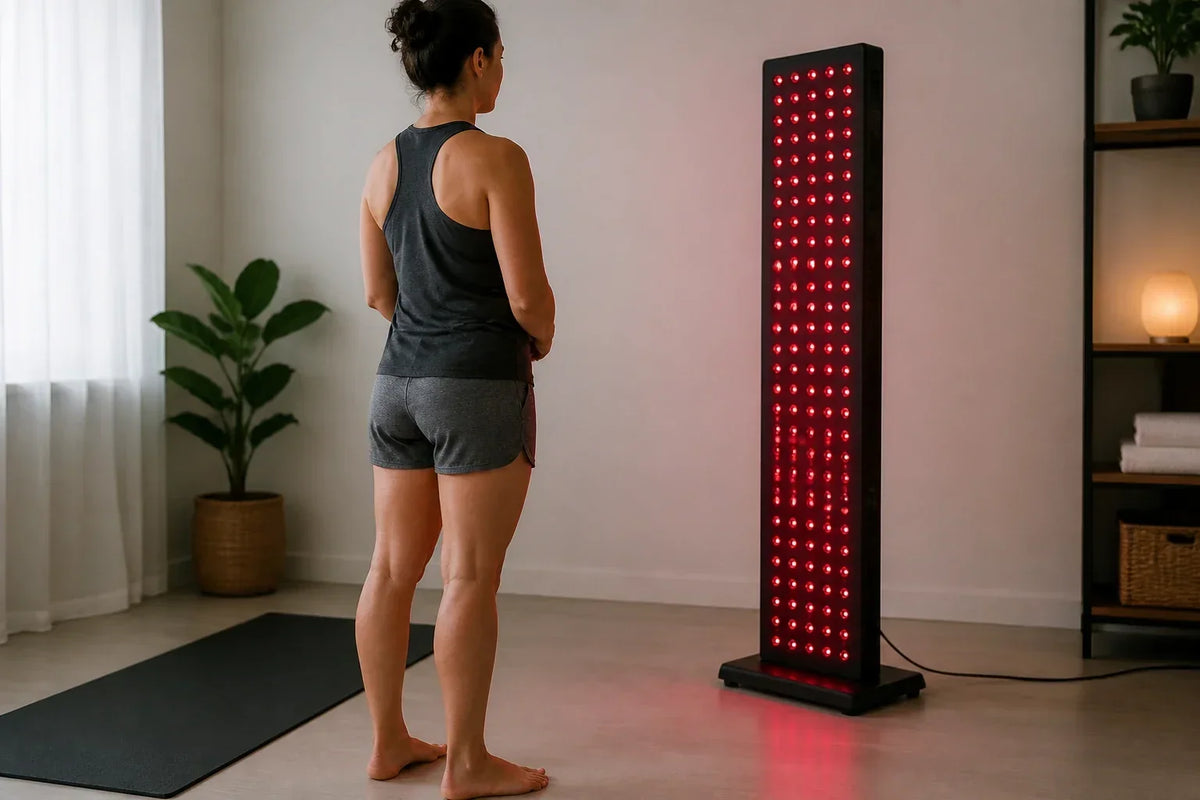
If you searched red light machine at gym, the practical answer is this: it is usually a standing booth, light bed, LED panel system, or red-light-and-vibration machine that exposes a large part of the body to visible red light. Some gym machines also include near-infrared light, heat, vibration, or tanning technology, so you need to identify the exact machine before using it.
A typical gym session is preset and short. Depending on the equipment, that may mean roughly 10 to 20 minutes, although some booths use a different fixed cycle. Do not add extra cycles simply because the light feels gentle.
My personal take is simple: the most important question is not whether you use the machine before or after your workout. First confirm whether it is truly UV-free red light, a red light sauna, an LED bed, or a hybrid tanning unit. Those are different experiences with different safety considerations.
Quick Q&A: What Most People Want to Know First
| Question | Short Answer | My Practical Note |
|---|---|---|
| What is the red light machine at the gym? | It is usually a full-body red light booth, LED bed, panel system, or red-light-and-vibration machine. | Ask the staff for the exact model because gym machines are not all the same. |
| Should I use it before or after a workout? | Either can fit a routine. Some muscle-focused studies favor pre-exercise use, while post-workout use may be more convenient. | I would choose one consistent time rather than switching randomly. |
| Is 10 or 20 minutes better? | Use the machine’s preset cycle or posted instructions. Ten minutes is not automatically too short, and 20 minutes is not automatically better. | Do not run two cycles unless the gym and manufacturer clearly allow it. |
| Does the gym red light machine tan you? | A UV-free red light booth should not tan you, but a hybrid tanning machine may include UV. | Read the label instead of judging by the red glow. |
| What should I wear? | Follow gym rules. Shorts and a sports bra or other minimal athletic clothing are common. | Light cannot directly reach skin covered by thick clothing. |
| Do I need goggles? | Use goggles whenever the machine instructions recommend them or the light is close to your face. | I would not stare directly into bright LEDs. |
| How often can I use it? | Frequency depends on the exact machine and gym rules. Start with the posted schedule rather than using it every day immediately. | Consistency matters more than doing the maximum number of sessions. |
What Is the Red Light Machine at a Gym?
The phrase “red light machine” can describe several different pieces of gym equipment. A machine may look like a tanning booth, a horizontal light bed, an enclosed sauna cabin, a vibration platform surrounded by lights, or a wall of LED panels.
Planet Fitness, for example, describes its Total Body Enhancement booth as a UV-free application of red light paired with vibra-shape technology. That is not the same as a traditional tanning bed. However, equipment and amenities vary by club, and some locations list separate red light saunas, LED red light beds, tanning equipment, and hybrid light tanning systems.
You can review the official membership description here: Planet Fitness Total Body Enhancement description.
Cleveland Clinic explains that red light therapy uses low levels of visible red light and does not use UV light like sunlight or traditional tanning equipment. You can review its overview here: Cleveland Clinic red light therapy overview.
| Gym Machine Type | Main Technology | What It Feels Like | Important Check |
|---|---|---|---|
| Red light booth | Visible red LEDs, sometimes with NIR | Bright light with little heat | Confirm wavelength, session time, and UV status |
| Total Body Enhancement booth | UV-free red light plus vibration platform | Standing light session with optional vibration | Follow the booth program and balance instructions |
| LED red light bed | Full-body LED arrays above and below | Lying down under bright red light | Confirm whether near-infrared is included |
| Red light sauna | Red light combined with substantial heat | Warmer and more enclosed | Hydration and heat tolerance matter |
| Hybrid tanning machine | Red light combined with UV tanning technology | May look similar to a red light bed | It can include UV and is not the same as UV-free RLT |
Does the Gym Red Light Machine Use UV?
Some gym red light machines are UV-free, while others combine red light with UV tanning lamps. This is one of the most important distinctions to make before entering the machine.
A red glow does not prove that a machine is UV-free. Some hybrid tanning systems use red LEDs alongside UV lamps. Ask the staff, read the printed equipment label, and look for terms such as “UV-free,” “red light only,” “hybrid tanning,” or “red light sauna.”
Here’s the practical way I’d look at it: if the machine appears in the tanning area, do not assume it is a tanning machine—but do not assume it is UV-free either. Verify the exact program you selected.
| Label on Machine | Likely Meaning | Does It Tan? |
|---|---|---|
| UV-free red light | Visible red light without tanning UV | It should not create a UV tan |
| Total Body Enhancement | Red light plus vibration at participating gyms | Official Planet Fitness description says UV-free |
| LED red light bed | LED-based whole-body light system | Usually not, but verify the equipment |
| Hybrid light tanning | Red light combined with UV tanning | Yes, it may include UV exposure |
| Infrared sauna | Heat-focused cabin, possibly combined with red light | Not normally a tanning device |
Before or After Your Workout: What Does the Research Say?
The evidence is more complicated than many gym marketing pages suggest. Older muscle-focused photobiomodulation research reported possible performance and recovery advantages, especially when red or near-infrared light was applied to specific muscles before exercise.
A review of phototherapy and muscular performance concluded that benefits were seen mainly when light was applied before exercise. You can review the PubMed record here: PubMed phototherapy and muscle performance review.
A separate review of photobiomodulation in human muscle tissue discussed both pre-exercise and post-exercise use. You can review the full paper here: NIH/PMC photobiomodulation in human muscle tissue.
However, a newer 2025 systematic review of whole-body photobiomodulation found no clear evidence of improved exercise recovery or performance. This matters because a gym booth exposes the whole body and may not reproduce the targeted doses used in smaller muscle studies. You can review the PubMed record here: PubMed whole-body photobiomodulation systematic review.
In my view, the safer answer is that before-workout use has some support in targeted PBM research, but you should not assume every gym booth produces the same result. Post-workout use may still be a convenient wellness routine, but it should not be presented as guaranteed recovery.
| Timing | Why People Choose It | Evidence Context | Practical Limitation |
|---|---|---|---|
| Before workout | To fit PBM into a muscle-preparation routine | Some targeted muscle studies reported favorable results | Gym booths may not match the tested dose or wavelengths |
| After workout | Convenience, relaxation, and a structured cooldown | Research findings on recovery remain mixed | It does not replace hydration, food, sleep, or rest |
| Separate from workout | Easier scheduling and less rushing | Consistency may be easier to maintain | Timing may be less relevant to exercise goals |
| Before and after | User assumes two sessions are better | More exposure is not automatically better | May exceed gym or manufacturer instructions |
10 vs 20 Minutes: How Long Should You Use the Red Light Gym Machine?
Use the machine’s preset cycle or the instructions posted by the gym. Commercial booths are often programmed around a specific exposure time, and that preset may differ from one machine to another.
If the machine offers adjustable timing, a shorter introductory session is more sensible than immediately selecting the maximum. The correct dose depends on wavelength, output, distance, coverage, and exposure time—not the timer alone.
The part I would pay attention to is whether the machine automatically shuts off. Do not restart it immediately just to turn a 10-minute cycle into 20 or 30 minutes unless the instructions specifically permit multiple cycles.
| Session Length | Practical Use | My Practical Note |
|---|---|---|
| 5 minutes | Short first-use comfort test if the machine allows it | Useful for checking brightness, heat, and vibration |
| 10 minutes | Common conservative session range | Not automatically too short |
| 12–15 minutes | Typical preset-style gym session range | Follow the machine rather than copying another brand |
| 20 minutes | Appropriate only when the equipment instructions allow it | Longer does not automatically mean more useful |
| Two back-to-back cycles | Usually unnecessary without explicit approval | This is where overuse can begin |
What Should You Wear in a Gym Red Light Machine?
Wear whatever the gym permits and whatever makes the session comfortable. Because fabric blocks direct light, uncovered areas receive more direct exposure than skin under thick workout clothing.
You do not need to be nude. Many users wear athletic shorts, underwear, a sports bra, or lightweight clothing. Keep your head outside any enclosed blanket or pod unless the machine is specifically designed otherwise.
| Clothing Choice | Light Exposure | Practical Consideration |
|---|---|---|
| Full workout clothing | Only uncovered skin receives direct light | Convenient but limits body coverage |
| Shorts and T-shirt | Arms and lower legs may be exposed | Easy option before or after exercise |
| Shorts and sports bra | Greater torso and limb exposure | Common in private booths |
| Minimal clothing | Maximum direct skin exposure | Follow club hygiene and privacy rules |
| Shoes | Feet remain covered | Remove only if the equipment and gym permit it |
How to Use a Red Light Machine at the Gym
- Ask the staff for the machine name and whether it uses UV, red light, NIR, heat, vibration, or a combination.
- Read the posted instructions before entering the booth or bed.
- Remove makeup, heavy body products, or reflective accessories if the instructions recommend clean skin.
- Wear the required goggles or eye shields before the lights turn on.
- Select the approved program rather than the maximum setting automatically.
- Stand or lie in the position shown in the machine instructions.
- If vibration is included, begin with a lower setting until you understand the platform movement.
- Do not stare directly into the LEDs.
- Leave the machine when the programmed session ends.
- Clean the contact surfaces according to gym procedures.
Eye Protection, Skin Sensitivity, and Heat Safety
The American Academy of Dermatology advises users to follow device instructions and wear eye protection when recommended. You can review its guidance here: American Academy of Dermatology red light therapy safety guidance.
I would be careful if you have a light-sensitive condition, take medication associated with photosensitivity, recently had an eye procedure, or experience migraines triggered by bright light. Ask an appropriate healthcare professional before using a bright full-body booth if any of these apply.
A red light sauna adds another factor: heat. Stop the session if you feel dizzy, unusually hot, faint, nauseated, or uncomfortable. Red light should not become a test of how much heat or brightness you can tolerate.
| Safety Concern | Practical Response |
|---|---|
| Bright light near eyes | Use the recommended goggles and avoid direct viewing |
| Unknown UV status | Ask staff and read the equipment label before use |
| Photosensitive medication | Ask a clinician or pharmacist before the session |
| Strong heat | End the session if you feel overheated or dizzy |
| Vibration platform instability | Use a low setting and hold the support rails if provided |
| Skin discomfort | Stop for persistent warmth, irritation, or unusual sensitivity |
What the Gym Staff Should Be Able to Tell You
Commercial machines often give users less technical information than home panels. Before relying on the machine as part of a serious routine, ask the staff for the equipment name, posted instructions, session limit, UV status, and whether eye protection is required.
This is where many home users get confused: they assume every glowing booth is a standardized medical-style PBM device. It is not. The exact wavelengths, power, and program may differ significantly.
- What is the exact machine name and model?
- Is the program UV-free?
- Does it contain red light only or red plus near-infrared?
- Does it include heat or vibration?
- How long is one preset cycle?
- How frequently does the manufacturer recommend using it?
- Are goggles mandatory?
- Is it cleaned between users?
Common Mistakes with Gym Red Light Machines
| Mistake | Why It Happens | Better Move |
|---|---|---|
| Assuming every red booth is UV-free | All machines glow red | Check the exact program and machine label |
| Using two cycles back-to-back | More time feels more effective | Follow the preset and frequency instructions |
| Skipping goggles | The light does not feel painful | Use the provided eye protection |
| Treating it as a warm-up replacement | Pre-workout research sounds promising | Still complete a normal dynamic warm-up |
| Treating it as a recovery replacement | Gym marketing emphasizes recovery | Prioritize sleep, food, hydration, and training load |
| Copying another machine’s timing | All red light equipment looks similar | Use the instructions for the exact machine |
My Practical View
My personal take is simple: a red light machine at the gym can be a convenient way to try a full-body light routine without buying equipment, but convenience does not make every gym booth equivalent to a research device.
If I were using one for the first time, I would identify the exact machine before worrying about before-versus-after timing. I would confirm that the program is UV-free, use the preset session, wear goggles, and avoid the maximum vibration setting.
From an editor’s point of view, what often gets missed is the difference between targeted muscle photobiomodulation and a whole-body commercial booth. Research on one should not automatically be used to make strong promises about the other.
If the machine is convenient before training, I would use it before—but I would still warm up normally. If using it after training helps me maintain a calm, repeatable routine, after is also reasonable. I would not expect the timing decision alone to transform performance or recovery.
The part I would pay attention to is consistency and equipment identity: one verified UV-free session, used correctly two or three times per week, makes more sense than repeatedly entering an unknown machine and assuming the red glow tells you everything.
References
- Planet Fitness: Total Body Enhancement Description
- Planet Fitness: Example Club Wellness Amenities
- Cleveland Clinic: Red Light Therapy Overview
- American Academy of Dermatology: Red Light Therapy Safety
- PubMed: Whole-Body Photobiomodulation Systematic Review
- NIH/PMC: Photobiomodulation in Human Muscle Tissue
- PubMed: Phototherapy and Exercise Performance Review
- FDA: General Wellness Policy for Low-Risk Devices
- FTC: Health Products Compliance Guidance
FAQ
What is the red light machine at the gym?
It may be a UV-free red light booth, Total Body Enhancement machine, LED red light bed, red light sauna, or hybrid tanning system. Check the machine name and instructions because the technologies differ.
Should I use the red light machine before or after my workout?
Either timing can fit a gym routine. Some targeted PBM research favors pre-exercise application, but evidence for whole-body gym booths and exercise outcomes remains mixed. Choose a consistent time and follow the machine instructions.
How long should I use a red light machine at the gym?
Use the preset cycle or posted instructions. Many sessions are short, often around 10 to 20 minutes, but the correct time depends on the exact machine.
Does the Planet Fitness red light machine use UV?
Planet Fitness describes Total Body Enhancement as a UV-free red light application paired with vibra-shape technology. Other machines or hybrid tanning programs at a gym may include UV, so verify the exact equipment.
What should I wear in a red light therapy booth?
Follow club rules. Lightweight athletic clothing, shorts, underwear, or a sports bra are common. Uncovered skin receives more direct light than skin covered by thick clothing.
Do you need goggles in a gym red light machine?
Use goggles whenever the machine instructions require them or bright red or near-infrared light is near your face. Avoid staring directly into the LEDs.
Can a gym red light machine replace a warm-up or recovery routine?
No. It should not replace dynamic warm-ups, sensible training loads, hydration, nutrition, rest, or sleep. Treat it as an optional wellness amenity rather than the foundation of your fitness routine.
Continue reading