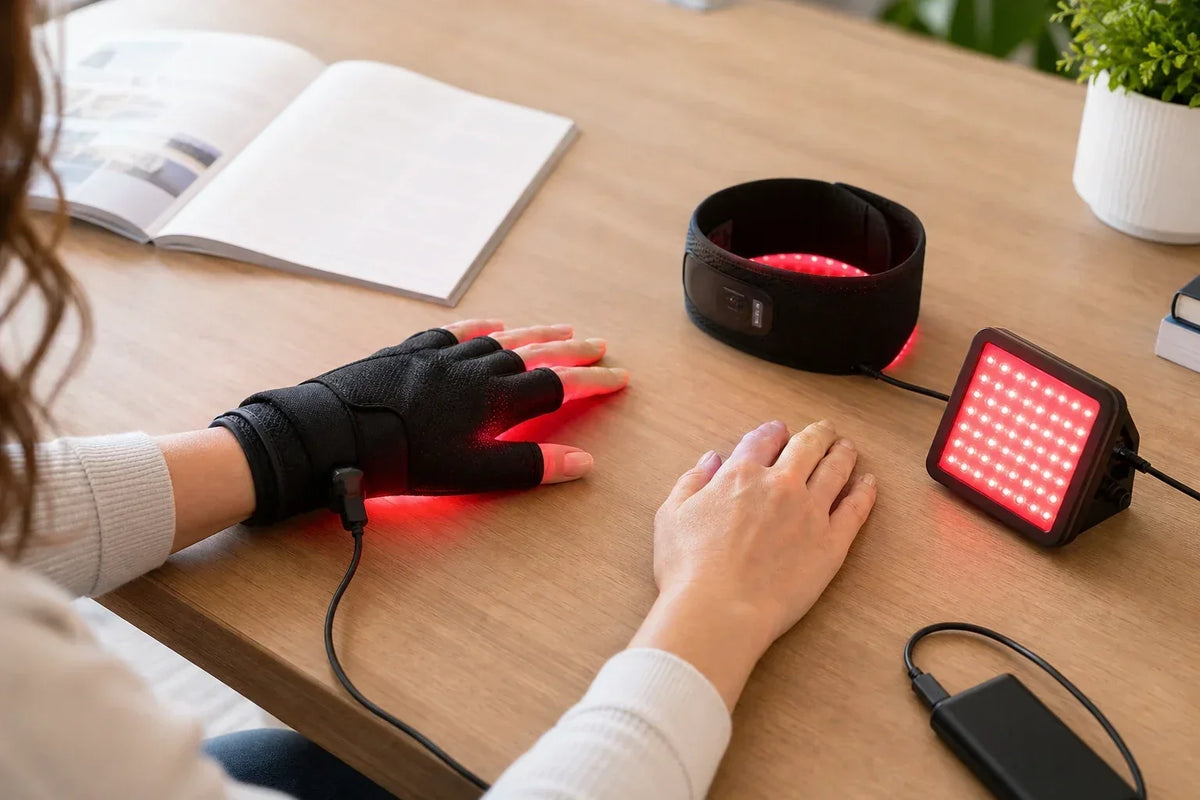
Red light therapy sleeping bag guide: compare 15 vs 30 minute sessions, blanket vs panel, 660nm vs 850nm, safety, cleaning, and buying specs.
Editorial Review: This article was written for consumer education about red light therapy sleeping bags, full-body LED blankets, red and near-infrared wavelengths, session timing, device safety, cleaning, and buying specifications. It references public resources from Cleveland Clinic, NIH/PMC, FDA, and FTC. It is not medical advice and does not replace guidance from a qualified professional.
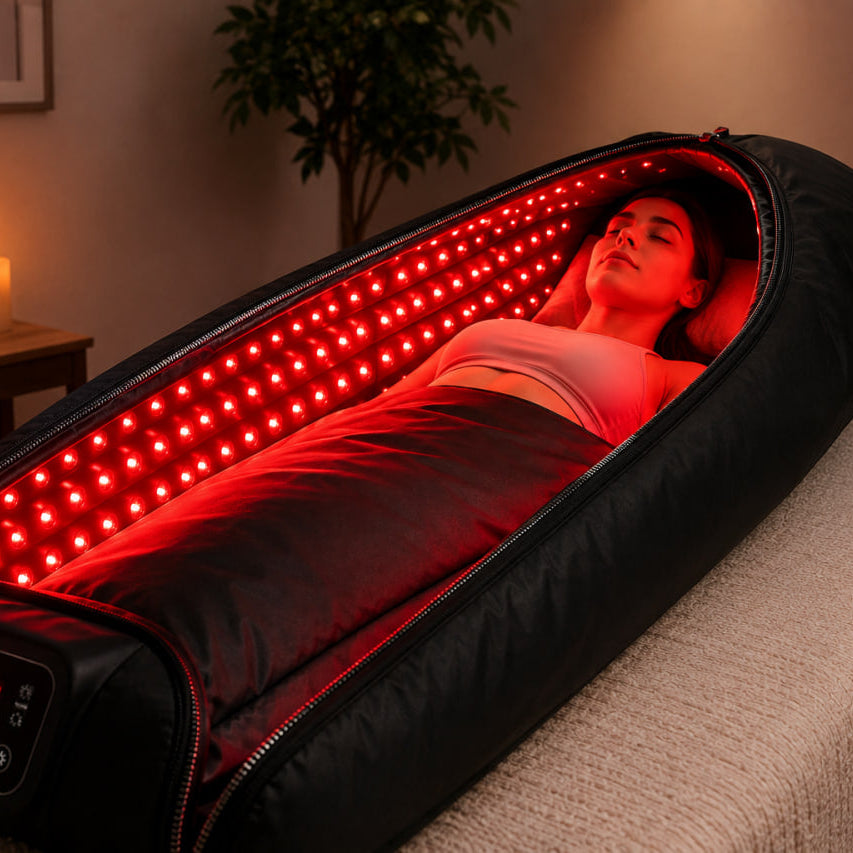
If you searched for a red light therapy sleeping bag, the practical answer is this: it is usually a flexible, full-body LED blanket or pod with red and near-infrared lights facing inward. You lie between two illuminated mats for a short, timed session rather than sleeping inside it overnight.

Most home devices use wavelengths such as 660nm red light and 850nm near-infrared light. Consumer session instructions commonly fall between 10 and 30 minutes, but the correct time depends on the device’s output, intensity setting, construction, and manufacturer directions.
My personal take is simple: the sleeping-bag format is appealing because it provides broad coverage without requiring you to stand and rotate in front of a panel. Its biggest weaknesses are heat buildup, cleaning, storage, uncertain specifications, and the temptation to stay inside longer simply because it feels comfortable.
Quick Q&A: What Most People Want to Know First
| Question | Short Answer | My Practical Note |
|---|---|---|
| What is a red light therapy sleeping bag? | It is a full-body LED blanket or pod with inward-facing red and near-infrared lights. | I would think of it as two flexible light mats zipped together, not as ordinary bedding. |
| Can you sleep inside it overnight? | Usually no. The name describes the shape, not an overnight-use routine. | Use the timer, stay awake, and leave the bag when the session ends. |
| Is 15 or 30 minutes better? | Fifteen minutes is a more conservative starting point. Thirty minutes should only be used when the manual supports it. | I would not double the time before checking skin comfort, warmth, and device instructions. |
| Is a sleeping bag better than a panel? | It is better for convenient full-body coverage; a panel is better for airflow, distance control, and targeted positioning. | The better format depends on whether you value comfort or control more. |
| Is it the same as an infrared sauna blanket? | No. A red light blanket uses LEDs, while a sauna blanket primarily uses heat. | If the main result is heavy sweating, you are probably looking at a different device category. |
| Should you wear clothes inside? | Direct light reaches uncovered skin more easily, but comfort and hygiene still matter. | I would use minimal, breathable clothing if direct skin contact feels uncomfortable. |
| How often should you use it? | Many home routines begin around 2–3 times weekly and may increase if the device instructions allow it. | Consistency matters more than starting with the longest possible routine. |
What Is a Red Light Therapy Sleeping Bag?
A red light therapy sleeping bag is also commonly called a red light therapy blanket, red light therapy pod, full-body LED mat, or red light sleep bag. Most designs use two flexible sections that surround the front and back of the body.
The inner surfaces contain arrays of LEDs. Depending on the product, the two sections may zip together, attach with hook-and-loop fasteners, or separate into independent mats. The user generally lies flat with the head outside the device.
Cleveland Clinic describes red light therapy as exposure to low levels of red light without the ultraviolet light used by tanning devices. It also emphasizes short-term use according to device directions. You can review its overview here: Cleveland Clinic red light therapy overview.
| Common Name | What It Usually Describes | Important Difference |
|---|---|---|
| Red light therapy sleeping bag | A zippered or wraparound full-body LED device | “Sleeping bag” describes the physical shape |
| Red light therapy blanket | A flexible LED device used over or around the body | May separate into two flat mats |
| Red light therapy pod | An enclosed or semi-enclosed full-body system | May be flexible or rigid depending on the product |
| Full-body red light mat | A flat LED mat placed below or above the user | One mat may illuminate only one side at a time |
| Infrared sauna blanket | A heated wrap designed to create substantial warmth | It is primarily a thermal device, not an LED light blanket |
15 vs 30 Minutes: How Long Should a Session Be?
There is no universal session length for every red light therapy sleeping bag. Two products can look nearly identical while using different LED counts, chip layouts, intensity settings, surface areas, and electrical power.
Photobiomodulation research frequently describes a biphasic dose response: increasing the exposure does not always create a proportionally stronger response. A dose can be too low, but it can also be unnecessarily high. You can review the NIH/PMC dose-response paper here: NIH/PMC biphasic dose-response review.
Here’s the practical way I’d look at it: start near the lower end of the manufacturer’s timing range. If the manual allows 15–30 minutes, begin with 10–15 minutes rather than assuming 30 minutes is automatically better.
| Session Length | Best Fit | Practical Interpretation | When to Be Careful |
|---|---|---|---|
| 5–10 minutes | First-use comfort test | Useful for checking warmth, fit, skin response, and controls | May be shorter than the device’s intended routine |
| 15 minutes | Conservative beginner session | A practical starting point for many full-body devices | Still follow the stated intensity and safety instructions |
| 20 minutes | Established routine | Commonly manageable without making the session feel excessive | Reduce time if the enclosed space becomes uncomfortable |
| 30 minutes | Only when supported by the manual | May suit lower-output settings or specific products | Do not assume longer exposure creates better results |
| Over 30 minutes | Device-specific use only | Often unnecessary for an introductory home routine | More warmth, moisture, and prolonged light exposure |
Can You Actually Sleep in a Red Light Therapy Sleeping Bag?
Treat “sleeping bag” as a product description, not permission to sleep overnight while the LEDs are powered. Most devices are built around a timed wellness session, electrical controller, power adapter, and auto shutoff.
I would be careful here. Falling asleep can prevent you from noticing excessive warmth, a folded cable, skin discomfort, a controller problem, or a shifted device. Unless a manufacturer explicitly states that overnight operation is permitted, use it only while awake.
- Use the built-in timer for every session.
- Do not bypass the automatic shutoff.
- Do not place another heavy blanket over the powered device.
- Do not use it on wet skin or near spilled liquids.
- Keep the controller and power adapter uncovered.
- Leave the bag if you feel unusually hot, dizzy, irritated, or uncomfortable.
Sleeping Bag vs Panel vs Flat Mat
The sleeping-bag format is not automatically stronger than a panel. Its advantage is geometry: the LEDs surround much of the body, so you do not need to stand, turn around, or reposition several times.
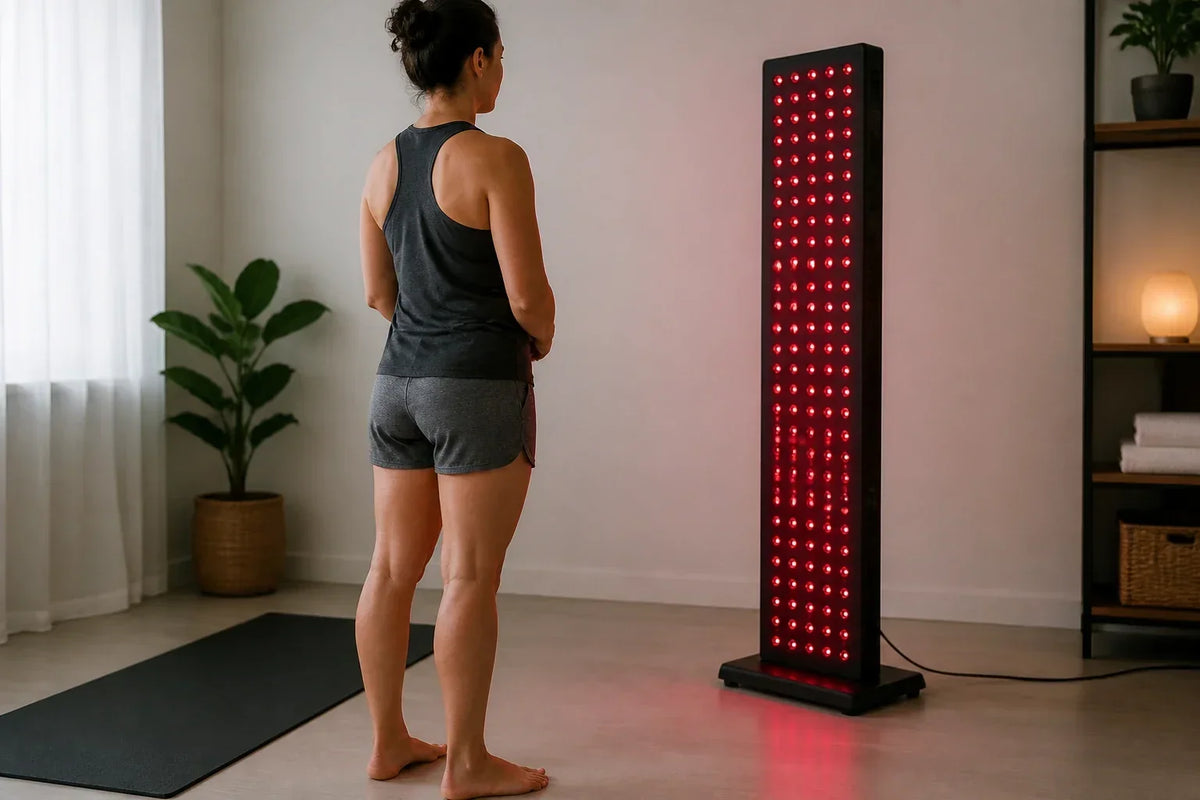
A panel provides more airflow and lets you control distance. A flat mat is easier to clean and store but may illuminate only one side unless you use two mats. A sleeping bag provides close, broad coverage but can feel enclosed.
| Feature | Sleeping Bag | Panel | Flat Mat |
|---|---|---|---|
| Coverage | Front and back simultaneously | One direction at a time | Usually one side at a time |
| Distance control | Limited because LEDs are close | Easy to adjust | Limited or contact-based |
| Airflow | Lowest | Highest | Moderate |
| Comfort | Relaxed lying position | May require standing or sitting | Relaxed but less enclosed |
| Storage | Bulky and should not be sharply folded | Rigid and requires dedicated space | Usually easier to roll or store flat |
| Best fit | Convenient full-body sessions | Targeted control and broader versatility | Simple one-sided relaxation routines |
Red Light Sleeping Bag vs Infrared Sauna Blanket
These products can look similar in photographs, but they are not interchangeable. A red light therapy blanket uses LEDs to emit selected red and near-infrared wavelengths. An infrared sauna blanket uses heating elements to create a much hotter, sweat-focused experience.
A red light sleeping bag may feel warm because it surrounds the body and contains powered LEDs, but strong heat is not supposed to be the main operating mechanism. If your primary goal is a sauna-like sweat session, you are comparing a different product category.
| Feature | Red Light Therapy Sleeping Bag | Infrared Sauna Blanket |
|---|---|---|
| Main technology | Red and near-infrared LEDs | Far-infrared or resistive heating elements |
| Typical sensation | Mild warmth and enclosed comfort | Strong heat and sweating |
| Main buying specs | Wavelength, LEDs, intensity, timer, coverage | Temperature range, heating zones, insulation, timer |
| Clothing | Minimal clothing may improve direct light exposure | Clothing or towel layers may be used for heat and hygiene |
| Common confusion | Assuming warmth proves the LEDs are effective | Assuming any infrared heat device is red light therapy |
660nm and 850nm: What Wavelengths Should You Look For?
Many consumer sleeping bags use a combination of visible red light around 630–660nm and near-infrared light around 810–850nm. These are common ranges in photobiomodulation devices, but wavelength alone does not tell you the complete dose.
A scientific review of photobiomodulation parameters explains that wavelength, irradiance, exposure time, pulse characteristics, and total delivered energy can all affect a light protocol. You can review the paper here: NIH/PMC review of light parameters and PBM efficacy.
This is where many home users get confused. A product can advertise thousands of LEDs, but the LED count alone does not reveal how much light reaches the skin or how evenly it is distributed.
| Specification | What It Tells You | What It Does Not Prove |
|---|---|---|
| 630–660nm | The device includes visible red wavelengths | That the dose or coverage is appropriate |
| 810–850nm | The device includes near-infrared wavelengths | That invisible LEDs are operating at the claimed output |
| LED count | How many light packages are installed | The number of chips, power per chip, or uniformity |
| Irradiance | Light power measured over an area | The exact dose unless time and test method are also provided |
| Pulse mode | The device can cycle its output | That pulsing is automatically better than continuous light |
| Brightness level | User-adjustable output setting | A standardized dose across different brands |
9 Buying Checks Before You Spend Money
A red light therapy sleeping bag can cost substantially more than a small panel or mat, so the buying page should provide more than a large LED number and a glowing product photograph.
A 2026 consumer product guide in PubMed Central emphasizes the importance of evaluating wavelength, power-related parameters, treatment distance, dose, and credible product information when comparing red light devices. You can review it here: NIH/PMC red light therapy product guide.
| Buying Check | What to Look For | Red Flag |
|---|---|---|
| 1. Wavelengths | Exact red and NIR wavelength numbers | Only says “full spectrum infrared” |
| 2. Internal dimensions | Length and width that match your height and shoulder width | Only exterior package dimensions |
| 3. LED configuration | Number of LEDs, chips per LED, and red-to-NIR ratio | A huge chip count with no explanation |
| 4. Output testing | Irradiance with test distance and measurement method | A power figure with no testing context |
| 5. Controls | Timer, intensity adjustment, and separate red/NIR modes | No auto shutoff |
| 6. Materials | Durable, wipe-clean inner surface and reinforced wiring | Strong odor, thin seams, or exposed wiring |
| 7. Safety | Electrical certifications, overheating protection, and clear warnings | Only vague “medical grade” language |
| 8. Warranty | Clear coverage for controllers, adapters, LEDs, and the blanket | Short return period with no repair policy |
| 9. Cleaning instructions | A written method that protects the LEDs and electrical connections | No hygiene or maintenance guidance |
How to Use a Red Light Therapy Sleeping Bag at Home
If this were my routine, I would make the first session intentionally simple. Do not combine a new bag, maximum brightness, pulse mode, a long timer, and another light device on the same day.
- Lay the sleeping bag flat on a stable bed, table, or floor mat.
- Inspect the power cables, connectors, controller, seams, and LED surfaces.
- Make sure your skin and the inside of the device are dry.
- Keep the head outside unless the device is specifically designed otherwise.
- Use minimal clothing or breathable fabric according to your comfort and the manual.
- Begin with a lower intensity and a 10–15 minute timer.
- Keep the controller, adapter, and ventilation areas uncovered.
- Stay awake and stop if the enclosure becomes excessively warm or uncomfortable.
- Power the device off before getting out or disconnecting any cable.
- Wipe and fully dry the inner surface before storage.
Safety Checklist for Full-Body LED Bags
Red light therapy is generally discussed as low-risk when used for short sessions and according to instructions, but a powered full-body enclosure still needs more attention than a small tabletop lamp.
The FDA’s general wellness guidance distinguishes low-risk wellness claims from disease-related medical claims. You can review the guidance here: FDA General Wellness Policy for Low Risk Devices.
| Safety Area | Practical Rule |
|---|---|
| Session timer | Use automatic shutoff and do not operate it overnight |
| Skin comfort | Stop for excessive warmth, persistent redness, irritation, or discomfort |
| Eyes | Keep the face outside and use eye protection when bright LEDs are visible |
| Medication | Ask a healthcare professional about medicines associated with light sensitivity |
| Electrical safety | Keep connectors dry and do not use damaged cables or adapters |
| Folding | Do not sharply fold, crush, or sit on LED and wiring sections |
| Supervision | Do not use it casually with children or someone unable to report discomfort |
Cleaning and Storage: The Part Buyers Often Ignore
Cleaning matters more with a sleeping bag than with a panel because the inner material sits close to the body. Sweat, skincare products, oils, and moisture can collect on the surface even when the device is not intended to act like a sauna.
Use only the cleaning method specified by the manufacturer. In most cases, that means powering off, unplugging the device, wiping the surface with a lightly damp cloth or approved cleaner, and allowing it to dry fully before reconnecting it.
Do not machine wash a powered LED blanket. Do not soak it, spray liquid directly into connectors, use it while wet, or fold it tightly around the controller and wiring. Store it flat or loosely rolled according to the manual.
Common Red Light Sleeping Bag Mistakes
| Mistake | Why It Happens | Better Move |
|---|---|---|
| Sleeping inside while it stays powered | The product is called a sleeping bag | Treat it as a timed session device |
| Starting with 30–45 minutes | Longer feels more valuable | Start around 10–15 minutes if the manual allows |
| Confusing it with a sauna blanket | The products have a similar shape | Check whether it uses LEDs or heating elements |
| Buying by LED count alone | Large numbers look impressive | Compare wavelengths, output testing, size, and controls |
| Ignoring body dimensions | Product photos make every bag look large | Compare internal length and shoulder width |
| Using it while damp | Users shower immediately before a session | Dry the body and device fully first |
| Folding it sharply for storage | The device looks like normal fabric | Protect embedded LEDs, wiring, and connectors |
My Practical View
My personal take is simple: a red light therapy sleeping bag solves a real convenience problem. It gives users broad front-and-back coverage while they lie down, which may be easier to repeat than standing in front of a large panel.
What often gets missed is that close coverage also removes some control. With a panel, you can step backward, change angle, expose one area, or leave more airflow. Inside a bag, the LEDs remain close, the device traps warmth, and the body position is less adjustable.
If I were helping a friend compare one with a panel, I would ask whether they actually enjoy enclosed devices. Someone who dislikes warmth, tight spaces, cleaning flexible materials, or lying still may use a panel more consistently.
The part I would pay attention to is not the largest LED number. I would look for an appropriate size, exact wavelengths, measured output with context, a reliable timer, separate intensity controls, safe wiring, realistic claims, and a return policy long enough to test the routine.
I would not buy a red light sleeping bag specifically to sleep in it. I would buy it only if I wanted a comfortable 15–30 minute full-body light session and preferred lying down over standing and rotating in front of a panel.
References
- Cleveland Clinic: Red Light Therapy Overview
- NIH/PMC: Biphasic Dose Response in Low Level Light Therapy
- NIH/PMC: Review of Light Parameters and PBM Efficacy
- NIH/PMC: Controlled Trial of Large-Area Red and Near-Infrared Light
- NIH/PMC: What to Look for in Red Light Therapy Products
- FDA: General Wellness Policy for Low Risk Devices
- FTC: Health Products Compliance Guidance
FAQ
What is a red light therapy sleeping bag?
A red light therapy sleeping bag is a flexible full-body device with inward-facing red and near-infrared LEDs. It is also called a red light therapy blanket, LED pod, full-body mat, or red light sleep bag.
Can you sleep overnight in a red light therapy sleeping bag?
The sleeping-bag name describes the shape, not overnight use. Unless the manufacturer explicitly permits it, use the device only for a timed session while awake and allow the automatic timer to shut it off.
How long should you use a red light therapy sleeping bag?
Many consumer routines fall between 10 and 30 minutes. A conservative approach is to begin around 10–15 minutes and follow the exact timing and intensity guidance supplied with the device.
How often can you use a red light therapy blanket?
Some home routines begin around 2–3 sessions per week and increase gradually if the device manual permits it. Frequency should be based on the product’s output, session length, and individual comfort.
Is a red light therapy sleeping bag better than a panel?
A sleeping bag offers convenient front-and-back coverage while lying down. A panel provides more airflow, easier distance control, and more flexible targeting. The better choice depends on space, comfort, and preferred routine.
Is a red light sleeping bag the same as an infrared sauna blanket?
No. A red light sleeping bag primarily uses red and near-infrared LEDs. An infrared sauna blanket primarily uses heating elements to create substantial warmth and sweating.
What wavelengths should a red light therapy sleeping bag use?
Many products use visible red wavelengths around 630–660nm and near-infrared wavelengths around 810–850nm. Wavelengths should be considered together with measured output, timing, intensity, and coverage.
Do you need eye protection in a red light therapy sleeping bag?
Keep your head outside the bag unless it is specifically designed otherwise. Avoid looking into exposed LEDs and use goggles when bright red or near-infrared lights are visible near the face.