Red light therapy encyclopedia
Can a Device Remove Face Wrinkles? A Realistic Home-Device Guide
No home device literally erases every wrinkle. Some cleared LED and radiofrequency devices can improve the appearance of certain wrinkles with consistent use, while deeper folds and skin laxity usually need professional assessment.
A home beauty device may soften the appearance of some facial lines, but it cannot literally erase every wrinkle. The result depends on what is creating the line, which technology the device uses, how consistently it is used, and whether the product was designed for that specific cosmetic concern.
For fine lines and an overall smoother-looking complexion, a well-documented red and near-infrared LED device is often the simplest noninvasive option. A home radiofrequency device may be more relevant when the main concern is a slightly looser or less firm-looking appearance. Microcurrent is usually chosen for temporary facial toning and contour definition rather than gradual fine-line care.
The most important step is not choosing the most powerful-looking device. It is identifying what you are calling a “wrinkle” before spending money.
Can a Device Remove Face Wrinkles? The Quick Answer
No home device can guarantee complete or permanent wrinkle removal. A better expectation is a gradual improvement in the appearance of selected fine lines, texture, or facial firmness.
| Main concern | Most relevant starting point | Realistic expectation |
|---|---|---|
| Fine lines that look worse when skin is dry | Moisturizer and daily sun protection before buying a device | Skin may look smoother quickly when dryness is reduced |
| Fine lines and general skin texture | Red and near-infrared LED device | Subtle, gradual improvement in overall appearance with consistent use |
| Slightly loose or less firm-looking skin | Home radiofrequency device designed for facial use | Modest changes that depend heavily on correct technique and regular use |
| Temporary facial toning or contour definition | Microcurrent device | A short-term toned or lifted-looking effect that usually requires continued use |
| Deep expression lines | No home device is likely to remove them | At-home changes are usually limited |
| Deep folds or visible volume changes | Professional assessment rather than another home gadget | These concerns are not simply surface wrinkles |
| Established uneven texture or significant sun-related changes | A broader skincare or professional plan | A single home device is unlikely to address every visible feature |
My practical view: LED is usually the easiest place to start for someone who wants a low-effort, noninvasive routine for fine-line appearance. RF requires more technique and attention to contact, movement, and heat. Microcurrent can make sense for temporary facial definition, but it should not be confused with a permanent change in facial structure.

First Identify What Kind of “Wrinkle” You See
Wrinkle is a useful everyday word, but it can describe several visibly different concerns. This is why two people can buy the same device and come away with completely different opinions.
One person may be looking at fine dehydration lines under the eyes. Another may be concerned about lines that appear only while smiling. Someone else may be noticing looser-looking skin around the jawline rather than a true surface crease.
Those concerns do not require the same buying decision.
Fine lines made more visible by dryness
Dry or dehydrated skin can make shallow lines look more pronounced. These lines may appear especially noticeable after cleansing, during cold weather, in air-conditioned rooms, or after using an overly aggressive skincare routine.
Before buying an expensive device, try improving the basic routine:
- use a mild cleanser;
- apply a suitable moisturizer consistently;
- avoid overusing exfoliating products;
- protect exposed skin from the sun; and
- give the routine enough time to settle.
A device cannot compensate for a routine that leaves the skin visibly dry and irritated. In many cases, improving moisture balance makes fine lines look softer faster than adding another gadget.
Dynamic or expression lines
Dynamic lines appear when facial muscles move. Common examples include smile lines around the eyes, forehead lines while raising the eyebrows, and lines between the brows while frowning.
A home beauty device may improve the surrounding skin's overall appearance, but it does not stop normal facial movement. Anyone expecting a mask or handheld tool to permanently remove expression lines is likely to be disappointed.
Static lines
Static lines remain visible when the face is relaxed. They may have started as expression lines and gradually become more noticeable at rest.
Fine static lines are the type most likely to fit the realistic promise of gradual cosmetic improvement. Deeper etched lines are less likely to change substantially with a home device.
Loose or less firm-looking skin
Some people describe lower-face softness, jawline changes, or creasing around the mouth as wrinkles. In these cases, the main concern may be firmness or facial contour rather than a surface line.
This distinction matters because LED, RF, and microcurrent are chosen for different reasons:
- LED is commonly used as part of a gradual skin-appearance routine.
- RF is generally selected for a firmer-looking appearance.
- Microcurrent is usually used for temporary toning and definition.
Posture, shadows, and camera processing
Not every apparent wrinkle represents a lasting change in the skin. Overhead lighting, phone-camera sharpening, facial position, makeup settling, and dehydration can all make lines look deeper.
Before deciding that a device is working—or failing—compare photographs taken under the same conditions. Otherwise, a brighter window or a different camera angle can create a more dramatic “result” than the device itself.
LED vs. Radiofrequency vs. Microcurrent for Facial Lines
| Technology | How it is used | Most suitable cosmetic goal | Main limitation |
|---|---|---|---|
| Red and near-infrared LED | Non-contact or wearable light exposure | Fine-line appearance and overall skin texture | Changes are usually gradual and modest |
| Home radiofrequency | A handheld applicator warms the skin while moving over a conductive medium | Firmer-looking skin and mild laxity concerns | Technique, contact, temperature control, and consistency matter |
| Microcurrent | Low-level electrical current passes between conductive contact points | Temporary facial toning and contour definition | The visible effect may fade without continued use |
| Massage, rollers, and gua sha | Manual pressure and movement | Temporary reduction in a puffy appearance and a refreshed look | They do not remove established wrinkles |
| Microneedling or RF microneedling | Needles penetrate the skin, sometimes while delivering RF energy | Professional aesthetic procedures | Not equivalent to an ordinary home beauty device |
The best device is therefore not the device with the longest specification sheet. It is the one that matches the visible concern and remains practical enough to use as directed.
When an LED Mask or Panel Makes Sense
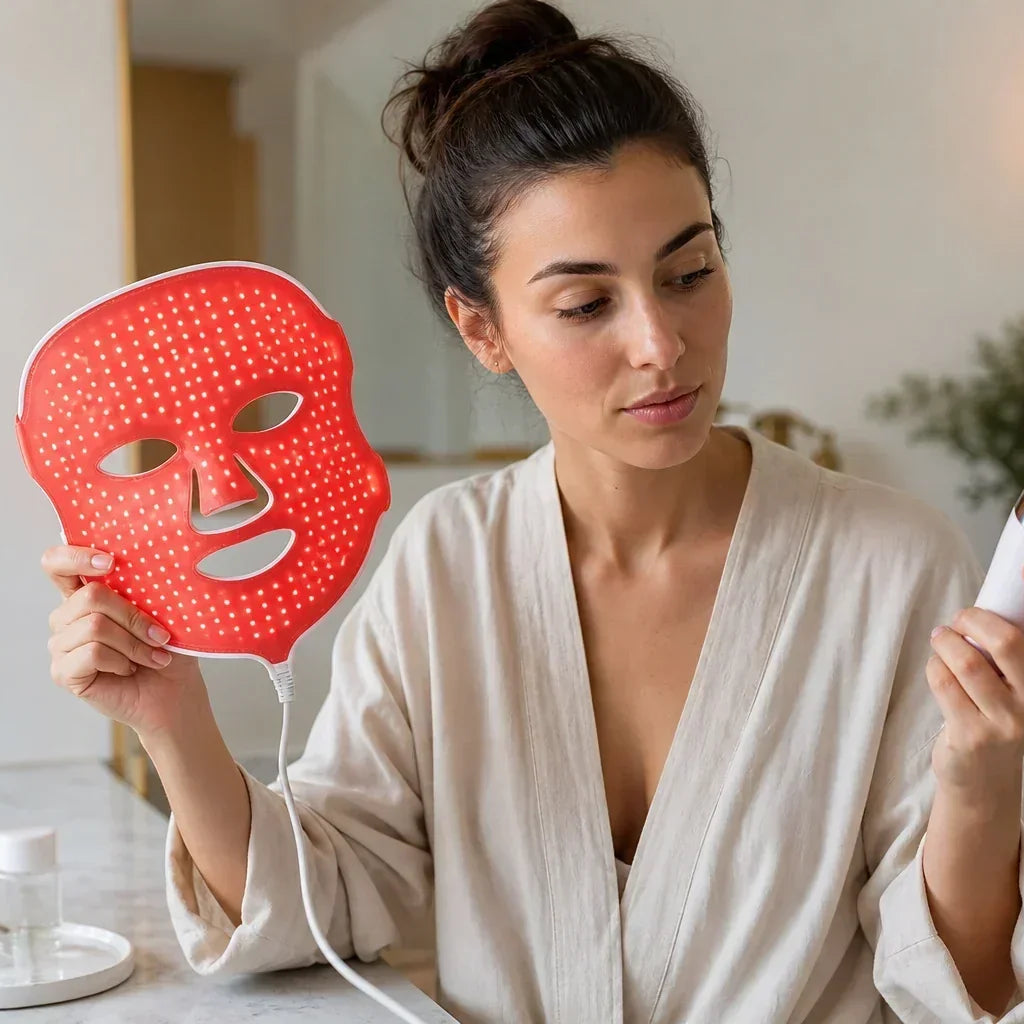
Red and near-infrared LED products are common choices for people who want a hands-free or non-contact beauty routine. Depending on the model, the device may use visible red wavelengths, near-infrared wavelengths, or a combination of both.
Commonly listed ranges include:
- approximately 630 to 660 nm for visible red light; and
- approximately 810 to 850 nm for near-infrared light.
Those wavelength numbers help identify the type of light. They do not tell you how well the device fits, how evenly it covers the face, how much output reaches the skin, or whether the product has a wrinkle-related intended use.
What an LED device may realistically do
A carefully selected LED device may support a routine aimed at:
- softening the visible appearance of fine lines;
- creating a smoother-looking complexion;
- supporting a more even and refreshed appearance; and
- maintaining a consistent, noninvasive skincare routine.
The changes are generally expected to be gradual. An LED mask should not produce the type of immediate contour change sometimes associated with massage or microcurrent.
That slower pace is not necessarily a disadvantage. A hands-free mask can be easier to repeat consistently than a device that requires careful movement across every area of the face.
Why the exact model matters
Recent FDA device summaries include specific over-the-counter LED masks intended for full-face wrinkle-related use. These documents list individual model numbers, wavelengths, output characteristics, controllers, eye shields, and operating instructions.
This does not mean every red-light bulb, panel, mask, or wand should be described in the same way.
The responsible comparison is:
- exact model versus exact model;
- stated wavelength versus stated wavelength;
- measured output at a stated distance;
- full-face coverage versus partial coverage;
- mask fit and eye shielding;
- recommended session time; and
- the specific intended use stated by the manufacturer.
LED mask or LED panel?
| Feature | LED face mask | LED panel |
|---|---|---|
| Distance | Usually fixed or limited by the mask design | User must maintain the recommended distance |
| Coverage | Designed mainly around the face | May cover the face, neck, chest, or a larger area |
| Fit | Can vary around the nose, jaw, forehead, and eye area | Does not press against the face |
| Ease of use | Often hands-free and portable | Requires suitable positioning or a stand |
| Heat and comfort | May feel close, heavy, or warm | Air gap can feel more comfortable |
| Best choice when | The priority is a compact face-only routine | The user wants more flexible coverage |
Neither format is automatically better. A mask may provide repeatable placement, but poor fit can create uneven spacing. A panel can offer broader coverage, but only when the user can position it consistently.
Do more wavelengths make a better wrinkle device?
Not necessarily. Some devices advertise amber, red, deep red, near-infrared, blue, green, yellow, and several combination modes.
For someone focused on fine-line appearance, a clearly documented red and near-infrared program is generally easier to understand than a seven-color chart filled with vague promises.
More modes create value only when the manufacturer explains:
- the wavelength of each mode;
- which cosmetic concern it is designed around;
- whether the lights run together or separately;
- the recommended session schedule; and
- which claims apply to the exact model.
My preference is fewer, better-explained modes. A device should not need a rainbow of colors to appear advanced.

When a Home Radiofrequency Device May Be Relevant
Home radiofrequency devices use electrical energy to create controlled warmth while the applicator moves over the skin. They are generally marketed to people concerned about a firmer-looking appearance rather than only shallow surface lines.
RF requires more active technique than an LED mask. The user may need to:
- apply the specified conductive gel;
- maintain full contact with the skin;
- move the applicator at the correct speed;
- avoid holding it in one place;
- select an appropriate setting; and
- follow the stated session pattern for each facial area.
This makes instructions especially important. A device that depends on controlled warmth should not be used by guessing the temperature, copying a social-media routine, or replacing the supplied conductive product with an unverified alternative.
What home RF is best suited for
A home RF device may be worth considering when:
- the main goal is a slightly firmer-looking appearance;
- the user is comfortable operating a handheld tool;
- the routine includes clear movement and contact instructions;
- the device is specifically designed for home facial use; and
- the user is willing to repeat the process consistently.
It is less convincing when the product page promises a dramatic lift, permanent tightening, or professional-level results from a few minutes of use.
Home RF is not the same as RF microneedling
This distinction should be clear.
A noninvasive home RF applicator moves across the surface of the skin. RF microneedling uses small needle-like electrodes that enter the skin while delivering energy at selected depths.
RF microneedling is not a casual DIY alternative to a home RF beauty tool. FDA safety information issued in 2025 describes RF microneedling as a professional procedure and specifically advises against at-home use.
I would not purchase an online “professional RF microneedling pen” simply because it is available without an appointment. Marketplace availability does not establish that a device is appropriate for unsupervised home use.
What Microcurrent Is Best Suited For
Microcurrent devices use low-level electrical current delivered through conductive contact points. They are most often chosen for temporary facial toning, a more defined-looking contour, or a refreshed appearance before an event.
This is different from the gradual skin-appearance goal associated with LED.
Why microcurrent can look more immediate
A microcurrent session may create a temporary visual change in facial definition or symmetry. Lighting, hydration, massage movement, and reduced puffiness may also contribute to the before-and-after appearance.
The visible effect should not automatically be interpreted as a permanent change in the skin or face.
Microcurrent tends to make the most sense for someone who:
- wants a temporary toned look;
- does not mind manually treating different areas;
- is comfortable using conductive gel;
- can follow the contact pattern shown in the instructions; and
- accepts that regular maintenance may be necessary.
Microcurrent is not the most direct fine-line device
A consumer may see “lifting,” “sculpting,” and “wrinkle reduction” used together on product pages. Those phrases describe different visual goals.
Microcurrent may make the face look temporarily more toned, but that does not mean it is the most direct choice for fine lines across the full face. Someone mainly concerned with fine-line appearance may find an LED routine easier and more relevant.
Conductive gel is part of the system
Conductive gel is not merely an optional skincare extra. It helps the electrical current travel between the device and the skin.
Before substituting another gel or serum, check:
- whether it remains wet for the full session;
- whether it is compatible with the device;
- whether it contains irritating ingredients;
- whether the manufacturer permits alternatives; and
- whether it changes how the device glides or maintains contact.
What a Home Device Is Unlikely to Change
A realistic buying guide should be just as clear about limitations as it is about features.
Deep folds
Deep folds around the mouth or lower face are not simply larger versions of dry surface lines. Their appearance can be influenced by movement, facial shape, skin support, and changes beneath the surface.
A home LED, RF, or microcurrent device may improve the surrounding appearance, but complete removal is not a realistic expectation.
Facial volume changes
A light mask cannot replace lost facial volume. A microcurrent tool cannot permanently move facial tissue into a new position. A home RF device should not be marketed as a substitute for every professional option.
This is an important distinction because some “wrinkle” searches are actually searches about hollow areas, deeper folds, or facial contour changes.
Lines caused by repeated movement
Home devices do not stop the facial expressions that create dynamic lines. They may support overall skin appearance, but they do not remove the movement itself.
Visible spots or changing areas
Do not assume that every mark, rough area, or line is a normal sign of aging. An area that changes noticeably, bleeds, does not heal, or looks unlike surrounding skin should not simply be covered with a device and ignored.
A poor basic skincare routine
No device can fully offset:
- frequent unprotected sun exposure;
- persistent irritation from using too many strong products;
- dryness caused by an unsuitable cleanser;
- inconsistent moisturizing; or
- a routine that changes every few days.
Daily sun protection and moisturizer are less exciting than a new beauty gadget, but they create the foundation that makes any device easier to evaluate.
What Should Come Before an Anti-Wrinkle Device?
Before comparing masks, wands, and handheld tools, make sure the basic routine is stable.
| Routine step | Why it comes first |
|---|---|
| Gentle cleansing | Repeated irritation can make lines and texture look more noticeable |
| Moisturizer | Improving hydration can soften the appearance of shallow dry lines |
| Daily broad-spectrum sun protection | Helps reduce further visible sun-related changes |
| A stable nighttime routine | Makes it easier to identify what is improving or irritating the skin |
| Realistic photography | Prevents lighting and camera processing from being mistaken for results |
A device should be an addition to a workable routine, not a replacement for one.
How to Build a Realistic Home-Device Routine
1. Choose one primary cosmetic goal
Avoid starting with a vague goal such as “reverse aging.” Choose something that can actually be observed:
- fine lines around the eyes;
- overall skin texture;
- forehead line appearance;
- a firmer-looking jawline; or
- temporary facial definition.
A clear goal makes it easier to select the technology and judge whether the purchase was worthwhile.
2. Add one device at a time
Starting LED, RF, microcurrent, a new retinol product, an exfoliating acid, and a facial massage routine during the same week makes the result impossible to interpret.
It also increases the chance of irritation.
Start with one meaningful change. Keep the rest of the routine stable while you evaluate comfort and consistency.
3. Follow the exact device schedule
Do not assume that more time, more power, or more frequent sessions will produce a better result.
Different products may use different:
- wavelengths;
- output levels;
- contact methods;
- session durations;
- recommended frequencies; and
- treatment areas.
A schedule written for one device should not be copied to another simply because both use red light or RF.
4. Use it at the right point in the skincare routine
The correct order depends on the device.
Many LED products are designed for clean, dry skin, with skincare applied afterward. Microcurrent and RF devices commonly require a suitable conductive medium. The manual should take priority over a generic social-media routine.
5. Keep the routine sustainable
A device that requires twenty minutes of preparation, a difficult cleanup process, and precise manual movement may be abandoned after two weeks.
Before buying, ask yourself:
- Where will I use it?
- How long does setup take?
- Does it need charging?
- Do I need replacement gel?
- Can I use it without holding it?
- Is the mask comfortable enough to repeat?
- Can the device be cleaned easily?
Consistency usually matters more than owning the most complicated option.
How to Tell Whether a Wrinkle Device Is Helping
Beauty-device results are easy to exaggerate unintentionally. A bathroom light, phone camera, facial expression, or freshly applied moisturizer can change the apparent depth of a line.
Create a useful baseline
Before the first session, take photographs using:
- the same camera;
- the same lens;
- the same room;
- the same time of day;
- the same distance;
- the same facial expression;
- the same head position; and
- no beauty filter or portrait retouching.
Take one relaxed front-facing photograph and consistent side views. For expression lines, capture both a relaxed face and the same repeated expression.
Do not compare immediately after a session
Immediately after using a device, the skin may look temporarily different because of:
- warmth;
- moisture from a conductive gel;
- massage;
- temporary flushing;
- reduced puffiness; or
- more flattering lighting.
For a fair comparison, take progress photographs under normal conditions rather than at the most flattering moment after use.
Use the model's evaluation period
There is no universal number of days that applies to every technology. Follow the assessment period provided for the exact model.
If a product promises a permanent transformation after one or two uses, that should raise more questions than confidence.
Evaluate more than one line
Track several practical factors:
| Area to evaluate | Question to ask |
|---|---|
| Fine-line appearance | Do lines look softer under the same lighting and facial position? |
| Overall texture | Does the skin look smoother without changing camera settings? |
| Comfort | Can I use the device without persistent heat, pressure, or irritation? |
| Adherence | Am I actually following the recommended schedule? |
| Time cost | Does the routine fit into normal life? |
| Ongoing expense | Does it require replacement gel, accessories, or subscriptions? |
A device that creates a small cosmetic change but is unpleasant enough to abandon may still be a poor purchase.
A Practical Home Wrinkle-Device Buying Checklist
| Check | What to look for | Warning sign |
|---|---|---|
| Primary concern | A clear match between the technology and the visible concern | One device claims to solve every sign of aging |
| Exact intended use | Model-specific wording about fine lines, wrinkles, or cosmetic appearance | Claims copied from unrelated products or general research |
| Technology | A clear explanation of LED, RF, or microcurrent | Several technologies listed without explaining which mode does what |
| Operating instructions | Specific session time, frequency, contact method, and facial areas | “Use as often as desired” |
| LED specifications | Wavelengths, operating modes, output conditions, and coverage | Only LED count or electrical wattage |
| RF specifications | Home-use design, heat controls, contact instructions, and compatible gel | Professional-level language with no clear consumer instructions |
| Microcurrent use | Conductive medium, contact pattern, and maintenance schedule | Permanent lifting claims |
| Eye guidance | Clear positioning or protective instructions for light devices | No guidance because the product is described as “non-UV” |
| Regulatory wording | Exact model and record when a clearance claim is made | “FDA approved” based only on registration or listing |
| Return window | Enough time to evaluate fit, comfort, and routine compatibility | Final sale before the device can be meaningfully evaluated |
| Warranty | Clear coverage for the controller, battery, LEDs, and accessories | No model-specific warranty information |
FDA-registered is not the same as FDA-cleared
These terms should not be used interchangeably.
Registration or listing does not automatically mean that FDA reviewed the device for a particular wrinkle-related use. When a seller says a device is FDA-cleared, look for:
- the 510(k) number;
- the exact device name;
- the listed manufacturer;
- the model number;
- the intended use; and
- whether the product being sold matches the record.
A clearance associated with one face mask does not automatically apply to every mask, panel, wand, or newer model sold by the same company.
Common Buying Mistakes
Mistake 1: Searching for complete wrinkle removal
The phrase “remove wrinkles” creates an unrealistic standard. Even professional options are usually discussed in terms of reducing, smoothing, softening, or improving appearance.
A home device should be judged by a narrower and more realistic goal.
Mistake 2: Buying by the number of modes
Seven colors, multiple pulse settings, heat, vibration, massage, microcurrent, and RF may look impressive on a feature chart.
But every additional mode creates another question:
What does this mode actually add, and is it documented for this exact product?
Mistake 3: Assuming stronger is always better
Higher LED output, hotter RF, or a more noticeable electrical sensation does not automatically mean a better cosmetic result.
Comfort and consistency matter. A device that is repeatedly used beyond its instructions may create irritation rather than a better-looking complexion.
Mistake 4: Expecting one device to address every aging concern
Fine lines, dryness, pigmentation, laxity, puffiness, rough texture, and volume changes are different concerns. A device may be relevant to one and only loosely connected to another.
Mistake 5: Trusting dramatic before-and-after images
Look carefully for changes in:
- lighting direction;
- camera distance;
- facial expression;
- makeup;
- skin moisture;
- head angle;
- image sharpening; and
- beauty filters.
A credible comparison should keep these conditions as consistent as possible.
Mistake 6: Buying professional-style penetrating devices for home use
Microneedling and RF microneedling should not be treated as more powerful versions of an LED mask or surface RF tool.
Deeper does not automatically mean better, safer, or more suitable for DIY use.
My Practical Take
For someone mainly concerned about fine lines and general facial texture, I would start by getting the basic skincare routine right. After that, a clearly documented red and near-infrared LED device is often the most approachable home-device option.
I would consider a home RF device only when the main concern is a firmer-looking appearance and the user is willing to follow a more technique-dependent routine.
I would choose microcurrent for temporary toning or facial definition, not because I expected it to permanently remove wrinkles.
I would not buy a penetrating microneedling or RF microneedling product for casual home use, and I would be skeptical of any product promising permanent lifting, complete wrinkle removal, or professional results without professional oversight.
The most persuasive product page is not the one with the most dramatic biological explanation. It is the one that clearly states:
- what the device is designed to improve visually;
- who it is intended for;
- how it should be used;
- how long evaluation may take;
- what it is unlikely to change; and
- how the customer can return it if the format does not suit them.
Frequently Asked Questions
Can a face device completely remove wrinkles?
No home beauty device can guarantee complete or permanent removal. A more realistic goal is a subtle improvement in the appearance of fine lines, texture, or firmness.
Which device is best for facial wrinkles?
It depends on the visible concern. Red and near-infrared LED devices are commonly chosen for gradual fine-line and texture care. Home RF is generally chosen for a firmer-looking appearance. Microcurrent is usually used for temporary facial toning.
Is an LED mask good for fine lines?
A well-documented red and near-infrared LED mask may be suitable for someone seeking gradual improvement in fine-line appearance. Check the exact model, wavelengths, coverage, session instructions, eye guidance, and intended use.
Is an LED panel better than a mask for the face?
Not automatically. A mask offers fixed placement and portability, while a panel can provide more flexible coverage without pressing against the face. The better option is the one that can be positioned consistently and used comfortably.
Is radiofrequency better than red light for wrinkles?
They serve different goals. Red and near-infrared light are more commonly associated with gradual fine-line and texture routines. Home RF is generally selected when the main concern is a firmer-looking appearance. One is not universally better.
Does microcurrent permanently lift the face?
A permanent lift is not a realistic expectation for a home microcurrent device. Any more defined or toned-looking appearance may require continued use.
Can I use LED, RF, and microcurrent together?
Do not create a combined schedule by guessing. Check the instructions for each exact device, including whether the technologies should be used on the same day and in what order. Starting one device at a time also makes it easier to identify irritation or improvement.
How long does a wrinkle device take to show a difference?
There is no universal timeline. LED, RF, and microcurrent work differently, and models use different schedules. Follow the evaluation period for the exact device rather than expecting a meaningful comparison after one session.
Should a wrinkle device be used every day?
Only when the manufacturer's instructions recommend daily use. Different technologies and models may require very different frequencies.
Does a stronger LED device work faster?
Not necessarily. Wavelength, output, distance, coverage, session time, and consistency all matter. A larger output number without measurement conditions is difficult to interpret.
Does a hotter RF setting work better?
No. More heat is not automatically better. Use the stated setting, conductive medium, movement pattern, and session time for the exact home device.
Do facial rollers remove wrinkles?
Rollers and manual massage tools may temporarily reduce a puffy appearance or make the face look refreshed. They should not be expected to remove established wrinkles.
Can a home device replace moisturizer and sunscreen?
No. Moisturizer can make dry fine lines look softer, while daily sun protection remains a foundational part of caring for visible signs of skin aging.
Can red light remove deep forehead lines?
A red-light device may support the overall appearance of the skin, but complete removal of deep static or expression-related forehead lines is not a realistic home-device expectation.
Can an LED device be used around the eyes?
Only according to the exact product's intended treatment area and eye instructions. Do not assume that every mask, panel, or wand is designed for close use around the eyes.
Is FDA registration the same as FDA clearance?
No. Registration and listing do not establish that FDA reviewed a product for a specific wrinkle-related intended use. Verify the exact model and 510(k) record when a clearance claim is made.
Are seven-color LED masks better for wrinkles?
Not necessarily. A clearly documented red and near-infrared mode is generally more useful than several colors supported only by vague beauty descriptions.
When should I stop using a home beauty device?
Stop if the device causes persistent discomfort, excessive heat, blistering, lasting redness, visual changes, or another unexpected reaction. Review the product instructions and seek qualified advice when necessary.
The Bottom Line
A home beauty device may improve the appearance of selected facial lines, but it should not be expected to erase every wrinkle.
Red and near-infrared LED devices are generally the most approachable option for gradual fine-line and texture care. Home RF may be more relevant for a firmer-looking appearance but requires careful technique. Microcurrent is best understood as a temporary facial-toning tool.
Before buying, identify whether the main concern is dryness, fine static lines, expression lines, facial firmness, puffiness, or deeper folds. That decision is more important than the number of LEDs, colors, intensity levels, or modes listed on the box.
The best home device is one with a narrow, understandable purpose, model-specific instructions, realistic claims, comfortable use, and a routine you can actually maintain.
For more educational guides about red and near-infrared light, visit the Red Light Therapy Encyclopedia. You can also learn more about dual-wavelength red and near-infrared panels.
This article is provided for general beauty and skincare education. It does not replace individualized professional advice. Always follow the instructions and precautions supplied with the exact device.
Sources and Further Reading
- FDA: Wrinkle Treatments and Other Anti-aging Products
- American Academy of Dermatology: Ways to Reduce the Visible Signs of Aging
- American Academy of Dermatology: Building a Consistent Anti-aging Skincare Routine
- FDA 510(k) Summary: Red and Near-Infrared Full-Face LED Mask
- Review of Home Beauty Devices for Facial Appearance
- FDA Safety Communication: RF Microneedling Devices
- FDA: Microneedling Device Risks and Safety Information
Continue reading