Red light therapy encyclopedia
Red Light Therapy Blanket Benefits Evidence, Limits & 9 Buying Checks
A blanket may offer convenient, broad coverage and repeatable positioning. Research on red and near-infrared photobiomodulation suggests possible benefits for selected outcomes, but it does not prove that every blanket improves recovery, sleep, pain, circulation, or skin. Treat those claims as device- and outcome-specific.
Red Light Therapy Blanket Benefits丨Evidence, Limits & 9 Buying Checks
A red light therapy blanket can make whole-body light exposure much easier: instead of standing in front of a panel and turning several times, you lie inside or between flexible LED mats that place red and near-infrared light close to a large portion of the body. That convenience is real. The harder question is whether all of the claimed red light therapy blanket benefits are equally well supported.
Right now, the evidence is more nuanced than many product pages make it sound. Photobiomodulation research supports biological effects from specific red and near-infrared light protocols, and there is some research involving large-area or whole-body exposure. But relatively little high-quality research tests consumer zip-up LED blankets as their own device category.
My practical take is simple: separate the benefit of the blanket format from the biological claims made about the light. Full-body coverage, hands-free use, repeatable positioning, and less need to rotate are obvious usability advantages. Claims involving sleep, post-workout recovery, skin appearance, body composition, circulation, or broader health outcomes need to be judged individually.
Quick Q&A: What Most People Want to Know First
| Question | Short Answer | My Practical Note |
|---|---|---|
| Do red light therapy blankets actually work? | They can deliver red and near-infrared light over a large area, but the strength of evidence depends on the outcome and the exact device protocol. | I would not treat research on a panel or clinical PBM system as proof for every blanket. |
| What are the main red light therapy blanket benefits? | The clearest blanket-specific advantages are broad coverage, close positioning, hands-free use, and fewer body rotations. | Those are real design benefits even before discussing biological outcomes. |
| Can a red light blanket support sleep? | Some whole-body PBM studies have reported sleep-related signals, but the evidence remains small and does not prove that consumer blankets improve sleep. | I would call this promising but unsettled. |
| Is a blanket good for post-workout recovery? | Localized PBM has been studied extensively, but a 2025 review found no clear whole-body PBM benefit for exercise recovery or performance. | This is one area where marketing currently sounds stronger than the whole-body evidence. |
| Is 660nm and 850nm a good combination? | It is a common red-plus-near-infrared combination, although some blankets use 810nm or 830nm instead of 850nm. | Wavelength is only one specification; dose and measurement quality matter too. |
| Is a red light blanket the same as an infrared sauna blanket? | No. A red light blanket uses LEDs to deliver specific light wavelengths, while a sauna blanket is primarily designed around heat. | If sweating is the main feature, you are probably looking at a different category. |
| Should I buy a blanket or a panel? | A blanket is stronger on convenience and wraparound coverage; a panel is stronger on ventilation, flexible positioning, face use, and distance control. | I would choose based on the routine I would actually repeat. |

What Does a Red Light Therapy Blanket Actually Do Differently?
The first thing a blanket changes is not wavelength. It changes geometry.
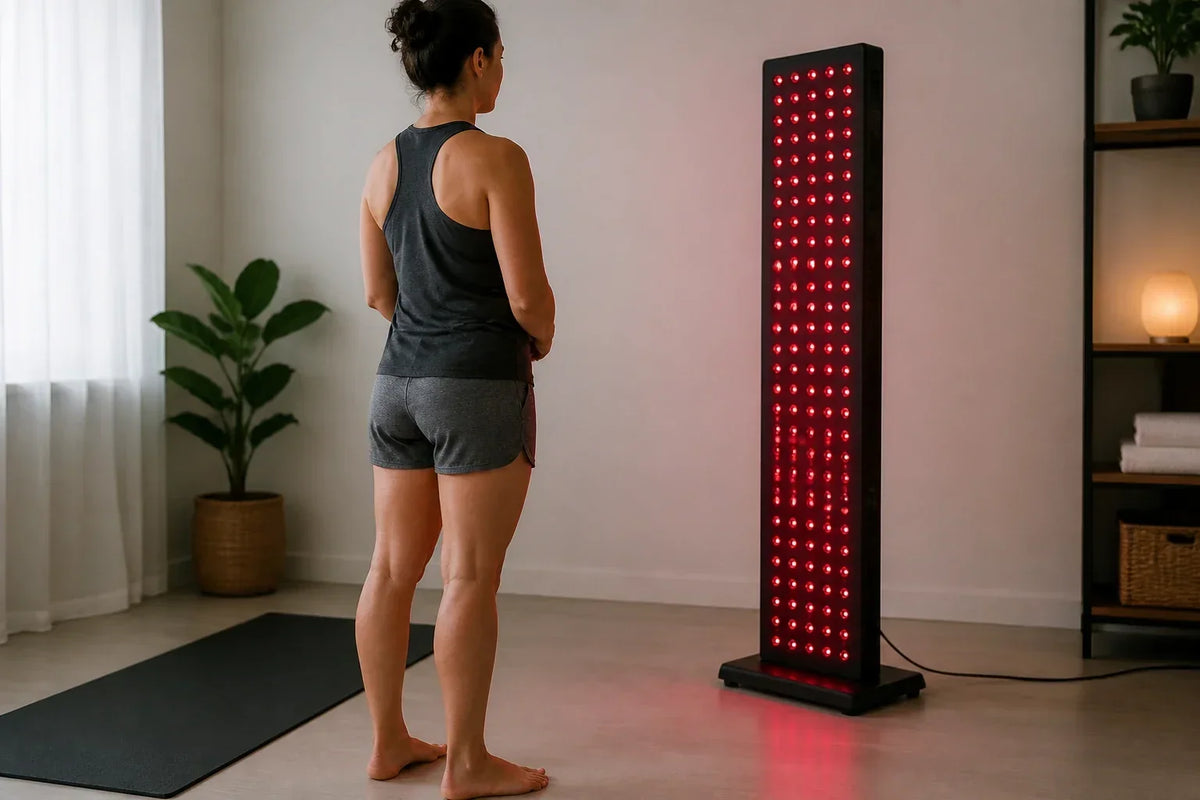
With a small panel, the distance between the LEDs and your body may be 6, 12, or 18 inches. You may expose your front, turn around, and then reposition again for the side of your body.
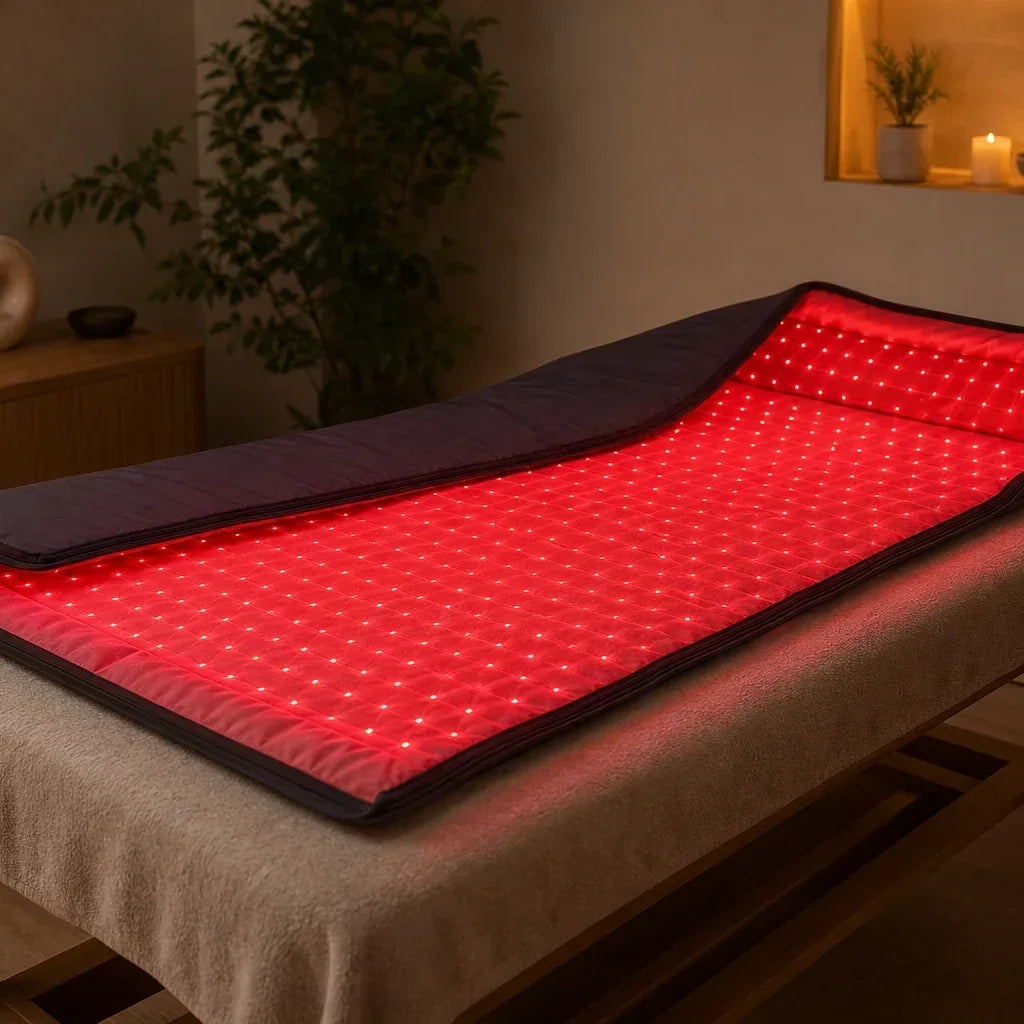
A blanket places flexible LED arrays much closer to the skin and can surround the front and back at the same time. Some products unzip into two mats; others function more like a sleeping bag or pod.
That can make a session feel easier because there is less measuring, less standing, and less turning around.
If I were evaluating the blanket format purely as a piece of hardware, this would be its strongest argument. It solves a practical problem that panels do not always solve elegantly: how do you illuminate a large part of the body at once without building a multi-panel room?
| Factor | Red Light Blanket | Rigid Panel |
|---|---|---|
| Distance | Very close or near-contact | Usually adjustable |
| Front and back coverage | Possible at the same time | Usually requires turning unless multiple panels are used |
| Session position | Lying down | Standing, seated, or lying depending on the stand |
| Ventilation | Lower | Generally better |
| Face access | Often limited by the blanket design | Easy to position for face and body |
| Storage | Can fold or roll, although some are heavy | Rigid and requires permanent space |
| Cleaning | Large skin-contact surface | Usually easier wipe-down surface |
Red Light Therapy Blanket Benefits: What Does the Evidence Actually Support?
This is where I would slow down.
The research question is not simply, “Does photobiomodulation have research?” It clearly does. The better question is, how closely does that research match a consumer red light blanket?
A 2025 systematic review specifically examined whole-body photobiomodulation for exercise performance and recovery. Only five studies met the review criteria, representing 105 physically active participants.
Two of those studies reported potentially favorable sleep-related findings. However, the review found no evidence that whole-body PBM improved biomarkers of fatigue, exercise performance, or exercise recovery.
You can review the study here: PubMed: Whole-Body Photobiomodulation Systematic Review.
That does not mean a blanket cannot be useful. It means I would not take a strong result from a small localized PBM study and automatically advertise it as a proven whole-body blanket benefit.
| Claim or Benefit | What the Evidence Tells Us | My Confidence |
|---|---|---|
| Broad body coverage | Directly follows from the physical blanket design. | High |
| More repeatable positioning | Close-contact geometry reduces distance variation. | High as a usability advantage |
| Skin appearance support | Red-light research exists, including controlled large-area studies, but blanket-specific evidence is limited. | Moderate for PBM generally; lower for blankets specifically |
| Sleep support | Some whole-body PBM studies show promising signals, but the evidence base is small. | Early / uncertain |
| Post-workout recovery | Localized PBM research exists, but a 2025 whole-body review did not find clear recovery or performance benefits. | Uncertain for whole-body blankets |
| Relaxation | Lying quietly in a warm, darkened setup may feel relaxing, but subjective relaxation is not the same as a verified physiological outcome. | Reasonable as an experience claim |
| Major weight loss or “detox” | These claims should not be inferred simply from red or near-infrared exposure. | I would be skeptical |
What Skin Research Can—and Cannot—Tell Us About Blankets
One often-cited controlled study included 136 volunteers and evaluated large-area or full-body exposure using red and near-infrared spectrum light. Participants received repeated sessions over 30 treatments, and investigators reported changes in skin roughness, complexion, and collagen-density measurements compared with controls.
You can read the study here: PubMed: Controlled Large-Area Red and Near-Infrared Light Trial.
That is useful evidence for the broader concept of large-area photobiomodulation.
But here is the part I would not skip: the study did not test your Amazon blanket, a modern zip-up sleeping bag, or every 660nm-and-850nm consumer device.
Its spectrum, irradiance, dose, distance, treatment frequency, hardware, and study population may be different.
The American Academy of Dermatology makes a similar point when discussing home red-light devices: researchers use different devices, exposure times, and study designs, so results from one study cannot simply be compared or transferred to another device.
See the AAD overview here: American Academy of Dermatology: Red Light Therapy.
This is one of the biggest gaps I see in commercial red light content. The sentence starts with “research shows red light can...” and quietly ends with “therefore our blanket will...”
Those are not automatically the same statement.
Does a Red Light Therapy Blanket Help With Sleep?
Sleep is one of the more interesting claims because there is at least some whole-body research behind it.
The 2025 systematic review found two studies reporting better sleep-related measurements after whole-body PBM, including changes measured using questionnaires and consumer sleep-tracking technology.
However, the total body of evidence was small, and individual studies do not all point in exactly the same direction.
For example, one whole-body PBM study found changes in nocturnal heart rate but also reported shorter total sleep time and reductions in some sleep stages after exposure.
You can review that research here: NIH/PMC: Whole-Body PBM and Sleep Physiology.
So if a blanket manufacturer says “supports relaxation before bed,” I can understand the positioning.
If the claim turns into “this blanket will make you sleep better,” I would want much stronger blanket-specific evidence.
If this were my routine, I would judge sleep as a personal secondary outcome rather than the main reason to buy a $1,000-plus device.
What About Post-Workout Recovery?
This is probably the area where I would be most careful about extrapolation.
There is a substantial PBM literature involving localized muscles and exercise protocols. That makes “recovery” an easy word for manufacturers to put on a product page.
But whole-body exposure is not necessarily equivalent to placing a carefully dosed light source over a specific muscle group.
The 2025 whole-body systematic review found no clear benefit for exercise performance or biomarkers of fatigue and recovery across the five included studies.
That is useful because it gives consumers a reality check.
I am not saying the topic is settled forever. I am saying I would describe post-workout use as an area under continued study rather than one of the guaranteed benefits of a red light therapy blanket.
660nm, 810nm, 830nm, or 850nm: Does the Wavelength Mix Matter?
Current blankets do not all use the same wavelength configuration.
Many consumer products combine 660nm visible red light with 850nm near-infrared light. Others are moving toward combinations such as 660nm, 810nm, and 830nm.
For example, one current BON CHARGE blanket lists 660nm red plus 850nm near-infrared. BlockBlueLight currently lists a three-wavelength configuration using 660nm, 810nm, and 830nm.
These examples are useful for understanding the market, not for declaring one product superior.
| Wavelength | Type | What the Buyer Should Understand |
|---|---|---|
| 630nm | Visible red | Found in some PBM devices; do not judge usefulness by wavelength alone. |
| 660nm | Visible red | One of the most common red wavelengths in home devices. |
| 810nm | Near-infrared | Invisible or barely visible and used in some multi-wavelength systems. |
| 830nm | Near-infrared | Another commonly studied PBM region appearing in newer devices. |
| 850nm | Near-infrared | Very common in consumer dual-wavelength blankets and panels. |
I would not automatically choose the blanket with the most wavelengths.
The part I would pay attention to is how much output each wavelength actually receives. A product can advertise three or five wavelengths while allocating only a small fraction of its emitters to one of them.
The Irradiance Problem: Why One Big Number Can Mislead You
Irradiance is usually expressed in milliwatts per square centimeter, or mW/cm². In theory, it helps describe the amount of optical power reaching an area.
In practice, comparing manufacturer numbers can get messy.
One current BlockBlueLight blanket specification is unusually helpful because the company publishes two irradiance readings for the same product: 121 mW/cm² measured using a solar meter and 36 mW/cm² measured using a light spectrometer.
You can see the current specification here: BlockBlueLight Red Light Therapy Blanket Specifications.
Another current blanket from BON CHARGE lists irradiance above 170 mW/cm² along with 660nm and 850nm wavelengths and a 10–30 minute protocol.
See the manufacturer listing here: BON CHARGE Red Light Therapy Blanket Specifications.
Those numbers should not immediately be placed into a ranking from “weak” to “strong.” The meter, spectral response, measurement distance, LED mode, contact geometry, calibration, and testing procedure all influence what the number means.
This is where many home users get confused.
If one brand says 170 mW/cm² and another says 36 mW/cm² using a spectrometer, it does not automatically mean the first blanket delivers nearly five times the useful dose.
I would rather see a manufacturer explain how the number was measured than simply publish the highest number it can produce.
Red Light Therapy Blanket vs Panel
| Factor | Blanket | Panel |
|---|---|---|
| Whole-body convenience | Excellent | Depends heavily on panel size |
| 360-degree coverage | Possible with zip-up designs | Usually requires multiple panels |
| Distance control | Limited because LEDs are close to the body | Very flexible |
| Face use | Often awkward or excluded | Easy |
| Ventilation | Can feel warm or enclosed | Open-air setup |
| Cleaning | Large contact surface requires regular wiping | Usually simpler |
| Targeting one area | Possible but not its main advantage | Excellent |
| Relaxed lying-down routine | Excellent | Requires suitable horizontal stand or setup |
If I lived in a small apartment and hated standing for sessions, I could see why a blanket would be attractive.
If I wanted one device for my face, neck, back, legs, different family members, and different distances, I would probably lean toward a panel.
Neither format wins automatically. The better one is the one whose inconvenience you dislike less.
Red Light Therapy Blanket vs Infrared Sauna Blanket
These two products look similar in photographs because both can resemble a sleeping bag. Their operating principles are different.
A red light therapy blanket uses LEDs emitting defined red and near-infrared wavelengths. It may become somewhat warm simply because LEDs, electronics, insulation, and body contact generate heat, but intense heating is not necessarily its primary purpose.
An infrared sauna blanket is primarily a thermal device. Its goal is to raise temperature and produce a sauna-like experience, often including substantial sweating.
| Feature | Red Light Therapy Blanket | Infrared Sauna Blanket |
|---|---|---|
| Primary mechanism | Red and near-infrared LED light exposure | Thermal heating |
| Main specification | Wavelength, irradiance, dose, LED coverage | Temperature range and heat control |
| Sweating | Not necessarily the goal | Common part of the experience |
| Typical feel | Light exposure with mild to moderate warmth | Deliberately hot |
I would not buy one expecting it to behave like the other.
9 Buying Checks Before Choosing a Red Light Therapy Blanket
If I were spending serious money on a full-body blanket, these are the nine things I would want answered before checkout.
| Buying Check | What I Would Look For | What Would Make Me Cautious |
|---|---|---|
| 1. Exact dimensions | Length, width, opening size, and illuminated area | Only lifestyle photos with no measurements |
| 2. Wavelength allocation | Exact wavelengths and percentage or LED distribution | “Multi-wavelength” with no allocation details |
| 3. Irradiance method | Instrument, measurement point, mode, and test conditions | One huge number with no method |
| 4. Intensity control | Several clearly defined output levels | Only maximum intensity |
| 5. Timer | Automatic shutoff and sensible session controls | Encouraging indefinite use |
| 6. Cleaning | Wipeable contact surface with clear cleaning instructions | Fabric or seams that are difficult to clean after direct skin contact |
| 7. Electrical and photobiological testing | Specific standards or test documentation that can be verified | A row of unexplained certification logos |
| 8. Warranty | Coverage for LEDs, controller, power supply, wiring, and flexible sections | Very short coverage for an expensive device |
| 9. Return terms | Clear return window, condition rules, and shipping responsibility | Large return freight charges hidden in policy pages |
LED Count Is Not the Specification I Would Lead With
Current red light blankets advertise numbers such as 2,320 LEDs, 2,520 LEDs, or thousands of individual LED chips.
Those numbers look impressive because they are easy to understand.
But LED count alone tells me very little.
Two blankets with 2,500 LEDs could have completely different wavelength ratios, drive currents, diode spacing, optical output, heat management, and illuminated dimensions.
The same problem applies to electrical wattage.
A 300-watt power supply does not mean 300 watts of optical energy is reaching your body.
I would much rather know whether the light is evenly distributed from shoulders to feet than whether one manufacturer found a way to print a larger LED number on the box.
How Long Should You Use a Red Light Therapy Blanket?
There is no universal blanket session time.
Current manufacturer protocols vary. One major blanket listing currently suggests 10–30 minutes, while other products build timers that extend considerably longer.
That does not mean 30 minutes is better than 10 minutes.
Exposure depends on optical output, wavelength, body contact, intensity setting, and session duration. When the LEDs sit close to the body, copying a protocol from a panel used 12 inches away makes very little sense.
If this were my first session, I would start at the shorter end of the exact manufacturer's instructions rather than testing the maximum time and maximum intensity simultaneously.
- Read the complete manual before the first session.
- Place the blanket on a flat, dry surface.
- Check all cables and controllers.
- Start with a lower or moderate intensity if the manual offers adjustment.
- Use the shorter recommended session duration initially.
- Keep the controller and power supply unobstructed.
- Use eye protection when the design or instructions call for it.
- Stop if the setup becomes excessively warm or uncomfortable.
- Allow the device to cool before folding or storing it.
- Clean the contact surface according to the manufacturer's instructions.
Can You Sleep Inside a Red Light Therapy Blanket?
I would not treat the word “blanket” or “sleeping bag” as permission to sleep in the device overnight.
Most products are designed around timed sessions, not eight hours of unattended use.
A timer exists for a reason.
There are also practical concerns that do not appear in wavelength studies: electrical hardware, body heat, limited ventilation, controllers, cords, and the possibility of falling asleep while a powered device is operating.
Unless the exact manufacturer explicitly states that overnight sleeping is an intended use and provides appropriate instructions, I would complete the timed session and get out.
Safety: Close Contact Changes the Practical Risk
Red and near-infrared light are not ultraviolet light. That does not mean every device, dose, or user situation should be treated casually.
The American Academy of Dermatology notes that short-term home red-light use appears generally low-risk when used properly, while questions remain about optimal dosing and long-term use.
Cleveland Clinic similarly advises following the instructions that come with the exact device and notes that excessive or incorrect use may affect skin or eyes.
See: Cleveland Clinic: Red Light Therapy Overview.
| Issue | Practical Approach |
|---|---|
| Excess warmth | Stop if the enclosed setup becomes uncomfortably hot. |
| Eye exposure | Follow the manufacturer's eye-protection instructions and avoid staring into exposed LEDs. |
| Damaged cables | Do not use the blanket with damaged wiring, adapters, connectors, or controllers. |
| Wet skin or moisture | Follow the device's dry-use and cleaning instructions. |
| Reduced heat sensation | Ask an appropriate healthcare professional before using an enclosed warming device. |
| Photosensitivity | Check medications and relevant medical history before use. |
| Pregnancy or significant health concerns | Discuss intended use with an appropriate clinician before starting. |
| Sleeping inside | Do not assume overnight use is appropriate because the product resembles a sleeping bag. |
Marketing Claims I Would Read Carefully
Some blanket marketing moves from reasonable to extremely broad in just a few sentences.
Here is how I would translate some common language.
| Marketing Phrase | What I Would Ask |
|---|---|
| “Clinically studied wavelengths” | Were these wavelengths studied in this device, at this dose, for this claimed outcome? |
| “Clinical-grade irradiance” | Measured by what instrument, in what mode, and at what point on the blanket? |
| “360-degree full-body coverage” | Does the illuminated area actually cover my height and width? |
| “FDA registered” | What exactly is registered or cleared, and for what intended use? |
| “Supports recovery” | Is the evidence localized PBM research or whole-body blanket research? |
| “Better sleep” | Is this supported by blanket-specific controlled research or extrapolated from broader PBM studies? |
| “Detox” | What measurable outcome does that word actually refer to? |
I am not suggesting that every marketing sentence is misleading. I am suggesting that the wording often becomes more confident as the evidence becomes less device-specific.
Who Does a Red Light Therapy Blanket Make the Most Sense For?
I think the blanket format has a very specific type of user.
It makes the most sense to me for someone who wants broad body coverage, prefers lying down, dislikes repeatedly turning in front of a panel, has enough storage space, and is comfortable cleaning a large skin-contact surface.
It makes less sense for someone mainly interested in the face, someone who runs hot, someone who prefers standing for five or ten minutes, or someone who wants to move one device between many different body areas and distances.
| User | My View |
|---|---|
| Wants front-and-back body coverage at once | Blanket format is very appealing. |
| Hates standing during a session | A strong reason to consider a blanket. |
| Mostly interested in facial routines | I would probably choose another format. |
| Needs highly adjustable distance | A panel offers more control. |
| Gets uncomfortable in enclosed warm spaces | Try the format before making an expensive purchase. |
| Wants proven results for one specific medical concern | I would start with professional guidance rather than a generic blanket claim. |
My Practical Take
What I like about the red light therapy blanket concept is not the promise of doing everything. It is actually something much less exciting: the geometry makes sense.
If I wanted broad body exposure and did not want to stand in four positions in front of a smaller panel, lying down between two flexible LED surfaces is an elegant solution.
But convenience and evidence are two different questions.
I would not buy a blanket because a product page lists ten benefits under photographs of athletes and sleeping models. I would buy one because I genuinely prefer the format, the technical information is unusually transparent, the return terms are reasonable, and I expect to use it often enough to justify the price.
The biggest mistake I see is people trying to pick a blanket by one heroic specification: highest irradiance, highest LED count, most wavelengths, or longest timer.
I would rather buy the manufacturer that tells me how it measured the irradiance than the one that gives me the biggest irradiance number.
I would rather have 2,300 evenly distributed LEDs with clear wavelength allocation than 7,000 “chips” where I cannot work out what each chip is doing.
I would rather have a 20-minute timer I understand than a 90-minute mode that tempts me to assume more exposure must be better.
And I would rather have a boring, clear return policy than a page filled with words like “professional,” “medical-grade,” and “clinical strength.”
The pattern I notice in home wellness devices is that the most valuable feature often turns out to be the one that makes you actually use the product. For one person, that is a wall-mounted panel permanently waiting in the home gym. For another, it is a blanket they can unfold on the bed, use for a short session, wipe down, and store.
If I were buying one today, my order of importance would be: fit and coverage first, transparent output data second, practical session controls third, cleaning and electrical quality fourth, return policy fifth.
I would put broad biological claims much farther down the list.
That may sound less exciting than “full-body transformation,” but it is a much better way to spend four figures on a device.
Frequently Asked Questions
What are the main benefits of a red light therapy blanket?
The clearest blanket-specific benefits are broad LED coverage, close and repeatable positioning, hands-free use, and the ability to expose much of the front and back of the body without repeatedly turning. Biological outcomes depend on the device, wavelength, dose, schedule, and specific goal.
Do red light therapy blankets really work?
They can deliver red and near-infrared light, so the underlying photobiomodulation mechanism is plausible. However, blanket-specific clinical research is limited, and results from panels, lasers, or supervised whole-body systems should not automatically be transferred to every consumer blanket.
Is 660nm and 850nm good for a red light therapy blanket?
660nm red and 850nm near-infrared are a common combination in current consumer blankets. Other products use wavelengths such as 810nm or 830nm. Wavelength alone does not determine device quality; irradiance, dose, uniformity, controls, and measurement quality also matter.
How long should you use a red light therapy blanket?
Follow the exact manufacturer's protocol because blanket output and close-contact geometry vary substantially. Current consumer devices commonly use timed sessions rather than continuous or overnight exposure. Start at the shorter end of the recommended range when using a new device.
Can you sleep in a red light therapy blanket?
Do not assume a blanket or sleeping-bag design is intended for overnight use. Most devices are built around timed sessions. Unless the exact manual explicitly permits sleeping in the powered device, finish the session and switch it off.
Is a red light therapy blanket better than a panel?
A blanket may be better for hands-free, wraparound body coverage and lying-down routines. A panel offers better ventilation, adjustable distance, easier face use, and more flexibility for targeting different areas. The better choice depends on how you plan to use it.
Is a red light therapy blanket the same as an infrared sauna blanket?
No. A red light therapy blanket primarily uses LEDs that emit selected red and near-infrared wavelengths. An infrared sauna blanket primarily creates thermal heat. They may look similar, but their specifications and intended experiences are different.
Does higher irradiance mean a better red light blanket?
Not automatically. Irradiance measurements can vary substantially depending on the meter and test conditions. Compare the measurement method, wavelength mode, uniformity, session protocol, and safety controls instead of ranking devices only by the largest mW/cm² number.
How many LEDs should a red light therapy blanket have?
There is no universal ideal LED count. Coverage area, LED spacing, wavelength allocation, chip design, optical output, and uniformity are more useful than the raw number of LEDs printed on the specification sheet.
Are red light therapy blankets worth the money?
They make the most sense for someone who values full-body coverage, prefers lying down, dislikes repositioning in front of a panel, and expects to use the device consistently. If you mainly want facial or small-area use, a less expensive and more flexible device may be the better purchase.
Sources and Further Reading
- PubMed: A Systematic Review on Whole-Body Photobiomodulation for Exercise Performance and Recovery
- PubMed: Controlled Large-Area Red and Near-Infrared Light Trial
- NIH/PMC: Whole-Body Photobiomodulation and Sleep Physiology
- American Academy of Dermatology: Is Red Light Therapy Right for Your Skin?
- Cleveland Clinic: Red Light Therapy Overview
- BlockBlueLight: Current Red Light Therapy Blanket Specifications
- BON CHARGE: Current Red Light Therapy Blanket Specifications
Continue reading