Red light therapy encyclopedia
Red LED Grow Bulb Guide: Spectrum, PPFD & Plant Uses
A red LED grow bulb can supplement plant lighting, but color alone does not establish useful canopy output. Compare spectrum, PPF, PPFD distribution, mounting distance, heat, and photoperiod before choosing a bulb for indoor plants.
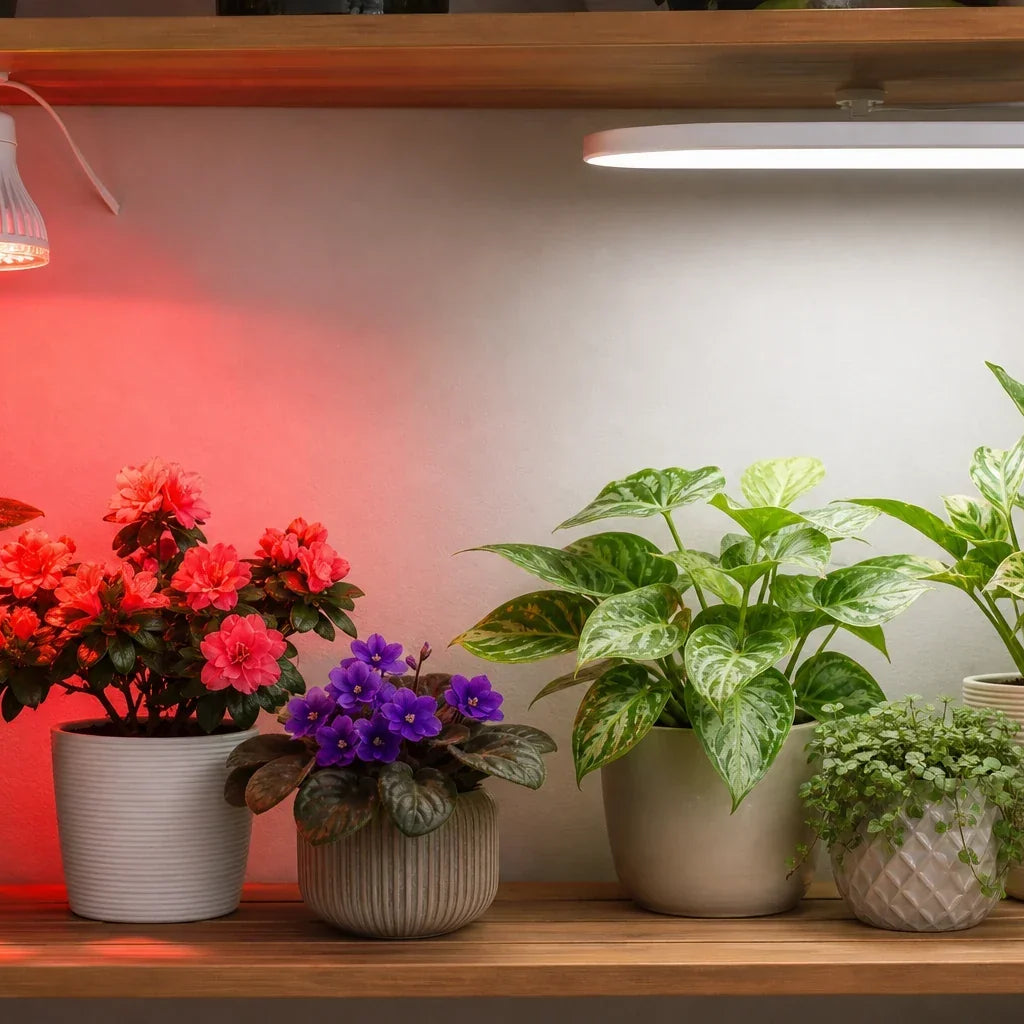
Red wavelengths support photosynthesis and can influence flowering and plant form, but a red-only bulb is rarely the most versatile choice. Blue or balanced white-plus-red light is usually easier for seedlings, leafy growth, and seeing plant health. Buy by photosynthetic output and canopy coverage rather than human-visible brightness.
Commercial disclosure: Yamuri sells red and near-infrared light devices. This guide uses model-neutral comparison criteria and does not assume a Yamuri product is suitable for every use discussed.
Quick Q&A: What Most People Want to Know First
| Option or question | Practical answer |
|---|---|
| Red-only bulb | Useful as a targeted supplement; poor color rendering for plant inspection. |
| Red-blue bulb | Efficient plant-focused spectrum; creates purple-looking work light. |
| White or balanced bulb | Easy visual inspection and suitable for many growth stages. |
| Adjustable spectrum fixture | Flexible for multiple crops; costs more and adds controls. |

Why red light matters to plants
Plants use photosynthetically active radiation across roughly 400–700 nm, including both red and blue. University of Minnesota Extension notes that red or mixed light can support bud formation, while blue or mixed light is useful for seedlings and leafy plants. Spectrum is only one input alongside intensity, duration, temperature, airflow, water, nutrients, and carbon dioxide.
How to read grow-light numbers
Lumens describe human visual brightness and are a poor primary metric for plants. Look for photosynthetic photon flux, measured in micromoles per second, and a PPFD map showing how photons reach a defined canopy at a stated distance. Photosynthetic photon efficacy in micromoles per joule helps compare electrical efficiency.
A bulb versus a fixture
A screw-in bulb can work for one or two plants when mounted safely in a suitable open fixture. Larger shelves need better distribution and thermal management. Narrow beams create a bright center and weak edges, so coverage maps matter more than the claimed maximum value.
Distance and photoperiod
Move the lamp only within the manufacturer’s guidance. Too far wastes output; too close can create uneven growth, bleaching, or excess heat. Use a timer and preserve the dark period appropriate to the plant. Light hours cannot compensate for inadequate intensity, and excessive duration wastes electricity.
What to buy for common uses
For seedlings and leafy herbs, choose balanced or blue-inclusive light with even coverage. For flowering plants, red-rich light can be useful, often as part of a mixed spectrum. For a decorative houseplant, start with a balanced lamp that lets you inspect leaf color naturally.
My practical take
A red glow is visually persuasive but tells you almost nothing about delivered plant photons. I would choose a product with PPF, a credible PPFD map, distance guidance, and safe thermal design over one marketed mainly by watt-equivalent language.
A Deeper Decision Framework
A grow bulb succeeds only when enough plant-usable photons reach the whole canopy for an appropriate number of hours. Color is easy to advertise; a credible PPFD map, mounting distance, beam distribution, heat management, and daily light plan provide the useful information.
A reliable comparison separates four layers: what the device is, what it measurably delivers, what evidence supports the intended use, and what ownership requires. Mixing those layers lets a true specification imply an unproven outcome. For example, a wavelength can be measured accurately while the promised benefit remains unsupported for that model, dose, or population.
Translate the sales page into verifiable questions
| Decision area | Evidence worth requesting | Weak substitute |
|---|---|---|
| Spectrum | Spectral power distribution or clearly identified mix | A photograph of a purple or red glow |
| Total output | PPF in micromoles per second | Watt-equivalent language |
| At the plants | PPFD map at stated height and area | One center-point maximum |
| Efficiency | Photon efficacy in micromoles per joule | LED chip count |
Ask for dated documents tied to the exact model: the user manual, electrical label, test conditions, warranty, and—when a medical claim is made—the named regulatory record. A distributor's badge or a statement that a facility is registered does not establish that every product it sells was cleared for every claim. FDA's PBM guidance and device database both reinforce the importance of device-specific intended use and testing.
Evidence Versus Marketing
| Statement type | What it can establish | What it cannot establish |
|---|---|---|
| Measured specification | Output under the disclosed setup | Clinical effectiveness by itself |
| Regulatory record | Status and intended use for the named device | Approval of a whole product category |
| Published study | Results for its participants, device and protocol | Equivalent results from another consumer product |
| Testimonial | A person's reported experience | Causation, typical results, or safety for others |
Evidence quality is not a yes-or-no badge. Laboratory measurements answer whether output is present; usability testing answers whether people can operate the system; controlled clinical research addresses a specified outcome; post-market records can reveal operational problems. Marketing often collapses all four into “clinically proven.” We recommend tracing every important claim back to the kind of evidence capable of supporting it.
Match the Format to the Real Scenario
| Scenario | More defensible starting point | Reason |
|---|---|---|
| One desk plant | Wide-beam balanced screw-in lamp | Simple coverage and natural leaf inspection |
| Seedling tray | Linear white or mixed-spectrum fixture | More even distribution across cells |
| Flowering supplement | Red-rich channel used with a base spectrum | Adds photons without making red the only input |
| Tall mixed collection | Multiple independently positioned fixtures | Different canopies need different distances |
These are starting points, not prescriptions. Room dimensions, mobility, electrical service, medications, eye sensitivity, pregnancy status, plant species, or other context may change the decision. Follow the exact manual and obtain professional guidance when the use involves a health condition, unusual sensitivity, or a time-sensitive medical choice.
Total Cost and Verification Worksheet
| Before purchase | At delivery | During ownership |
|---|---|---|
| Save the exact model and quoted specifications | Verify labels and contents against the order | Keep sessions and maintenance consistent with the manual |
| Confirm dimensions, circuit, ventilation, and return terms | Inspect damage before accepting freight | Record service contacts and replacement parts |
| Request measurement conditions and safety instructions | Test controls, timer, stability, and shutoff | Reassess if the product, goal, or health context changes |
| Calculate accessories, tax, assembly, and likely freight | Retain packaging through the return window | Track electricity, cleaning, downtime, and warranty labor |
Total cost is especially easy to underestimate for large hardware. Installation work, mounting, a dedicated circuit, return freight, inaccessible replacement parts, and downtime may outweigh a small difference in advertised output. For bulbs and strips, the same principle applies at smaller scale: sockets, fixtures, timers, power supplies, heat management, and replacement frequency belong in the comparison.
Editorial Judgment: Horticultural Performance
Our editorial preference is a modest lamp with published PPF and a believable coverage diagram over a visually intense bulb sold by color and nominal watts. We would measure the canopy, use a timer, watch plant response, and change one variable at a time. That approach produces more information than chasing a universal red-to-blue ratio.
That judgment is deliberately conservative. It does not assume that absence of evidence proves a product ineffective; it recognizes that a buyer cannot responsibly price a claim whose dose, coverage, intended use, or support is undefined. The strongest product page makes limitations easy to find and gives the reader enough detail to reproduce the claimed setup.
Turn a Red Grow Bulb Claim Into a Canopy Plan
Start with area, not color
Measure the canopy width and depth, then compare that area with a PPFD map measured at a disclosed hanging height. A single center reading can hide weak corners, especially beneath a narrow-beam bulb. For a shelf, several lower-output sources may distribute photons more evenly than one intense bulb. This is why a fixture designed around an area often outperforms a screw-in lamp whose brightest point looks impressive in a product photograph.
Connect intensity and time
PPFD is an instantaneous photon-density rate; daily light integral combines that rate with the hours supplied. The practical lesson is not to copy a universal timer setting. A dim source left on longer is not always equivalent to a stronger source used for fewer hours because plants also need an appropriate dark period and environmental conditions can become limiting. Use species-specific university guidance, a timer, and gradual observation of stretching, bleaching, curling, or stalled growth.
Red-rich is not the same as red-only
Red photons participate effectively in photosynthesis, but spectrum also influences plant form and development. Blue light can help produce compact vegetative growth, while green photons can contribute within a canopy. A red-rich flowering supplement may be sensible when a balanced base light is already present. For a first and only bulb, I would normally prioritize a documented mixed or broad spectrum because it is more versatile and makes leaf color, pests, and nutrient symptoms easier to inspect.
Verify electrical and thermal fit
Confirm the socket type, voltage, fixture rating, open-versus-enclosed fixture restriction, beam angle, moisture rating, and clearance from foliage or combustible material. An E26 base does not guarantee that every clamp lamp can safely dissipate the bulb's heat. Published PPF, PPFD maps, and photon efficacy are valuable only when the lamp can operate at the specified distance without overheating the plant or fixture.
What would change the recommendation?
A red-only bulb becomes easier to justify when a grower already has a measured base spectrum and needs a documented supplemental channel for a defined crop stage. Without that context, mixed-spectrum versatility wins. The decision should be revisited whenever canopy area, plant stage, ambient sunlight, or mounting height changes, because the old PPFD plan may no longer describe the plants.
A Decision Checklist
- Define the intended use before comparing features.
- Request the exact wavelength or spectrum and its tolerance.
- Look for output measured at the actual use distance.
- Check coverage, uniformity, timer, eye guidance, and heat management.
- Read installation, cleaning, warranty, return, and service terms.
- Verify any regulatory statement against the exact model and record.
Frequently Asked Questions
Does more electrical wattage mean more useful light?
No. Electrical input, optical output, and energy reaching the target are different measurements.
Is visible brightness a reliable output test?
No. Human vision and camera processing are not calibrated meters, especially for near-infrared light.
Does a longer session always provide more benefit?
No. Follow the model-specific instructions. Exposure depends on output, distance, time, and area.
Is red or near-infrared light ultraviolet?
No. They occupy different spectral regions, but product-specific eye and skin guidance still matters.
What makes a source claim credible?
The source should identify the device, population, exposure, outcome, and limitations. General wavelength research does not validate a particular product.
When is professional guidance appropriate?
Seek qualified guidance for pregnancy or fertility decisions, photosensitivity, relevant medicines, eye concerns, significant health conditions, or uncertainty about a device’s intended use.
Sources and Further Reading
- University of Minnesota indoor plant lighting guide
- U.S. Department of Energy agricultural lighting overview
- DOE and USDA horticultural lighting report
Editorial Standards and General Information
This article separates general light education from model-specific documentation. Regulatory records apply only to the devices and intended uses named in those records; they are not automatically applied to Yamuri or other models. The content supports consumer education and specification literacy, not personalized medical advice. Follow the exact device manual and seek qualified guidance when individual health circumstances affect the decision.
Continue reading