Does red light help with acne scars? Learn what it may do for post-acne marks, pitted scars, redness, timeline, and when to see a dermatologist.
Editorial Review: This article was created with reference to public dermatology and light therapy resources, including Cleveland Clinic, the American Academy of Dermatology, NIH/PMC, Harvard Health, FDA general wellness guidance, and FTC health product compliance guidance. It is written for consumer education and skincare routine planning, not medical advice.
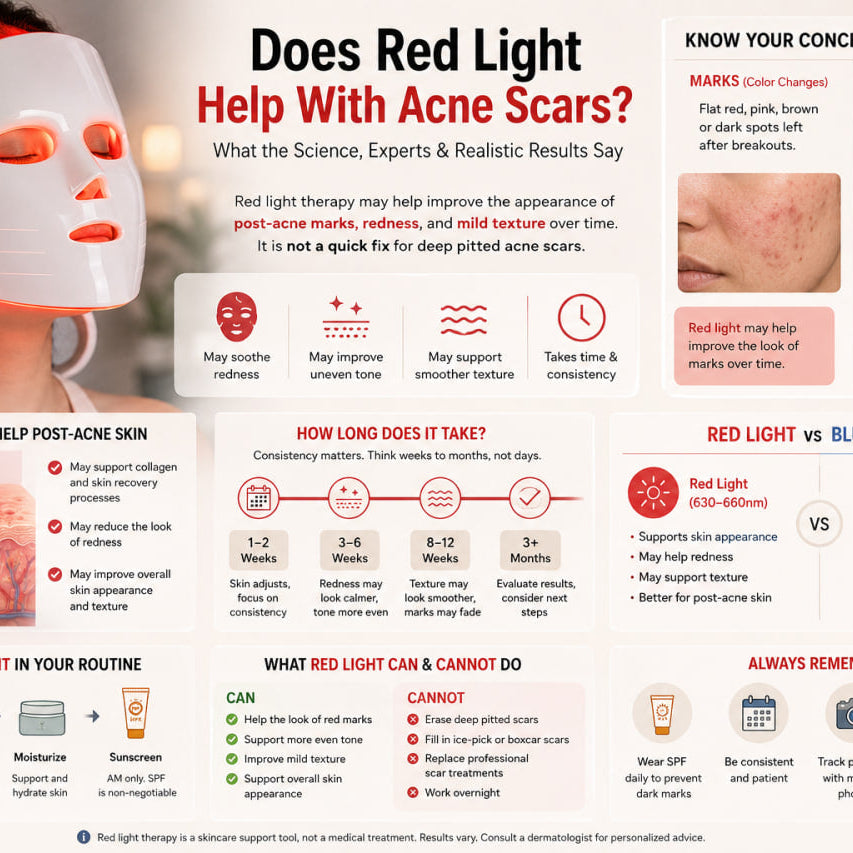
If you are asking does red light help with acne scars, the honest answer is: red light may help improve the look of some post-acne marks, redness, uneven tone, and mild texture over time, but it is not a quick fix for deep pitted acne scars. The first thing to know is that “acne scars” can mean two different things: color marks left after breakouts, or actual indented texture in the skin.
My personal take is simple: red light is more realistic as a supportive skincare tool than as a scar-erasing treatment. If your main concern is red or brown post-acne marks, red light may fit into a gentle routine. If you have deep rolling, boxcar, or ice-pick scars, I would not expect a home LED mask or panel to do the same job as professional scar procedures.
The smarter question is not only “Does red light help?” It is “What kind of acne scar do I have, what can red light realistically support, and when should I talk to a dermatologist?”

Quick Q&A: What Most People Want to Know First
| Question | Short Answer | My Practical Note |
|---|---|---|
| Does red light help with acne scars? | It may help improve the appearance of mild marks, redness, and uneven texture, but deep pitted scars usually need professional options. | I would first separate post-acne marks from true indented scars. |
| Can red light fade acne marks? | It may support a calmer-looking, more even skin appearance over time, especially when paired with daily SPF and a simple skincare routine. | For discoloration, sunscreen matters more than most people want to admit. |
| Does red light fill acne pits? | No home red light device should be expected to “fill” deep pits by itself. | For ice-pick or boxcar scars, I would look at dermatologist-guided options. |
| Is red or blue light better for acne scars? | Blue light is usually discussed more for active breakouts, while red light is more often discussed for redness, texture, and skin appearance. | If the acne is still active, manage that first before chasing scar improvement. |
| How long does red light take for acne scars? | Think in weeks to months, not days. Skin texture changes slowly. | I would track photos monthly under the same lighting. |
| Can I use red light at home for acne scars? | Yes, if the device is made for skincare use and you follow the instructions. | Do not use it as an excuse to skip dermatologist advice for deep scarring. |
First, Know the Difference: Acne Marks vs Acne Scars
This is the most important part of the topic. Many people say “acne scars” when they really mean red marks, brown marks, or uneven tone left after a breakout. These are not the same as true indented scars.
Post-acne marks are usually color changes. They may look red, pink, purple, brown, or gray depending on skin tone and how the breakout resolved. True acne scars usually change the texture of the skin. They can look like pits, dents, waves, or small holes.
The American Academy of Dermatology explains that even professional laser scar procedures cannot completely remove a scar; they can make a scar less noticeable. You can review its scar laser guidance here: American Academy of Dermatology scar laser guidance.
| Skin Concern | What It Looks Like | Can Red Light Help? | My Practical View |
|---|---|---|---|
| Red post-acne marks | Pink, red, or purple flat marks | May support a calmer-looking skin appearance over time | This is where red light feels more realistic. |
| Brown post-acne marks | Flat dark spots or uneven tone | May help overall skin appearance, but SPF and pigment-focused skincare matter a lot | I would not rely on red light alone. |
| Shallow texture | Slight roughness or uneven surface | May support smoother-looking skin with consistent use | Expect subtle changes, not overnight resurfacing. |
| Deep pitted scars | Ice-pick, boxcar, or rolling dents | Home red light is unlikely to be enough by itself | I would talk to a dermatologist about options. |
| Active breakouts plus marks | New spots mixed with old marks | Red light may be one part of the routine, but active acne control matters first | Stop new breakouts before obsessing over old marks. |
How Red Light May Support Post-Acne Skin
Red light therapy is often discussed for skin appearance because it may support collagen-related processes, overall tone, and the look of redness or roughness. Cleveland Clinic describes red light therapy as an emerging option showing promise for wrinkles, redness, acne, scars, and other signs of aging, while also noting that more clinical trials are needed. You can review its overview here: Cleveland Clinic red light therapy overview.
That is why the answer is not a hard yes or no. For post-acne skin, red light may be useful as part of a consistent skincare routine. But for true acne scar remodeling, especially deeper texture, professional treatments usually have a stronger role.
Here’s the practical way I’d look at it: red light is a “slow support” tool. It is not a “make my scars disappear by Friday” tool.
What Red Light Can and Cannot Do for Acne Scars
The main mistake people make is asking red light to do every job. Red light is not a peel, not a filler, not a resurfacing laser, and not a microneedling treatment. It is a light-based skincare tool that may support skin appearance when used correctly and consistently.
A controlled trial on red and near-infrared light reported improvements in skin complexion, skin feeling, collagen density, skin roughness, and wrinkle status in the studied groups. You can review that study here: NIH/PMC controlled trial on red and near-infrared light and skin appearance.
That kind of research is relevant to skin texture and appearance, but it should not be stretched into a promise that every acne scar will flatten or disappear.
| Red Light May Help With | Red Light Is Less Likely to Handle Alone | What I Would Do |
|---|---|---|
| Red-looking post-acne marks | Very deep ice-pick scars | Use red light as a gentle support step, not the whole plan. |
| Uneven-looking tone | Severe texture depressions | Add daily SPF and consider pigment-focused skincare. |
| Mild roughness | Long-standing pitted scars | Track progress over months, not days. |
| General skin appearance | Scar removal | Aim for “less noticeable,” not perfect skin. |
Red Light vs Blue Light for Acne and Scars
People often confuse red light and blue light because LED masks may use both. In acne discussions, blue light is usually mentioned for active blemish-prone skin, while red light is more often linked with the look of redness, texture, and overall skin recovery appearance.
A PubMed Central review on light-based therapies in acne found evidence suggesting blue light and blue-red light combinations can be useful for mild to moderate inflammatory acne lesions, while also calling for more long-term and comparative trials. You can review that article here: NIH/PMC review on light-based therapies in acne.
My view is simple: if you are still breaking out often, focus on controlling active acne first. If new breakouts keep appearing, new marks will keep forming, and the scar conversation becomes harder.
| Light Type | Common Skincare Discussion | Best-Fit User Question | My Practical Note |
|---|---|---|---|
| Red light | Skin appearance, redness look, texture, collagen-related support | Can it help old post-acne marks look better? | Better for the “after acne” conversation. |
| Blue light | Active acne-prone skin routines | Can it help current breakouts? | More relevant when new blemishes are still active. |
| Red + blue combination | Active acne plus skin appearance support | Can one LED mask do both? | Useful category, but follow the device instructions closely. |
| Near-infrared light | Often paired with red light in panels and masks | Does deeper light matter? | Do not choose only based on “deeper” marketing language. |
Can Red Light Help Pitted Acne Scars?
This is where I would be very direct. Red light may support the overall look of skin texture, but deep pitted acne scars usually need more than a home LED routine. Ice-pick scars, rolling scars, and boxcar scars are structural texture changes.
Professional options for acne scars may include dermatologist-guided lasers, microneedling, chemical peels, subcision, fillers, or a combination plan. The right option depends on scar type, skin tone, budget, downtime, and risk tolerance.
The American Academy of Dermatology notes that laser procedures can make scars less noticeable, but cannot fully get rid of scars. That point is useful because even stronger professional tools have limits. A home red light device should be described even more carefully.
| Scar Type | What It Usually Needs | Where Red Light Fits |
|---|---|---|
| Ice-pick scars | Dermatologist-guided procedures are often discussed | Red light alone is unlikely to create a major change. |
| Boxcar scars | Texture-focused professional options may be considered | May support overall skin appearance, not replace resurfacing. |
| Rolling scars | Often need a customized plan | Do not expect a mask to lift depressed areas. |
| Flat red marks | Gentle skincare, SPF, patience, sometimes professional help | This is a more realistic home-use target. |
| Flat brown marks | SPF and pigment-focused skincare are usually important | Red light may be supportive, but not the main pigment tool. |
How Long Does Red Light Take for Acne Scars?
For post-acne marks and mild texture, think in weeks to months. I would not judge red light therapy after three sessions. Skin routines need time, and acne marks often fade unevenly.
At-home red light devices also tend to be less intense than professional systems, so consistency matters. A realistic routine might mean several sessions per week, following the device manual, while keeping the rest of the skincare routine stable.
Harvard Health explains that red light therapy is not a miracle fix and that expectations should stay realistic. You can review its overview here: Harvard Health red light therapy overview.
A Realistic Tracking Plan
| Timeframe | What to Track | My Practical Note |
|---|---|---|
| Week 1–2 | Comfort, dryness, irritation, routine consistency | Do not judge scar change yet. |
| Week 3–6 | Redness look, overall tone, skin comfort | Small changes may begin to show in photos. |
| Week 8–12 | Texture, marks, overall skin appearance | This is a more reasonable checkpoint. |
| After 3 months | Whether the routine is worth continuing | If deep scars remain the main issue, consider a dermatologist visit. |
How to Use Red Light in a Post-Acne Skincare Routine
If I were building a simple routine for post-acne marks, I would keep it boring and repeatable. Too many people add red light, retinoids, acids, vitamin C, peels, and new moisturizers at the same time. Then they cannot tell what helped or what irritated the skin.
Start with clean, dry skin. Use the red light device as directed. Then apply a gentle moisturizer. In the morning, sunscreen is non-negotiable if discoloration is part of the issue.
| Routine Step | What to Do | What I Would Avoid |
|---|---|---|
| Before red light | Cleanse gently and dry the skin | Using strong acids right before light if your skin is easily irritated |
| During session | Follow device time, distance, and eye guidance | Extending the session because you want faster results |
| After session | Use a simple moisturizer or calming skincare | Layering too many actives at once |
| Morning routine | Use sunscreen daily | Trying to fade marks while skipping SPF |
| Weekly tracking | Take photos in the same lighting | Judging progress under different bathroom lights |
Who Should Be Careful With Red Light for Acne Scars?
The American Academy of Dermatology says that red light therapy appears safe in the short term, with common side effects usually being mild, but it also recommends caution and appropriate device selection. You can review its red light therapy guide here: American Academy of Dermatology red light therapy safety guide.
I would be careful if your skin is very reactive, if you use photosensitizing medications, if you have a known light-sensitive condition, or if you are using strong prescription skincare. This does not mean red light is automatically wrong; it means you should not guess.
Eye comfort matters too. If your device includes goggles or eye shields, use them. If the light feels too bright near your face, do not push through it.
Common Mistakes With Red Light and Acne Scars
The biggest mistake is expecting red light to erase deep scars. The second is skipping sunscreen. The third is using red light on top of a chaotic skincare routine and then blaming the device when the skin feels irritated.
From an editor’s point of view, the best red light routine is usually calm and boring: same device, same schedule, same lighting for progress photos, and no dramatic claims.
| Mistake | Why It Happens | Better Move |
|---|---|---|
| Calling all marks “scars” | People use the word scars for discoloration too | Identify whether the issue is color or texture. |
| Expecting pitted scars to disappear | Marketing often oversimplifies scar improvement | Use red light as support, not a deep-scar solution. |
| Skipping sunscreen | SPF feels unrelated to red light | For dark marks, daily SPF is essential. |
| Overusing the device | Users think more time means faster results | Follow the manual and stay consistent. |
| Changing every product at once | People want fast improvement | Keep the routine stable so you can judge progress. |
| Ignoring active acne | Scars feel more urgent | Reduce new breakouts first to prevent new marks. |
My Practical View
My personal take is simple: red light may be worth considering for post-acne skin, but only if expectations are grounded. I would use it for the look of redness, uneven tone, and mild texture support. I would not use it as my only plan for deep pitted acne scars.
If this were my routine, I would first figure out whether I am dealing with flat marks or true dents. For flat marks, I would build a gentle routine with red light, moisturizer, and daily SPF. For deep scars, I would still use skincare carefully, but I would also talk to a dermatologist about realistic options.
The part I would pay attention to is consistency without overdoing it. A simple 10-minute device routine several times a week, paired with sunscreen and fewer random skincare changes, is more believable than chasing every scar hack online.
So, does red light help with acne scars? It may help the appearance of some post-acne marks and mild texture over time, but it should not be sold or used as a guaranteed acne scar remover.
References
- Cleveland Clinic: Red Light Therapy Overview
- American Academy of Dermatology: Red Light Therapy Safety Guide
- American Academy of Dermatology: Laser Treatment for Scars
- NIH/PMC: Controlled Trial on Red and Near-Infrared Light and Skin Appearance
- NIH/PMC: Light-Based Therapies in Acne Treatment
- Harvard Health: Red Light Therapy for Skin Care
- FDA: General Wellness Policy for Low Risk Devices
- FTC: Health Products Compliance Guidance
FAQ
Does red light help with acne scars?
Red light may help improve the appearance of some post-acne marks, redness, uneven tone, and mild texture, but deep pitted acne scars usually need dermatologist-guided options.
Can red light fade acne marks?
It may support a more even-looking skin appearance over time, especially when paired with a simple skincare routine and daily sunscreen. It should not be expected to erase marks quickly.
Does red light help pitted acne scars?
Red light alone is unlikely to make deep pitted scars disappear. Ice-pick, boxcar, and rolling scars often need professional evaluation and a customized scar plan.
Is red or blue light better for acne scars?
Blue light is more often discussed for active acne-prone skin, while red light is more often discussed for redness, skin appearance, and texture support after breakouts.
How long does red light take for acne scars?
For post-acne marks and mild texture, think in weeks to months. Taking monthly photos under the same lighting is a better way to judge progress than checking daily.
Can I use red light therapy at home for acne scars?
You can use a skincare-focused red light device at home if you follow the manual, use eye protection when recommended, and keep expectations realistic. For deeper scars, consider a dermatologist consultation.